

Life and health insurance markets lack inclusion, Swiss Re Institute study shows
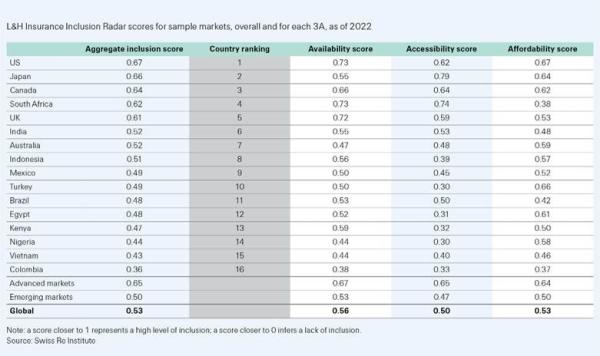
A new Swiss Re Institute (SRI) study explores the extent to which life and health insurance in 16 markets is available, affordable, and accessible.
It concludes that none of the focus markets is fully inclusive. By identifying inclusion deficits, SRI's "Life & Health Insurance Inclusion Radar" can help guide and inspire life and health re/insurers as they work to narrow protection gaps that leave underserved groups vulnerable.
Melissa Leitner, Head Sustainable L&H Delivery: "The L&H Insurance Inclusion Radar is a new resource calibrated to help steer our industry toward new sources of growth by better serving the needs of people who are particularly vulnerable to financial hardship."
Julien Descombes, Head Life & Health Products Reinsurance: "By making life and health insurance more available, accessible, and affordable (the Inclusion Radar's 3As), families and households will be better equipped to withstand financial challenges that occur when a breadwinner passes away or when they incur healthcare treatment costs. Making insurance more inclusive helps create a stronger, more resilient society."
Jérôme Jean Haegeli, Group Chief Economist: "The research comes as the global economy is slowing and social inequalities have increased enormously on the back of the uneven recovery and highest inflation surge in 40 years. Life and health insurance is a powerful remedy, providing families with financial relief after tragedies and by covering healthcare costs. Insurance covers are key to fostering economic and social progress with more focus needed now on inclusion to narrowing protection gaps in life and health."
Key take-aways
• Accessibility is the biggest factor behind a lack of inclusion in emerging markets, driven partly by lower financial literacy as well as lower usage and trust in the financial services sector.
• Advanced market consumers face fewer barriers to obtaining insurance, but higher incomes in advanced economies do not necessarily translate into higher levels of insurance affordability.
• While life insurance inclusion levels in the US are highest among the markets assessed, the availability of insurance helped offset relatively lower scores for accessibility and affordability. In emerging markets, inclusion was highest in South Africa, where a robust showing in the availability and accessibility dimensions offset low marks for affordability.
• Improving insurance inclusion demands a multi-faceted approach that starts with better understanding of consumer needs via market research prioritising underserved communities.
• Re/insurers must explore novel strategic partnerships to foster distribution diversity and use digital technology to achieve scale.
• Continued innovation in product design must accompany more efficient, inclusive underwriting practices.
• The report also examines selected market trends: UK insurance buying norms that leave women more vulnerable, India's "Missing Middle", South Africa's innovation success, digital insurance opportunities in Brazil, and US diversity recruitment efforts to reach underserved customers.
• The report inspires and guides insurers where to focus their future efforts for maximum impact in closing the protection gap.
Please download the full study here: The Life and Health Insurance Inclusion Radar: Why markets are more, or less, inclusive.
Click here to read more...


