

JSE Index Harmonisation

Michael Dodd
Striking the right chord
In March 2024 the Johannesburg Stock Exchange (JSE) will implement the first phase of its Index Harmonisation project. The first phase will, initially, align the weighting methodologies of what the JSE are calling their ‘vanilla’ indices [which includes the FTSE/JSE All Share Index (ALSI) and the FTSE/JSE Top 40 Index] with those of their Shareholder Weighted (SWIX) variants. The second phase of the project will see the termination of the SWIX indices and the effective collapse of the vanilla and SWIX indices into one set of benchmark indices. It has not yet been announced when the second phase will be implemented.
How did we get here?
The changing dynamics of both the South African equity market and regulatory environment have seen the local asset management industry shift its preferred benchmark a few times over the last two decades. Initially, most South African equity managers benchmarked themselves against the ALSI, which is the longest-standing South African equity market index. However, the strong run of Resource companies in the mid-2000s saw the weights of those companies increase significantly in the ALSI at that particular point in time. At around this time, the preferred industry benchmark shifted from the highly concentrated and Resource-heavy ALSI to the SWIX.
The SWIX followed a different weighting methodology to the ALSI that was seen to be more representative of the investable universe for South African equity managers. The SWIX’s free float weighting methodology (as opposed to the gross market capitalisation methodology followed by the ALSI) means that the weights are determined by a free float adjustment factor determined by the portion of that company’s stock that is freely tradable in the South African market.
The SWIX generally worked as a suitable South African equity market benchmark up until the meteoric rise of Naspers saw the concentration risk in the SWIX increase. At its peak in 2017, Naspers’ weight in the SWIX reached roughly 25% of the index. In response to requests from the South African asset management industry, the JSE launched the Capped SWIX in 2016 to address the concentration risk present in the SWIX index. The Capped SWIX restricted shares to a maximum weight of 10% of the overall index, and so alleviated some of the concentration risk present in the SWIX index.
As can be seen in Exhibit 1 below, the Capped SWIX became the preferred industry benchmark for the South African equity market and is currently used by 39% of South African General Equity funds as their stated benchmark. However, the chart below also highlights that its adoption has not been universal, with many managers still benchmarked to the ALSI and the SWIX.
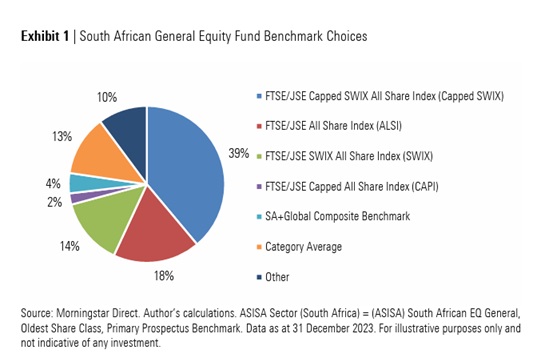
Recent changes to regulations and the fact that ASISA’s South African General Equity category allows managers to invest up to 45% offshore has resulted in several funds in this category changing their benchmarks from domestic-only benchmarks to composite benchmarks of South African and Global equity benchmarks to better reflect their new, broader investable universe.
The different weighting and capping methodologies across these indices have resulted in some vastly different return outcomes over the years. This can be seen below in Exhibit 2. The simple question of “How did the South African equity market do last year?” has not had a straightforward answer for several years.
Click here to read more...


