

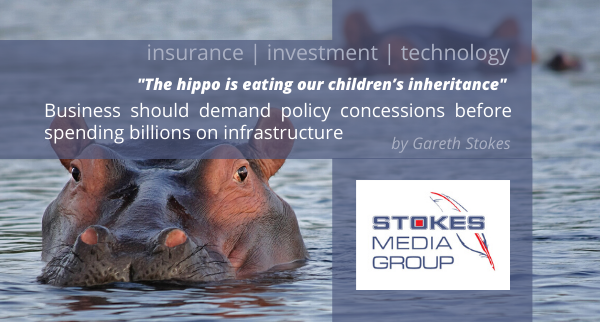
“The hippopotamus is eating our children’s inheritance” - Business should demand policy concessions before spending billions on infrastructure
South Africa’s private sector should hold out for policy concessions before acceding to government’s requests to pour billions into infrastructure projects. Some level of commitment from government and labour to follow a more business friendly path seems fair in an environment where businesses are expected to put their weight behind infrastructure and other investments. Government’s overtures to large corporations and investors coincides with the worst economic outlook the country has seen in decades. Those who have not yet cottoned on to the seriousness of our financial distress will have ‘seen the light’ following finance minister Tito Mboweni’s supplementary budget speech, delivered 25 June 2020.
Teetering on the bankruptcy brink
Mboweni pulled no punches when informing South Africans of the dire economic situation. The fiscus, already teetering on the brink following decades of mismanagement, was dealt a coup-de-gras courtesy the coronavirus pandemic. The minister acknowledge the President’s April 2020 request to “not merely return our economy to where it was before the coronavirus, but to forge a new economy in a new global reality”; but he steered clear of admitting that doing so was merely a step back to a better worse. The frightening reality is that if SA Inc were an ordinary household, the Sheriff would be banging at our door to seize our assets; and our unfortunate creditors would be lining up for less than 1 cent in the rand.
The impact of pandemic was top of mind throughout the speech. “After the storm ends, we must work quickly to emerge with a sustainable fiscus,” said Mboweni, after commenting on the emergency monetary policy and fiscal interventions already implemented by government and the central bank in the first half of this year. But the scenarios he sketched suggest South Africa is racing headlong toward a fiscal crisis that will rival that faced by the so-called PIGS (Portugal, Italy, Greece, and Spain) during the Global Financial Crisis (GFC). “Debt is our weakness”, lamented the minister. “This year, out of every rand that we pay in tax, 21 cents are spent paying the interest on our past debts”. He followed this statement with on of his trademark analogies: “Our Herculean task is to close the mouth of the hippopotamus; it is eating our children’s inheritance”.
Millions of jobs are on the line
The statistics are alarming. Global economic growth is set to contract by 5,2% through 2020, with South Africa’s economy forecast to contract by a staggering 7,2%. One of the consequences of the economic predicament is that millions will lose their jobs. Statistics SA has already reported an increase in unemployment to 30,1% to end-March 2020, prior the crisis, and experts fear that this measure will reach 50% before the year is out. The double-whammy of job losses and economic contraction will likely lay waste to a third of government’s income. Mboweni indicated that government’s income would be at least R300 billion below target! The only good news shared during the presentation was that inflation would remain benign, perhaps falling to 3% by year end.
The debt situation will worsen as cash is thrown at a range of COVID-19 initiatives. According to Mboweni, South Africa’s consolidate budget deficit will spike to R761,7 billion, or 15,7% of GDP, in 2020-21 while gross national debt will rise to almost R4 trillion, or 81,8% of GDP. Against this backdrop we were surprised that economists and market commentators, when asked to rate the supplementary budget via a Moneyweb.co.za soundbite, rated it so favourably.
Cautiously optimistic despite the mountain of despair
Economist, Mike Schussler, gave the minister eight out of 10; but suggested the market had rated the budget even higher. “[The minister] has given us a cautiously optimistic picture of the deep despair that the economy is in; but the debt projections are astronomical,” said Schussler. He added that it was unlikely that South Africa would be able to keep its debt to GDP ratio below 90%, suggesting that Mboweni might come to regret his promise in this regard.
Cas Coovadia, CEO of Business Unity South Africa, also rated the speech at eight out of 10. “The minister pointed out the serious economic situation the country finds itself in,” he said. “It would, however, have been useful for some pointers on government’s thinking in the medium term [as to] how we are going to control expenditure and deal with our increasing fiscal deficit, and how we are going to put the country on a sustainable economic growth path”. Concerns about rising debt and interest repayments were central to Nazmeera Moola’s assessment too. Moola, who is head of investments at Ninety One, rated the budget speech at nine out of 10 for its intent; but nearer six out of 10 for likely execution. “If we have to do a score for executability, that will drop down to a generous six out of 10, because there are significant execution risks in this budget,” she said. Her major concern was that the promise to reduce the public sector wage bill by R390 billion over the following three years would prove unworkable.
Ryk van Niekerk, editor at Moneyweb.co.za, noted that the budget “did not contain major surprises; but rather underlined the precarious financial position that South Africa finds itself in”. His major concerns centred on the projected government debt to GDP and the dearth of facts on how the situation would be turned around. Johann Els, chief economist at Old Mutual Investment Group, told us that the pandemic was an opportune time for the finance minister to push through unpopular changes such as wage bill reductions. “It is easier now, than a year or two ago, to push through drastic change,” he said, before singling out State Owned Entities (SOEs) as an area requiring urgent attention. “We need to see serious action around SOEs – we cannot afford to carry poor decisions for long periods,” he said, referring to the lengthy and uncertain business rescue process at South Africa Airways.
Economic growth is our only salvation
Growth was singled out as the country’s only salvation. “The only solution is meaningful and sustained economic growth,” concluded Van Niekerk. “We hope that government will be forced to implement business friendly policies to facilitate such growth”. Els agreed, singling out the lack of consistent economic growth as the single largest issue that the country needs to address. “You can reduce the deficit by promising to cut spending or you can reduce it by raising taxes; but the real issue is the lack of growth,” he concluded. South Africa will languish at record levels of debt and poverty unless it significantly improves on its 0,8% per annum GDP growth over the past five years.
Mboweni quoted from Matthew, chapter 7 verses 13 and 14, in calling for government to reject the wide gate, which opened a path to bankruptcy. Instead, he appealed, Cabinet should “open the narrow gate to a path of prosperity”. The writer hopes that he is successful in narrowing the gate; but also calls on the private sector to go beyond a project-by-project view when lending money to government. They must use this opportunity to demand concession that will create a supportive policy environment built on accountability and oversight.

