

How many litres of water does one AI prompt use?
Every time you ask a chatbot a question, somewhere in the world a server warms up. What feels like a simple digital interaction is, in fact, a physical process.

Behind every prompt sits a data centre that consumes electricity, generates heat, and relies on water to keep systems cool and running.
And that physical footprint is no longer marginal. AI, and increasingly agentic AI that can complete multi-step tasks autonomously, has shifted from a curiosity to a core accelerator of business operations. The scale of adoption is moving faster than most balance sheets have caught up with. Anthropic’s Claude alone recorded close to 290 million website visits in February 2026, up almost 31% month on month, with mobile usage growing nearly 50% over the same period. Multiply that pattern across OpenAI, Google, Meta, and the agentic AI tools now embedded in every major enterprise software suite, and demand on physical infrastructure becomes the headline story.
Globally, data centres already consume more than 560 billion litres of water a year (Aquatech, 2023). For a country where the grid is fragile and entire suburbs already live in de facto Day Zero conditions, that reality is no longer abstract. South Africa is not a bystander to the global AI build-out; it is increasingly a destination for it. Microsoft has pledged a further ZAR 5.4 billion, roughly USD 297 million, to expand its cloud and AI infrastructure in South Africa by the end of 2027, on top of more than ZAR 20 billion already invested locally over the past three years. The latest commitment explicitly earmarks investment in power and water readiness. The water question, in other words, is no longer someone else’s problem.
Recent studies have attempted to quantify the water usage of AI systems, raising the question: how much water does a single AI prompt consume?
Estimates of water use per AI interaction span three orders of magnitude, depending on the model, the data centre, and what exactly is being measured.
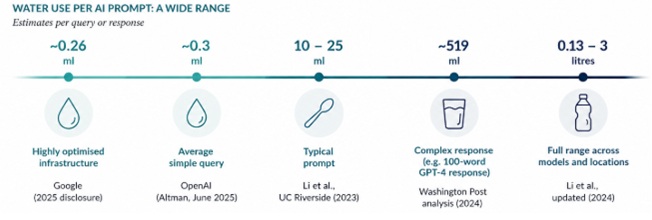
Source: Image generated by ChatGPT (as at 4 May 2026)
The takeaway is not a single number. Water usage is shaped by model complexity, data centre design, geography and the energy mix that powers the workload, which means context drives the answer.
The question of how much water a single AI prompt consumes may seem small. In isolation, it is. But at scale, it becomes a proxy for something much larger: how the digital economy is built, where it draws its resources, and who carries the cost when those resources run short.
Four implications stand out for investors, regulators and businesses alike.
1. Sustainable technology wins
Efficiency is becoming a key point of differentiation at the technology level. More efficient model architectures, lower compute intensity, and reduced resource usage per task are moving from engineering concerns to competitive advantages. Providers that can deliver similar performance with a lower environmental footprint are likely to win enterprise demand, particularly as companies begin to account more carefully for the indirect impacts of their digital operations.
2. Infrastructure as investment opportunity
For investors, this shifts the question from curiosity to materiality. The water footprint of AI is not just an environmental issue. It is an infrastructure and pricing problem. Data centres behave less like software businesses and more like long-duration physical assets, with exposure to land, power, and increasingly water availability. In water-stressed regions, the ability to operate efficiently is no longer optional. It will determine which assets remain viable and which face rising costs or even stranded risk.
3. The ESG blind spot is shifting from carbon to water
This is where the ESG conversation is beginning to evolve. For years, the focus has been on carbon emissions and energy use. Increasingly, attention is turning to water, physical infrastructure, and the broader environmental footprint of digital growth. AI introduces risks that are highly location-specific and directly tied to resource constraints.
In a country like South Africa, where water and energy systems are already under pressure, large-scale digital infrastructure does not exist in isolation. It draws from the same networks that households, agriculture and industry rely on, and ESG frameworks that fail to capture that participation is measuring the wrong thing.
4. Implications for South Africa
South Africa already accounts for roughly three quarters of Africa's data centre capacity, and that footprint is set to expand sharply over the next decade. This creates a clear role for both investors and policymakers. Capital will be needed to finance more water-efficient data centres, support renewable energy integration, and develop infrastructure that can scale sustainably.
The regulatory environment is moving in parallel. The FSCA's March 2025 Sustainable Finance Update Report signalled its intention to introduce mandatory corporate sustainability disclosure aligned with IFRS S2, beginning with a climate-first approach, and to shift ESG claims from voluntary guidance into enforceable conduct standards. The JSE has already updated its Sustainability Disclosure Guidance to align with the ISSB's IFRS S1 and S2 standards, giving the listed market an early roadmap for what comprehensive sustainability reporting will look like in practice. As these frameworks bed in, the environmental footprint of digital activity, including water and energy intensity, will become more visible, more measurable, and ultimately more investable.
Every prompt is a small drop. Multiplied across billions of users and connected to a grid and water network already under strain, those drops add up to a defining question for the country's digital future. The answer will be written in the disclosure frameworks, infrastructure choices and policy decisions taken now.


