

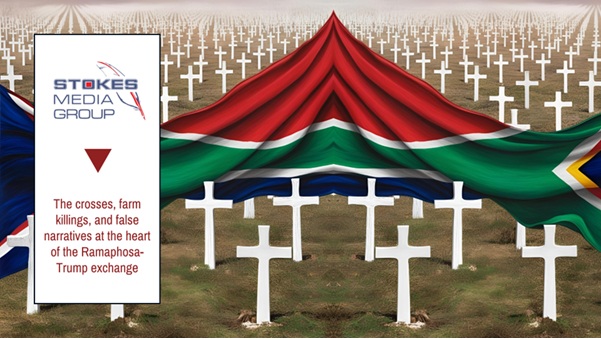
The crosses, farm killings, and false narratives at the heart of the Ramaphosa-Trump exchange
Love him or hate him, United States (US) President Donald Trump has brought a new, albeit uncomfortable, level of transparency to White House proceedings. His abrasive and erratic approach contributes to countless uncomfortable moments; but your writer would rather push through these unscripted encounters than have each party to the conversation read from prepared notes, and then refuse to answer questions afterwards.
Next level transparency
The public interaction between Trump and South Africa’s President Cyril Ramaphosa, broadcast from the White House on 21 May 2025, offered viewers a smorgasbord of half-truths and misinformation, one hopes in good faith.
According to reports, the South African entourage attending this bilateral discussion included golfing legends Ernie Els and Retief Goosen, businessman Johann Rupert, the SA Minister of Agriculture, the president of COSATU, and others. South African-born entrepreneur Elon Musk was also in attendance, but he did not speak during the public session.
The meeting intended to reset US-South Africa relations, focusing on trade and cooperation. Both leaders made courteous opening statements before diving into more heated issues like farm killings, land expropriation, and race-based persecution. As the hour-long discussion played out, it became increasingly difficult to tell whether Ramaphosa was squirming at the video montage of Economic Freedom Fighters (EFF) leader Julius Malema chanting ‘Kill the farmer, kill the Boer’ or at Trump’s pit bull-like persistence with his false narrative about land grabs and executions. The US President repeatedly said: “There are very bad things going on in Africa.”
Your writer is staggered by how poorly briefed Trump is about the on-the-ground situation in South Africa. Yes, the country has a serious capital crime problem. Yes, there is a preponderance of race-based legislation. Yes, by most metrics white farmers have a disproportionate per capita murder rate compared to other segments of the population. Yes, there is an Expropriation Act that enables government to seize private property with ‘nil’ compensation. Yes, many political figures have chanted ‘kill the Boer’ and spewed clearly anti-white vitriol. And yes, much property has been ‘lost’ due to government’s failure to address crime and inner city decay.
Disconnected and misrepresented
It is the way this information has been stitched together and interpreted by Trump and his cohort that beggars belief. There is not an Afrikaner or white genocide underway. Private farmland is not being grabbed by the State its owners summarily executed. And it gets worse from there. Some of the video footage shared to support the various allegations was disconnected and misrepresented, while the stack of articles that Trump waved at the cameras fails to distinguish between race-based attacks and the broader context of South Africa’s high crime rate. PS, this is assumed, your writer did not get a close look at any of them.
Even the reasonably true observation that people were fleeing South Africa over concerns for personal safety rang hollow as presented. There is no doubt that South African citizens – black and white – are emigrating in their droves. And there is no disputing that concerns over rampant crime feature strongly as a motivator for those leaving our shores. But the way Trump put it, saying that families were literally running away from burning farms under threat of imminent death, is patently untrue. He repeated this lie a couple of times through the scrap: “They are taking people’s land away and, in many cases, those people are being executed.”
A hollow opening
The longer one watched, the more it felt like two meetings. “We are essentially here to reset the relationship between the US and South Africa; we are long-standing partners in many, many ways [and] we have collaborated in many fields [including] in space issues, in energy, and in trade,” Ramaphosa said in his brief introductory remarks. He wanted to talk trade and investment, but Trump had other plans.
If one considers the events leading up to this meeting, then Ramaphosa’s opening remarks about the 600 US companies already investing in South Africa, the country’s mineral wealth, and an expression of a mutual desire to end global conflicts feel misjudged in tone and timing. Trump, meanwhile, wasted little time getting to the crux of his position. He ranted about an organised campaign against white farmers involving land seizures and murders.
And he made an interesting, yet valid observation about the media’s role in reporting on this and other contentious issues. “Apartheid [was] terrible; that was the biggest story [and it] was reported on all the time. This is sort of the opposite of apartheid … and what is happening now is never reported,” he said, referring to farm murders and race-based laws in post-apartheid South Africa. It is not that the stories do not exist, but that the victims do not fit the script.
Ironically, one of the reporters in attendance had demonstrated this very dilemma moments earlier. After watching a reel packed with variations of the ‘Kill the farmer, kill the Boer’ chant, an NBC journalist sidestepped the footage entirely to question whether the US had accepted a presidential jet from Qatar. Trump snapped back, arguing that no serious journalist would watch such chilling images and respond by launching an unrelated attack on a sitting president.
Some version of the truth, perhaps
Ramaphosa was nonplussed throughout, as he generally is. He deflected from the ‘Kill the Boer’ footage saying that the African National Congress (ANC) was “completely opposed to it” having adopted a document back in 1955 which holds, “South Africa belongs to all who live in it.” He noted that the EFF was a minority party with its own views, all protected by the country’s constitution.
Trump offered a no-nonsense riposte to this, saying: “If somebody gets up in Parliament and starts saying ‘kill a certain group of people’, he should be arrested very quickly.” He also pointed out that the call for slaughter was being made in a stadium that holds 100000 people, with hardly an empty seat. PS, your writer remains bemused by how this chant gets by the country’s venerated constitutional and human rights safeguards, and is perturbed by how many of his fellow citizens accept the status quo.
One of the problems with Trump is he is simply too literal. For example, he shared an image of a site containing hundreds of crosses, saying: “These are burial sites right here [of] over a thousand white farmers.” Technically, the crosses did represent murder victims, but the image was not a burial ground. After an extensive web search, your writer reckons it was either of the Witkruis Monument, situated on the slopes of Ysterberg and established in June 2004, or a temporary roadside memorial in KwaZulu-Natal, created in 2020 to honour a couple murdered during a robbery. In either case, the crosses were symbolic, not actual graves.
At last, some rational comment
It was left to the invited extras to offer some rational input. “We want to see things get better in our own country, and that is the bottom line,” said Els. He commented on South Africa’s sporting achievements during the early years following Nelson Mandela’s release from prison. He also noted how business and government were working together domestically, and how farmers were getting involved in local municipalities, trying to rebuild some of the infrastructure that has been decaying for decades. “There is a lot of co-existence going on and help from a lot of areas; but I feel we need the US to push this thing through,” he said.
Rupert did his part to normalise the conversation too. “We have too many deaths [in South Africa], but these deaths are across the board … it is not only white farmers,” he said. He confirmed his belief in South Africa’s future, saying that he was building cottages for his grandchildren on his farm near Graaff-Reinet, and that Ernie Els was building a new home in George. Playing the business card, Rupert hinted that South Africa needed technology like that provided by Elon Musk’s Starlink to help fight crime.
Blaming inequality and unemployment
Given the rare opportunity to chime in, Ramaphosa said that “crime really thrives where there is inequality and unemployment. He concluded: “Our main reason for being here is to foster trade and investment, so that we can grow our economy [and secure] the US’s support to help to address our societal problems.” If successful, South Africa could protect the jobs in its agricultural, automobile, oil, and mining sectors – and create more.
It remains to be seen what happened during the closed meetings before and after this media spectacle. Suffice to say, the South African contingent was intent on advancing the country’s trade and investment interests without offering any admissions or concessions on the key issues Trump had raised. Time will tell whether AGOA is salvaged, whether the US shows up for the G20 in Johannesburg this November, and whether Trump yanks the welcome mat from under the trickle of so-called Afrikaner refugees.
Follow the writer on
LinkedIn: https://www.linkedin.com/in/gareth-stokes-media/
X: @stokesmedia


