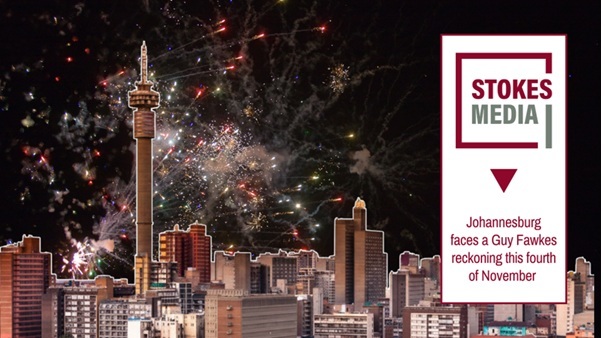
Johannesburg faces a Guy Fawkes reckoning this fourth of November
“Remember, remember the [fourth, sorry] fifth of November; Gunpowder, treason and plot”. The opening line of today’s op-ed is based on your writer’s hazy recall of a line of poetry with political import that he felt was a shoo-in to introduce musings over South Africa’s upcoming local government elections. May it be the fourth, he hoped; alas, it was not.
Guy Fawkes and fireworks
The fifth of November rings out because of England’s failed Gunpowder Plot of 1605, when Guy Fawkes and his co-conspirators set out to blow up the House of Lords during the State Opening of Parliament, with the king, lords and commons present. South Africa’s 4 November 2026 elections promise to be a gentler affair, featuring millions of voters passing judgement on the parties and politicians that have governed their cities and towns. Used properly, this vote gives citizens a chance to end a decades-long track record of ‘treason and plot’ in local governance.
This election will also be a litmus test for voter sentiment following the shock outcomes of the May 2024 national elections. For those who have already forgotten, this was the first time since 1994 that the African National Congress (ANC) failed to secure an outright majority, falling to just 40.18% of the count. The Democratic Alliance (DA) came in second, with 21.81%, followed by Umkhonto we Sizwe (MK), the Economic Freedom Fighters (EFF) and Inkatha Freedom Party (IFP) with 14.58%, 9.52% and 3.8% respectively.
Local elections matter more than you might think, dear reader, because they transmit directly to your experience of the town or city you live in. At a household level, the politicians in charge determine the level of service you receive, and the price you pay. Businesses grapple with poor service delivery too, but often the very goods and services they offer depend on basic municipal infrastructure being in place and functioning. In recent years, entire companies have uprooted from one location to another on the basis that municipal electricity, road and water infrastructure was unreliable at best, and non-existent at worst.
It cannot get worse, can it?
Alas, the decaying infrastructure that confronts South Africans at the municipal level is a symptom of a far bigger problem. Administration and governance in large metros such as Ekurhuleni, Johannesburg and Tshwane are a total mess, with the politically-connected diverting budgets to salaries, perks and patronage rather than repair and maintenance. Even where infrastructure projects are approved, the rand-for-infrastructure curve is hopelessly skewed by corrupt and inefficient procurement practices. And it gets worse, due to a little something called political fragmentation.
Alicia Seckam, moderator for a recent PSG Think Big webinar, described the landscape through a Johannesburg lens, saying that the “city had suffered from a revolving door of unstable coalition government since 2016” and that this crisis was “marked by deteriorating infrastructure, unreliable service delivery, urban decay and water shortage”. She was joined on the virtual stage by Gareth van Onselen, political strategist and commentator, to consider prospects for the City of Johannesburg under the banner ‘The 2026 municipal battleground’. The ensuing chat focused on just two players, and could have been billed as a Mashaba v Zille affair.
Van Onselen suggested that the DA, with Zille as its Johannesburg mayoral candidate, had a major head start on the campaign trail. He commended the official opposition’s target of securing 500 000 votes on 4 November, saying this should be enough to secure a majority in the city. To balance this upbeat assessment, he said that in reaching this target, the party would have come full circle to the vote count it achieved a decade ago, in 2016. He also criticised the party for “its inability to generate high-quality candidates in Johannesburg despite having been active there for over 30 years”.
The small party dilemma
Action SA’s mayoral pick, Herman Mashaba, was described as a reluctant candidate who had already indicated that should he be elected, he would only consider serving for one term. Van Onselen conceded that many of the Action SA challenges were typical of smaller parties, in that it was stretched thin, having to select its ward battles, and often spreading key leadership figures across multiple roles. “Mashaba has national obligations which require campaigning outside of Johannesburg; he cannot dedicate himself to Johannesburg in the way Zille can,” he said.
This writer was fascinated by the Think Big Series’ decision to feature a David versus Goliath analysis of the DA, which secured 21% of the vote in May 2024, and Action SA, which secured just 1.2%. The smaller party is, however, polling better at the city level, nearer 5%. This decision was explained away on the grounds that the likes of the ANC and Patriotic Alliance had not yet named their Johannesburg mayoral candidates. Fair enough. Of greater concern was Seckam’s question about whether “coalition arithmetic might matter more than who wins the mayoral race”.
Van Onselen pointed out that support for political parties outside of the ANC and DA had grown to about 43% in the City of Johannesburg, labelling this grouping as the most powerful and fastest growing political force in South Africa. The rest of the Joburg city vote contenders, totalling some 50 parties in the 2021 local government election, each have their own agendas. “These parties want a prominent position; they want key influence often disproportionately powerful to their actual electoral result,” Van Onselen said. This makes it difficult to form and maintain coalitions; a construct that Joburg residents are quite familiar with.
Five to 10 years to course correct
In a recent discussion with a large national insurance broker, your writer learned that improved macroeconomic factors usually took two years to reflect in turnover. This observation tied in nicely with the discussion’s back-and-forth on how long it might take a new political party to address the systemic rot that afflicts present-day Johannesburg. Zille has said it would take a decade or longer to fix the city’s finances and start chipping away at the infrastructure backlog. And anecdotally, it has been nearly impossible for coalitions to make the aggressive interventions needed to deliver meaningful change.
“The sooner that you can get the short- and medium-term budgetary processes realigned with your priorities, the better; that determines your programme of action going forward,” Van Onselen said. He estimated that a new administration would need a full five-year cycle to “fundamentally own the budget”. A new political leadership will face significant human resourcing challenges at the local government level, as well as political power mismatches at the state-owned enterprises that support many infrastructure and service functions.
Reimagining a world class African city
Governance and oversight were singled out as non-negotiable to migrate from planning to effective implementation. “You need a good executive team,” Van Onselen said. “You need executive councillors who are just as competent as the mayor, and are able to drive changes in each portfolio … and you need to find good administrators, heads of departments, city managers etc.” The key to success was to appoint individuals who can implement programmes systematically, but more importantly, who are aligned with a global vision rather than a factional agenda.
The rallying cry to readers is to do your part to bring excellence to your local municipality. You should be thinking about who you want to represent you; how you want them to show up; and what you can do to ensure that your vote gets them part of the way there. This writer’s challenge to you is to reflect on the outcomes following prior elections, and then make an informed decision on which party really goes to bat for citizens. But do not stop there.
Try to make your vote more about community by reaching out to your neighbours and peers about what they need from elected leaders, and work together to bring about the change that the city so desperately needs. If you let your mind guide your heart in such matters, Joburg may even be able to live up to the world-class African city moniker that some marketing heavyweight conjured up in the distant past.
Follow the writer on
LinkedIn: https://www.linkedin.com/in/gareth-stokes-media/
X: @stokesmedia