SA businesses seriously impacted by political instability, poor government service delivery and crime – Grant Thornton survey
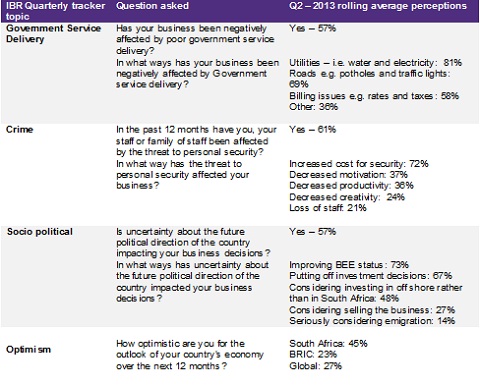
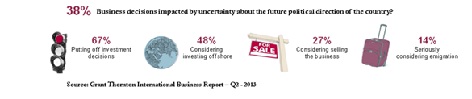
Sixty seven percent of South African privately held businesses are putting off investment decisions owing to uncertainty about the future political direction of the country. A further 48% are looking at investing offshore rather than in SA while 27% are c
The Grant Thornton International Business Report (IBR) quarterly research data for the second quarter of 2013 to June reveals a drastic increase in uncertainty which is directly impacting business decisions and overall confidence of South African privately owned business executives.
“There is no doubt that businesses are waiting for next year’s elections hopefully to bring stability and clarity on the future direction of our country,” says Deepak Nagar, national chairman of Grant Thornton SA. “This is possibly one of the core reasons for delays in private business investment decisions which we are observing in our IBR results each quarter.”
The Grant Thornton data also revealed that 57% of business executives are being negatively impacted by poor government service delivery. The striking feedback in this set of data for the second quarter of 2013 is in relation to business executives’ responses to the specific service delivery issues. These statistics more than doubled and sometimes even trebled since Q1 just three months earlier.
When businesses were asked in what ways had they been negatively affected by poor government service delivery a massive 81% of respondents stated utilities as a core issue, such as water and electricity supply (Q1: 2013 – 41%), while 69% said road concerns including potholes and traffic light issues (this response trebled since Q1:2013 – 21%) and 58% lamented billing issues (up from 23% in Q1 this year).
An additional 36% of respondents stated being impacted by a combination of red tape, transport inefficiencies, labour strikes, poor payment from government and tender fraud, quoted as core issues in the “other” category.
“The economic slowdown is still extremely burdensome on the South African economy and additional local pressures are not helping at all,” says Nagar. “The battling BRIC region continues to directly impact business expansion for South African privately held businesses while local service delivery concerns and political uncertainty persistently lash organisational growth.”

Grant Thornton’s quarterly International Business Report (IBR) research data for the second quarter of 2013 provides tracker insights into the views and expectations of over 12 500 privately held businesses surveyed in total per year across 44 economies. The Q2 data for IBR to June 2013 also highlights regional and national perceptions of privately held businesses regarding crime, service delivery and political climate for South African business owners.
Crime & security
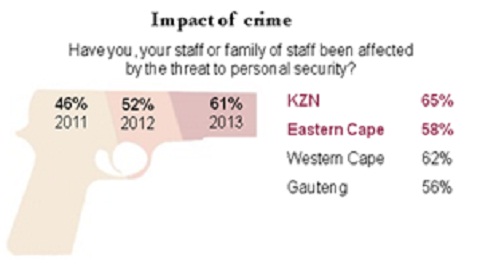
Regrettably, the impact of crime on SA businesses continues to be on the increase, with 61% of business executives, their staff or family of staff directly affected through a contact crime incident in the past 12 months. Contact crime is defined in the research as housebreaking, violent crime, road rage or hijacking.
This figure has increased 15 basis points since 2011(46%) with KwaZulu-Natal and Western Cape regions recording the highest impact at 65% and 62% respectively.
“It is a serious concern to see the figures rising so rapidly. We can no longer ignore this blight – something just has to be done. Not tomorrow, not next week – right now,” says Nagar.
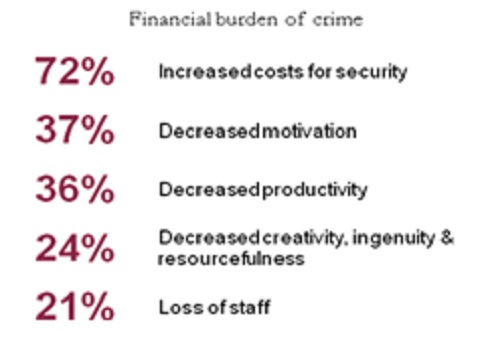
In terms of the financial burden that crime has on SA businesses, the IBR data for Q2 2013 highlighted that a startling 72% of business leaders who stated crime as a real concern in the past year reported that they had experienced increased costs for security systems in their organisations.
“It’s hard to understand how security costs for businesses just never seem to stabilise. Investing in securing your premises and protecting your staff is a massive cost outlay for South African companies and it is a sad state of affairs that crime is so financially burdensome,” continues Nagar.
When asked if any executives had given serious consideration to emigrating, only 19% stated that they were considering it (2009: 30%). In addition, when privately held business owners were asked to provide reasons why they were considering emigrating, 84% said it was the high crime rate, 83% responded stating that the political climate was prompting them to consider emigrating and 58% said racial discrimination, with 54% commenting on the poor quality of education and healthcare.
SA’s euphoric disposition shines on
Despite all the doom and gloom, business owners in South Africa still have a euphoric future outlook and continue to express positivity about the next 12 months with 45% of executives surveyed stating that they are optimistic about business prospects for the next 12 months.
Globally, optimism data reveals a dramatic reversal of fortune for business leaders in the world’s two largest economies – the US and the UK.
The IBR reveals that US business optimism climbed to 55% in Q2 up from 31% in Q1 which is the highest level recorded since 2005. Optimism in the UK broke through from -1% in Q1 to +34% in Q2 revealing a dramatic improvement in sentiment overall, in terms of future business growth prospects.
However, while US businesses are feeling more confident about growth in their operations and the economy, optimism amongst peers in China dropped to 4% from 25% in Q1 which is China’s lowest level since 2006. The BRIC region of economies also saw a dramatic decline in business optimism, recording optimism down to 23% in Q2, from 48% in Q1 – there’s no doubt that the China data had a massive impact here.