

Rising energy costs and exchange rate fluctuations constrain SA business decisions - Grant Thornton quarterly survey
Q2 2014 survey reveals crime is on the increase and business optimism continues to plummet.
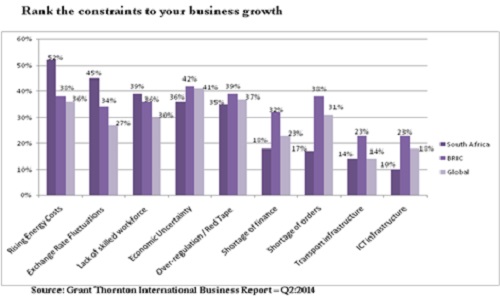
For the first time since 2007, overregulation and a lack of availability of a skilled workforce are no longer the top concerns constraining business growth in South Africa. The second quarter tracker data from Grant Thornton for 2014, to June reveals that 52% of SA business executives lament rising energy costs and 45% rank exchange rate fluctuations as the two biggest factors currently hampering growth and expansion in South Africa.
“Increased energy costs and fears about the long term sustainability of energy for business is a growing concern in South Africa,” says Deepak Nagar, National Chairman of Grant Thornton South Africa. “Dramatic fluctuations in exchange rates, and particularly the recent collapse of the Rand, do not help matters either.”
Grant Thornton’s International Business Report (IBR) provides tracker insights for the second quarter of 2014 to June specifically presenting perceptions into the views and expectations of over 12 500 privately held businesses surveyed in total per year across 44 economies on an annual basis. It also highlights regional and national perceptions of privately held businesses regarding crime, service delivery and political climate of 600 South African business owners annually (150 business executives per quarter).
In comparison, the biggest constraint to business expansion globally is anxiety regarding economic uncertainty with 41% of businesses ranking this factor as a core inhibiter. Business executives in the BRIC economic region concur with 42% of respondents expressing concern about uncertainty about the economy (SA – 32%).
The lack of availability of a skilled workforce continues to restrict business growth and 39% of South African business executives rank this concern as a key constraint.
But the issue of overregulation and excessive red tape remains very high on the list of factors constraining business growth worldwide with 35% of SA businesses, 39% of businesses in the BRIC region and 37% of privately held organisations globally highlighting this as a major concern.
“The world is plagued with red tape matters,” says Nagar. “Stifling regulatory controls and too many systems and processes affect the day-to-day functions within a company and they have a long term impact on the growth and expansion prospects of an organisation too.”
Crime a growing distress for SA business
Sadly, the impact of crime on businesses and the direct effect on individuals is rapidly climbing again.
When SA business owners were asked if, in the last 12 months, they had directly been affected, or whether their staff or family of staff had been affected by the threat to personal security such as house breaking, hijacking, violent crime, road rage, the results were very disturbing with a massive 65% stating yes.
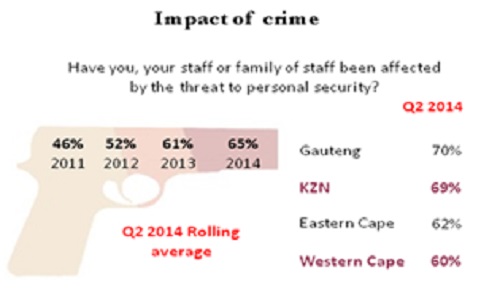
“We started surveying the impact of crime on South African businesses in 2007, when an astonishing 84% had been directly affected by crime during the 12 months under review,” says Nagar. “We were very pleased during 2011 when this figure dropped to its record low of 46% which was almost 40% lower than 2007. But to see crime statistics on the increase again is extremely concerning.”
Grant Thornton’s Q2 data for 2014 highlights that Gauteng is most affected by crime (70%), with KZN following closely behind at 69%. The Eastern Cape (62%) and Western Cape (60%) regions seem to be better protected against crime, according to the data.
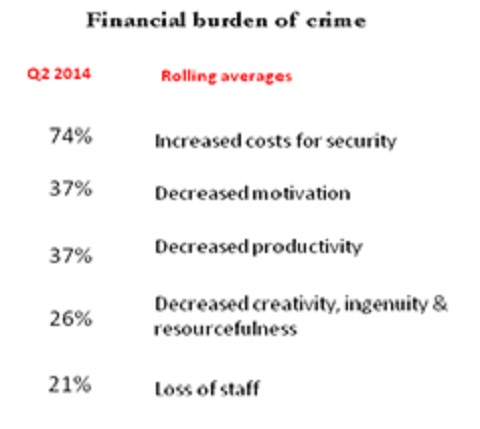
When South Africans were asked to list the ways in which their businesses were affected by crime, 74% stated that the increased costs for security are a grave financial burden. Other factors include decreased motivation (37%), decreased productivity (37%), decreased creativity (26%) and loss of staff affects 21% of business executives surveyed during Q2.
Source: Grant Thornton International Business Report Q2 2014
Government service delivery concerns are growing
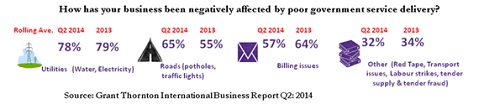
The negative impact that poor government service delivery has on businesses is continuing to increase. Second quarter IBR data for 2014 reveals that a startling 62% of all business owners surveyed are negatively affected by poor government service delivery. This has increased from 59% during 2013, from 57% in 2012 and from 53% during 2011.
“Poor government service delivery is a real and continuous impediment to business growth in South Africa,” says Nagar. “I urge the newly elected local government constituencies to make this concern a priority to be properly resolved over the next four years. Let us not be lamenting these matters again, to such an enormous extent, when we vote again in 2018.”
When businesses were asked to list the types of government service delivery that are currently negatively affecting their businesses, utilities was once again the greatest factor, with 78% of businesses stating this as a concern. Sixty five percent lamented road issues and 57% complained about billing issues (rates and taxes).
SA business optimism plummets as local strains continue to affect business expectations
When South African business executives were asked how optimistic they are for the outlook of the country’s economy in the next 12 months, research reveals a very pessimistic outlook with only 27% of privately held businesses expressing optimism for the second quarter of 2014. South Africa’s optimistic outlook has been steadily declining since 2010’s high of 60% (2011: 58%; 2012: 49%; 2013: 39%).
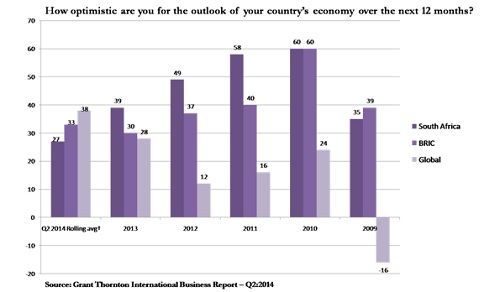
“There are a multitude of factors influencing SA business executives’ outlook,” says Nagar. “The global economic crisis has played a major role in the pessimistic expectations, so have the labour issues such as the Marikana strike of 2012, the more recent 2014 strike in the Platinum sector for five months, and various other strikes, currency fluctuations and general political uncertainty ahead of the elections earlier this year.”
In contrast, global optimism is sky rocketing with a record high of 46% achieved for Q2. The surge in optimism is being driven by increasing confidence in the European Union (at 43%, the highest since 2006), North America (at 73%, the highest since 2004) and the G7 (at 53%, another record high). This positive sentiment about the economic outlook is being fed by record-high expectations over exports; globally the proportion of businesses expecting exports to increase over the coming 12 months (24%) has only been equalled once before, in 2011. In the G7, a record 23% of businesses expect to grow exports over the next 12 months.
Not much export expectations are being predicted in South Africa with only 15% of the business executives surveyed during the second quarter of 2014 currently predicting that exports will increase in the coming 12 months.
“As economies continue to recover from the financial crisis, business leaders are sensing real opportunities to go overseas and capitalise on other markets,” says Ed Nusbaum, global CEO at Grant Thornton International. “These are exciting times for business leaders, and the focus on exports is a clear sign to policymakers that cross-border trade is critical to the long-term health and success of their operations and the wider economy.”

