

Prolonged negotiations in the public sector influence disposable salaries
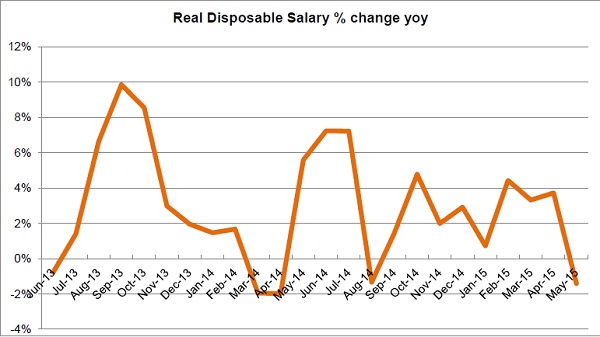
As the salary negotiations for public servants were not settled in May due to on-going bargaining, the average disposable salaries in the BankservAfrica Disposable Salary Index (BDSI) saw a year-on-year decline in real terms. May 2014 reflected a delayed increase of the April 2014 government salary adjustments, so this prolonged delay skews a year-on-year comparison. The May 2014 graph shows two months of salary increases rolled into one while May 2015 does not yet show an increase as salary talks had not concluded.
Public servants make up nearly a quarter of the total workforce - and around a third of the estimated number of employees in the BDSI - and receive nearly 30% of the non-farm payroll wages. In the salary payments systems, BankservAfrica believe this could be as much as 40% of the value of salary payments. So any delay in public sector wage increases has a massive knock-on effect, not only on the BDSI but also on retail sales and many other consumer indicators.
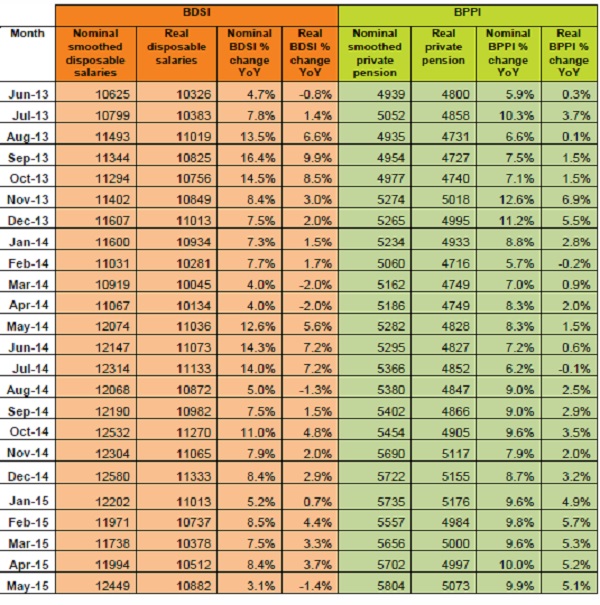
This resulted in a real decline of -1.4% in salaries while the nominal increase was 3.1%. However, on a monthly basis salaries still grew strongly as the April holiday season came to an end.
Graph 1: Inflation adjusted salary growth on a year ago
Source: BankservAfrica and Economists.co.za
The average person took home R12 449 in May, but the person in the middle (or ‘typical person’) took home 75% of the disposable salary that the average person received. The actual median take-home pay was R9 333 for May, and saw a real decline of -0.3% as this also increased below the rate of consumer inflation.
Disposable salary increases were therefore disappointing due to the drawn-out bargaining in the public sector, which is nothing more than a technical factor. However it makes monthly comparisons on a year ago inequitable and the weak numbers should be viewed in that light.
In the short-term there may be a lack of household spending as many will wait to see what their actual increase is going to be, and when it will take place. We can also expect to see a sharp spike in salaries in the months ahead but this will of course be due to the delayed settlement.
Another factor that is decreasing average disposable salaries is the tax increases that many higher salary-earners are now paying, which also constrains overall consumer spending. We estimate that this has taken close to 1% away from the real salary increase.
Fewer lower income employees
Nevertheless, salaries are still increasing in nominal terms, and BankservAfrica expect that when the full year’s salaries are reviewed the actual real disposable salary will be positive.
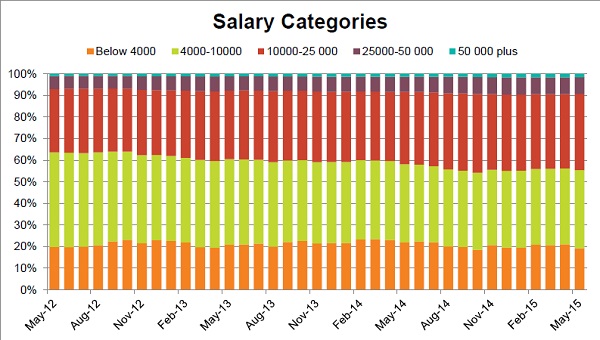
The percentage of employees who earn less than R4 000 per month has again dipped below 20% of the total number of people paid. This means that over 80% of formally employed people on the South African payment system take home over R4 000 a month.
Graph 2: Salary payments per category
Source: BankservAfrica and Economists,co.za
Pensioners are still getting above-inflation increases
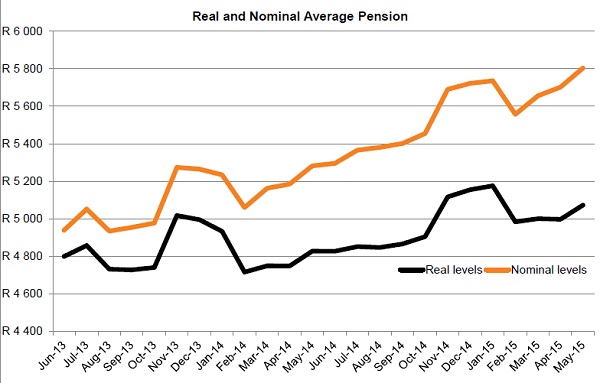
In contrast, South African pensions are still growing. Although average pensions are only 46.6% of the average salary, the increase over the last year has been 9.9%.
In real terms, pensions are up by 5.1%. While it is unlikely that they can continue to increase at the current rate, it is encouraging to see that both average and median pension payments have outperformed inflation. The fact that median pensions have increased by a double digit percentage for four months in a row must mean there have been reasonable returns from fund managers.
Another factor influencing this increase is that as workers retire and become new pensioners, their now higher salaries offer a higher pension level when they start receiving a pension.
Graph 3: Level of average pension
Source: BankservAfrica and Economists.co.za
Table 1: The BDSI and BPPI Numbers
Source: BankservAfrica and Economists.co.za

