

Disposable salaries grow faster than inflation for the fifth month
BankservAfrica’s latest data shows average disposable growth are at record highs.
Average disposable salaries are increasing in both nominal terms and real terms, as reflected in BankservAfrica’s Disposable Salary Index (BDSI) for July. In real terms, salaries increased by 2.5% in July - the fastest increase since August 2015.
For the fifth consecutive month in a row, average disposable salaries increased faster than the rate of inflation.
While this is partly due to the decrease in the inflation rate, salaries have also increased in nominal terms at a fast rate of 7.6%. This is the same as March 2017 - and the highest since December 2014.
Salary raises are increasing and this is reflected in consumer spending with retail sales recovering. Car sales are also no longer on the decline.
The average salary can be deceiving as some may have had large increases while others may have had no increase at all. This, however, does not seem to be the case as seen in the median salary, which measures a person’s typical salary.
The median disposable salary increased by 4.2%, indicating the majority of increases were in the middle and lower end of the salary distribution. This increase is the highest since July 2013.
The median salary is now 75.9% of the average salary in disposable terms. This is up from 72.7% in July 2012.
The above indicates that typical employees in the formal sector are certainly getting higher salary increases than in the last few years. It is also likely that garnishee orders are starting to become less of an influence on the salary structure in the formal sector.
The real median salary is at an all-time high at R10 680 per month while the average salary is still below the high in real terms of October 2015.
The fact that the average disposable salary is still below the average take-home pay levels of the end of 2015 and beginning of 2016 is the biggest reason that people feel “poorer”. The average salaries have not yet caught up to the highs of 18 months ago. Therefore, many employees are feeling less well off.
Graph 1: BDSI and BPPI nominal levels
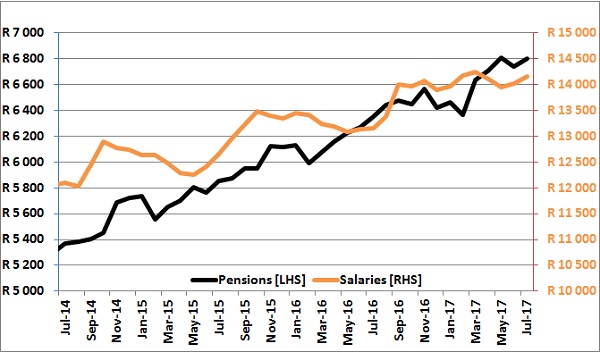
Source: BankservAfrica and Economistscoza
Pensions still better off but at a rate slower than salaries for first time in more than 18 months
The BankservAfrica Private Pension Index (BPPI) indicates that pensioners had a smaller increase than average disposable salaries for the first time since December 2015.
Pensions paid into bank accounts in South Africa have, however, again increased above the rate of inflation over the last year with 2.4% on average.
The median pension also beat inflation but with a lower 1.4% suggesting that those with smaller pensions are not seeing much of an increase in their pension payments.
The average real pension paid into a bank account was R6 584 while the typical (median) pension was R 4 547. The median pension was only 69.1% of the average pension.
Now in its fifth year of running and covering over 70% of pension payments, the BPPI provides a good overview of South African pensioners and their retirement savings. This is the first and only pension pay-out indicator that is available on a monthly basis in the world today.
Combined increase is strong indicator of a consumer recovery
The increases in both the BPPI and BDSI will help consumer recovery in South Africa. While consumer spending dropped in Q1 2017 as a result of a decline in real salaries and pensions, the upturn in both pensions and salaries in real terms indicates a stronger consumer with greater spending power in the coming quarters.
This will help the SA economy to grow. The country’s GDP growth is already ticking up - albeit not at the pace one would hope for.
Graph 2: Real levels of salaries and pensions
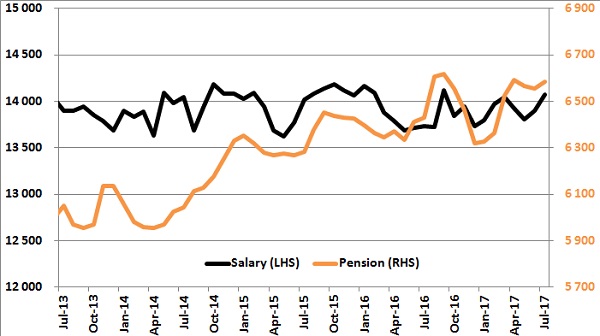
Source: BankservAfrica and Economistscoza
Table of disposable salaries and private pensions
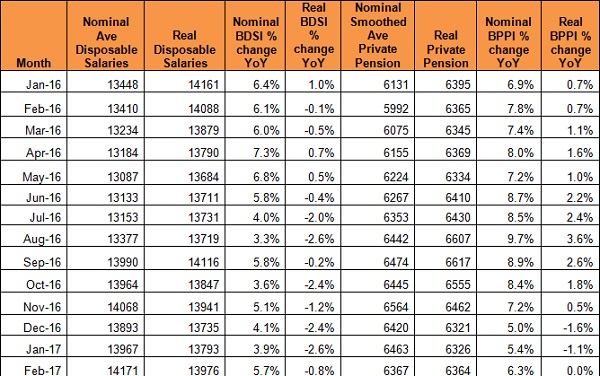

Source: Economists.co.za and BankservAfrica

