

Considerable rise in take-home pay of formal employees – BankservAfrica Index
The take home pay of formal sector employees increased by 11,2% in October 2014 on a year ago which was a 5% real increase.
The average real increase in take home pay as measured by the BankservAfrica Disposable Salary Index is 2,5% overall for the whole of the last 12 months from November 2013 to October 2014 over the same period a year ago.
Again the theme of those in work being able to maintain increases in their lifestyle is borne out as both private and public sector employees take more and more home after taxes, pensions and medical insurance as well as garnishee orders and firm deducted micro loans.
With most of the strikes now behind us the increases in the formal sector are quite astounding once again. The average salary that gets banked is R12 542 per month in the South African formal sector payments system. This is the sixth month that the average disposable salary is above R12 000 per month.
We estimate that there were only about 2 907 725 account holders in October receiving formal electronic salary payments through BankservAfrica. This is a decline of 1,2% when we would normally expect an increase in the number of accounts receiving electronic salaries due to the general shift towards electronic payments. This decline may have to do with both the post office strike and the fact that some bigger firms such as mines may have laid off employees.
Those with jobs are getting disposable salary increases
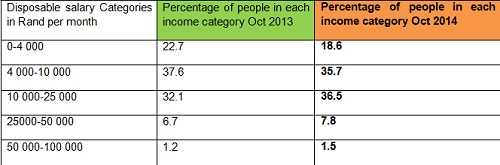
The increases in salaries are lifting people out of the lower disposable salary bands as the share of those receiving less than R4000 per month in disposable income has declined to less than 19% for the first time in the history of the BDSI. This may also be due to the reduction in garnishee orders over the last few years and consumers who have become more wary of micro loans. Of course higher salaries must also be part of the equation.
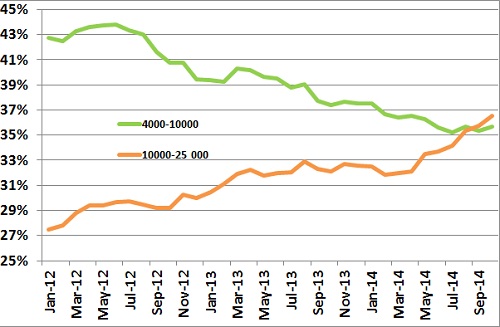
The most interesting aspect this month however is that the number of people who received between R10 000 to R25 000 was the biggest single grouping of people in the BDSI. Just over 1,1 million employees received a disposable salary between R10 000 and R25 000 per month which is just a touch more than the 1,08 million that received between R4000 and R 10 000 per month.
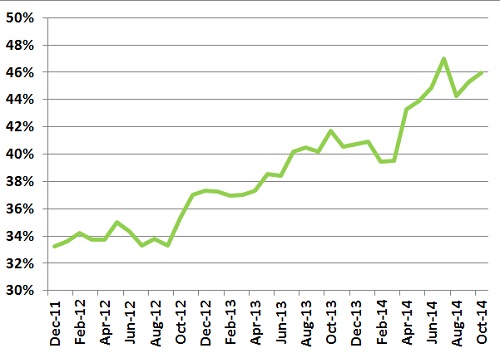
This trend is likely to continue in the future as the percentage of those getting more than R10 000 in their bank account now accounts for 46,2% of the total sample of the BDSI. This is up from 38.9% of employees taking home R10 000 or more in October 2013. (See chart 2)
While the numbers can fluctuate the major trend at present is that the number of people who take home over R10 000 is still increasing at a rapid rate. The number of people in this category increased by 15,9% while the top category of those earning between R50 000 and R100 000 saw the number of people increase by 25,7%.
The two lower income categories saw a decline in the number of earners. The fastest decline is for the category of people who earn less than R4 000 in take home pay which had an absolute decline of 16,2% in the number of people.
Those taking home between R4000 and R 10 000 declined by 3% over the last year. Certainly gross salaries have gone up but we also suspect that some people are getting rid of garnishee orders on their employees and so changes in the categories are probably not only salary increase related. With the fall over the last few years in civil debt judgements as recorded by StatsSA it is clear that some progress is being made on garnishee orders.
Table 1: A comparison of the proportion of people in different salary categories between October 2013 and October 2014
Note: Adjusted for weekly payments
Source: BankservAfrica and economists dotcoza
More South Africans are taking over R10 000 home every month than ever before and the median disposable salary in the BDSI is now well over R9 000 per month. One could say that the number of employees taking home R10 000 or more is a really good indication of the growing wealth of many in the formal sector.
This more than anything else is the major driver of consumer spending and retail sales and is probably what has been keeping retail sales and consumer spending on things like cars and cellular calls going. Retail sales may just be better than expected in the next month or two as the impact of the strikes disappear from the economic horizon and the salary increases take effect.
Chart 1: The percentage of employees in each of two categories over time
The percentage of people / payments in two broad disposable income categories show how more account holders now earn above between R10 000 – R25 000 pm than between R4 000 and R10 000.
Source: BankservAfrica and economists dotcoza
Chart 2: Percentage of accounts that get more than R10 000 take home salary
Percentage of accounts with income of R10 000 plus.
Source: BankservAfrica and economists dotcoza
Note on BDSI data:
Take home or disposable salary is the amount paid via the BankservAfrica system that indicates it is a salary payment and would already have taxes, UIF, Pension and medical insurance deducted. Other deductions according to payment firms and payment offices are Garnishee orders, up-front payments and deductions by some lenders such as the old Iscor Employee fund. Other deductions are much smaller in numbers but can from time to time be big amounts such as SARS penalties. We estimate weekly salaries to be about 9,5% of the total people or about 30% of actual payments.

