

Saudi Arabia growth projected at 1.2% from 5.2% average
While South Africa’s political relations with Saudi Arabia are strong, economic and trade ties should be reviewed and revitalised President Jacob Zuma said during his state visit to Saudi Arabia.
Zuma is looking at steps to enhance bilateral trade and investment flows, including skills and technology transfers.
Coface expects Saudi Arabia’s growth to be 1.2% in 2016, far below than the average of 5.2% in the past decade. Inflationary pressures are already increasing as the government hiked fuel prices in late December.
Annual inflation rose to 4.3% in March from 2.3% in December. Transport costs surged 12.7% in February from a year earlier. The gradual phasing out of subsidies may raise the level of prices in the upcoming period. The IMF has estimated that energy subsidies cost Saudi Arabia 13.2% of GDP in 2015. The Kingdom raised prices late in 2015 for fuel, electricity and water.
Saudi Arabia replaced oil minister al-Naimi after more than 20 years in the role with Khalid al-Falih, who was chairman of state-owned oil giant Aramco between 2009 and 2015. The decision came after a sustained fall in oil prices pushing the Kingdom to implement a fiscal consolidation after recording a record budget deficit in 2015. As a result, the Saudi cabinet approved the Vision 2030 reform plan aiming at freeing the country from its oil dependency.
The change is unlikely to mean a significant shift in Saudi’s oil policy. Since mid-2014, when oil prices began to plunge, Saudi Arabia has been involved in a battle to maintain its market share against new US producers. Within this “survival of the fittest” strategy, the Kingdom has refused to cut oil production which resulted in a supply glut in the oil market. The idea is based on balancing the market through cheap oil prices that would stimulate demand and shut down high-cost producers, although the Kingdom itself has earned less revenue.
Saudi Arabia’s marginal production cost of a barrel of oil stands at 3 USD (onshore) compared with 57 USD (deep water) for the United States. The new minister confirmed early May that the country would maintain its petroleum policies stable.
The government has also created a new ministry of trade and investment. Amid other changes, the electricity and water ministry was scrapped and a new central bank governor appointed. The reorganisation of the ministries indicates the Kingdom’s determination to ease bureaucracy and clarify responsibilities to offer better services.
The government’s restructuring came right after the announcement of the Vision 2030 plan. Because the level of the oil price is expected to remain low for some time, the Kingdom said it would implement a package of economic and social policies designed to reduce the country’s oil dependence.
The headline goals are to move the Saudi economy into the 15 largest economies in the world by 2030 (current position: 19), diversifying the economy from its oil-dependence by generating 100 billion USD a year in additional non-oil revenue (around 13% of GDP), privatising some government services, increasing transparency and accountability, reducing bureaucracy and ending the government’s dependence on oil revenue by 2020.
The plan includes reinforcing the Public Investment Fund by increasing assets from 600 billion SAR to 7 trillion SAR by 2030. The government also aims to ease SME’s access to credit by encouraging financial institutions to allocate up to 20% of overall funding to SMEs by 2030 (compared to 5% in 2015). SMEs activity accounted for 20% of GDP in 2015 and the government wants to increase this to 35% by 2030. The plan also considers increasing national employment by increasing female labour participation.
Risks
The plan looks ambitious, meaning it would take time to execute it. The deadline for some targets is set in 2020 while for others there is no specific time frame. The government will announce National Transformation Plan in late May or in June which would give a greater clarity about how and when these reforms will be implemented.
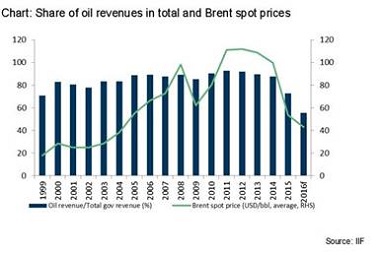
Reducing dependency on oil may take longer than expected. Beside the IPO of Saudi Aramco, the plan prioritises sectors like education, tourism, healthcare and manufacturing to sustain economic diversification. Yet the oil industry is a major employer of the country’s workforce and despite years of efforts of diversification, oil revenues still account for almost 70% of total government revenues, 45% of GDP and around 80% of total export revenues. Industrial sectors account for 21.4% of total employment in the Kingdom.
Reforms may be subject to changes or delays, if they trigger domestic instability while introducing free-market prices in energy. This is what happened in April to the minister of water, who was fired after public complaints over a surge in prices.

