

Germany: Going from “Jamaica” to Spain?
After about four weeks of intensive talks, the formation of a so called “Jamaica” coalition failed in Germany. The Liberal Party FDP stopped exploratory talks of the designated four-party-coalition, with the conservative parties: CDU and CSU and the Green Party.
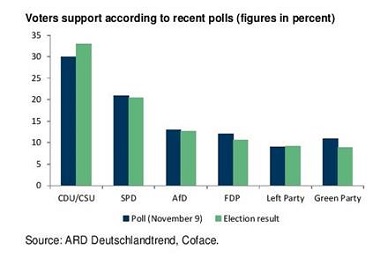
The most critical issues seemed to be Germany’s migration and refugee policy besides energy and climate policies. With these developments, the political landscape in Germany is facing a completely new situation. New elections could follow soon, similar to Spain’s recent history.
But there are two other options that could materialise. It is highly probable that the level of policy uncertainty will increase which could affect Germany’s position as Europe’s key anchor of stability.
Germany still has a government, since the current ministers of CDU/CSU and SPD remain in office managerially until the formation of a new government. But government’s position will be very weak and will go on acting like an administration, without significant initiatives for reforms. Merkel will at least remain in office until there are elections in the Bundestag for a new Chancellor.
After the break-up of exploratory talks, Chancellor Merkel could try to start negotiations with SPD again. But SPD’s chairman, Schulz, was clear after the elections that his party would not enter a grand coalition with CDU/CSU again.
Therefore, it is highly unlikely that the SPD could be re-won again as a government partner – even if Merkel’s Conservatives were to be generous in the number of SPD ministers appointed. Furthermore, a grand coalition is unpopular amongst voters. According to a recent ARD poll, 62% viewed such a coalition negatively.
Another unlikely option would be the formation of a minority government led by CDU/CSU – either with changing majorities or with a fixed partner like Green Party or Liberals. Such an option would be completely new at a federal level.
There will be no change in the government until the Bundestag initiates elections for a new Chancellor. In Germany’s constitution, there is no specific appointed time for such an election. In the first election, a candidate needs to be elected with absolute majority. If the candidate fails, there can be unlimited repetitions within 14 days to get an absolute majority.
After 14 days, there must be an election again. A candidate with the relative majority is (within 7 days) either nominated by the President or the President dissolves the Bundestag, which is followed automatically by new elections for parliament. In this scenario, the President plays a key role.
Risks
1) According to recent polls, it is highly unlikely that the party’s shares in the Bundestag would change markedly after new elections. Therefore, renewed negotiations for a new government will be difficult and time-consuming.
Political consensus between future partners will be contained. Hence, one cannot expect far-reaching reforms. One option (after new elections) could be a minority government such as Spain: CDU/CSU tolerated by SPD due to reason of state. Currently it is totally unclear if such a new government will be led by Merkel.
2) Germany will face a long period of political uncertainty and instability. Nevertheless, the economic implications could be contained because the German economy is growing at a dynamic rate. Economic policy reforms have not been initiated in the last two years and cannot be expected for the coming years due to difficult majority ratios. Therefore, German companies and consumers have become used to these circumstances. Furthermore, lower taxes (as planned by “Jamaica”) are not necessary in the current macroeconomic environment.
3) Germany, and Chancellor Merkel’s position in European policy, will be much weaker. On the one hand, this could hamper far reaching reforms about the Eurozone. But on the other hand, this could help consensus-building in programmes for the eurozone’s crisis countries like Greece – with less emphasis on stability and more emphasis on support and debt relief.

