

Will your retirement savings last? A fund manager answers the question...
Many people save diligently towards retirement with the expectation of building sufficient reserves to comfortably live out the remainder of their lives.
Upon retirement they face the difficulty of choosing an appropriate withdrawal and investment strategy one which ensures an acceptable standard of living, while at the same time reducing the risk of running out of money.
By making realistic assumptions regarding the expected returns and risks for equities and bonds , as well as the costs involved, we are able to help answer two critical questions:
1. How long will my retirement savings last?
2. How likely am I to have sufficient funds to last for the remainder of my life?
In the table below we attempt to answer the first question. We consider the number of years after retirement that our money is likely to last , given certain withdrawal rates and equity allocations. As we all wish to maintain our standard of living through time, we define the withdrawal rate as the percentage of initial capital withdrawn after we retire, and increase that amount every year by the rate of inflation . As the regulated withdrawal limits for annuitants was recently changed to between 2.5% and 17.5% of fund value per annum, these will form the upper and lower limit for our withdrawal rates.
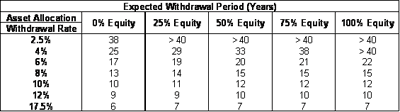
It is clear from the table above that the range varies dramatically. With high annual withdrawal rates our money is expected to last only 6 or 7 years, but for lower withdrawal rates our money is expected to last for over 40 years well past the expected lifespan for a person retiring at age 65. Note also, that generally speaking, the higher the equity allocation the longer our money is expected to last. This is not as pronounced at very high withdrawal rates, as the compounding effects of the higher returns that equities offer do not have time to benefit investors.
However, it is not sufficient to know how many years our money is likely to last. More importantly, we must consider the likelihood of not running out of money during our lives. As females tend to live longer than males we calculate these probabilities for both sexes.
The following tables give probabilities of not running out of money for males and females, who retire at age 65.
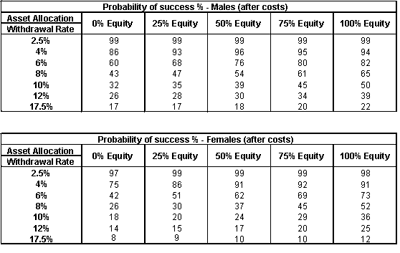
From the tables above, we note that the range of probabilities of success (i.e. not running out of money during our lifetime) is very broad (8% -99%). The chance of success is higher for males than females; is higher as the withdrawal rate decreases; and lastly, is higher if the equity allocation is increased. Furthermore, neither very high nor very low withdrawal rates are optimal for any asset allocation because the retiree is likely to either run out of money or unintentionally leave behind too much.
You may be surprised to note that there are, in many instances, quite low probabilities of success. It would seem, therefore, that a withdrawal rate in the region of 4-6% per annum (perhaps 8% for males), and having a reasonable portion (50-75%) invested in equities would ensure a fair chance of not running out of money.
Besides finding the success rates for different withdrawal strategies, another objective of this study was to show the effect of expenses on success rates. Our results show that if expenses are not deducted from the investment, the probabilities of success increase by 13%, on average. This highlights the importance of understanding the costs of advice and investment management.
In summary, although equities are risky in the short run, their long run outperformance makes them an essential component of every investment portfolio. Ultimately, we have to balance our needs for income against the sustainability of our investment portfolio and our desired estate at death. All decisions, whether relating to withdrawals, asset allocation or choice of service provider should be made after receiving expert advice.
Notes:
1. Equity returns of Inflation + 7.5% (17% volatility). Bond returns of Inflation + 2.5% (7% volatility)
2. Costs of 2.5% per annum in total
3. With a two-thirds probability of being correct
4. We make no assumptions about individuals tax rates although it must be noted that the withdrawal rates are therefore pre-tax and the actual disposable portion of each withdrawal would be reduced by the tax rate applicable to the individual.
5. Males are expected to live for 16 years from age 65 and females for 21 years.

