

90% of Africans Face Retirement Crisis as Climate Change Threatens Pension Sustainability
Industry leaders unite at conference to address continental financial security emergency
A staggering 90% of Africans lack adequate retirement coverage, creating a continental financial security crisis that experts warn could devastate millions of families as climate change increasingly threatens pension fund sustainability.
The alarming statistic emerged from a high-level panel discussion at the Institute of Retirement Funds Association (IRFA) annual conference, where leading retirement industry experts called for urgent cross-border collaboration to address what they described as one of Africa's most pressing socio-economic challenges.
"We're facing a perfect storm," said Amanda Khoza from the IRFA, citing the recent drought's impact on Lake Kariba as an example of how climate change is creating "socio-economic turmoil" affecting pension sustainability across Zambia, Zimbabwe, and the broader region.
While South Africa shows what's possible with 70% of employed workers covered by retirement funds, the vast majority of the continent's workforce - particularly in the informal sector -remains financially vulnerable in their old age.
Rwanda Shows the Way Forward
Despite the grim statistics, innovative solutions are emerging across the continent. Rwanda's digitised micro-pension system has achieved remarkable success, demonstrating how technology can extend retirement coverage to previously excluded populations.
"The positive impact of both digitization and micro pensions implemented in neighbouring states, notably Rwanda, shows us concrete pathways forward," said Zareena Camroodien from the African Pension Supervisory Authority (APSA).
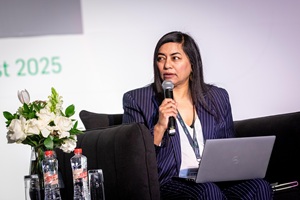
Zareena Camroodien
The panel, featuring experts from the UN Principles for Responsible Investment (UN PRI), APSA, and IRFA, identified several transformative strategies to address the crisis:
Environmental, Social, and Governance (ESG) Integration: Pension funds are being urged to embed ESG principles into investment strategies to build resilience against climate-related risks while generating sustainable returns.
Cross-Border Collaboration: Regional harmonization of pension systems and knowledge sharing could dramatically expand coverage and improve efficiency across African markets.
Technology and Innovation: Digital platforms and micropension systems offer scalable solutions for reaching informal sector workers who have traditionally been excluded from retirement savings.
Enhanced Governance and Education: Strengthening fund governance while boosting financial literacy among both trustees and members is seen as fundamental to building trust and engagement.
From Crisis to Opportunity
Tendai Matika from UN supported Principles for Responsible Investment (PRI) emphasised that Africa's infrastructure gap and unemployment challenges, while daunting, present opportunities for pension funds to invest in development projects that generate both returns and social impact.
"The imperative to include ESG principles into impact and infrastructure investment by retirement funds themselves presents opportunities for redress to these challenges," the panel concluded.
Nancy Andrews from the IRFA stressed that funds must view governance as more than mere compliance, advocating for member education around industry reforms and sustainable investment practices.
The experts agreed that member engagement has evolved from optional to strategic, with new and innovative approaches needed to maintain dialogue and boost financial literacy across the membership base.
Urgent Call for Collective Action
The panel's consensus was clear: addressing Africa's retirement crisis requires moving beyond operational and continental silos toward integrated policies, systems, and processes.
"Collective action is required by the industry," the experts emphasised, calling for the retirement sector to become "responsible, resilient and relevant to their members."
Key solutions identified include scenario planning, stress testing, capacity building across all stakeholder groups, and the development of generic toolkits for both trustees and members.
The IRFA 2025 conference, held in Cape Town this week, brought together stakeholders under the theme "Building Resilience: Leading Change for Lasting and Positive Impact."
As climate change continues to impact African economies and demographics shift toward longer life expectancy, the urgency for coordinated action has never been greater. The panel's message was unambiguous: the time for transformative change in Africa's retirement sector is now.

Geraldine Fowler

