

Bryte SA crime tracker: July to September 2018
• Significant spike noted in Q3 2018 crime levels
• Considerable decrease in incidents of hijacking noted in Q3 2018
• Q3 2018 marked the lowest levels of malicious damage since 2016
Bryte Insurance, a proactive business risk specialist, today released its Q3 2018 Crime Tracker; an indicator of long-term crime trends in South Africa as captured by insurance claims for the period July to September 2018. The Q3 2018 Bryte Crime Tracker measures the year-on-year change, on a quarterly basis, in crime-related claims (due to hijacking, robbery, theft and malicious damage) committed against South African businesses.
Bryte Crime Tracker: July to September 2018
Graph 1: Change in Crime-Related Claims Trends

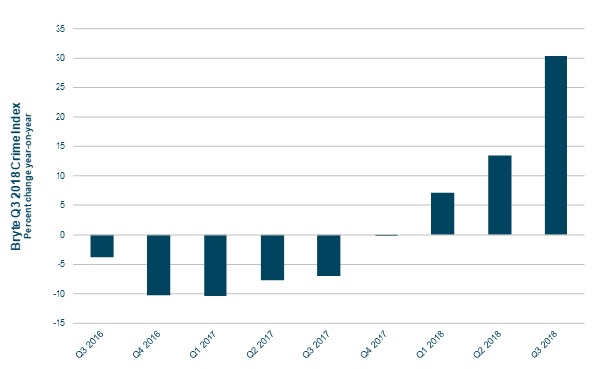
The Bryte Crime Tracker indicates a substantial peak in the total incidents of crime perpetrated against businesses in Q3 2018, noting a sharp acceleration of 30.3% year-on-year, following a 13.5% acceleration in Q2 2018.
The number of claims registered show that crimes perpetrated against businesses have increased consistently since Q1 2018. Stagnant economic growth coupled with a rising unemployment rate and the increased cost of living continue to be likely contributors to this disturbing trend. What’s more, at 27.5%1, unemployment reached even higher levels in the third quarter of 2018, with unemployment levels for youth aged 15-24 at a staggering 52.8%2 during the same period.
“Incidents of crime tend to spike ahead of school breaks as people go on holiday and unoccupied buildings are often left vulnerable to attacks by criminals. Business owners need to exercise more caution when making information about their whereabouts publicly available on social media platforms, as oversharing could leave them and their businesses exposed,” said Cloud Saungweme, Chief Claims Officer at Bryte.
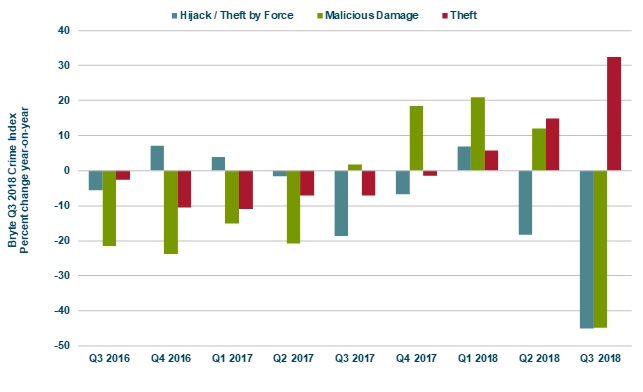
Graph 2: Contact Crime, Malicious Damage and Theft

Hijack/Theft by Force (Contact Crime)
A drastic decline in incidents of hijacking/theft by force was noted in Q3 2018, with a deceleration of 45% year-on-year. This marks the biggest year-on-year contraction since Q3 2016.
A possible contributor to the decrease in incidents of contact crime could be the enhanced efforts by law enforcement. In June 2018, Police Minister, Bheki Cele, announced the introduction of a high-density stabilisation intervention to combat incidents of serious and violent crimes. The deployment of strategic SAPS resources to enhance police visibility at various crime hotspots across the country may be paying dividends.
“We will ensure high-density visibility of uniformed police officers on foot and vehicles, supported by the SAPS air wing, continuous cordon and search operations, continuous roadblocks and relentless search for wanted suspects3,” the Minister explained.
“The sizeable decline in incidents of hijacking can be attributed to the government’s efforts to reduce crime in identified hotspots across the country. However, to sustain the effectiveness of these efforts, we must continue to work together. Access to intelligence remains a key challenge as members of communities often refrain from disclosing information about crime incidents in fear of becoming targets. Assurance that confidentiality and anonymity will be maintained may encourage greater participation in reporting crimes and restore confidence in the criminal justice system.
Information sharing with other relevant bodies such as local Community Watch Forums, can also be an effective way to reduce incidents of crime in communities. Alerting peers within the business community of suspicious activity is one way of actively participating in the fight against crime,” explained Saungweme.
Business owners must adopt a multifaceted approach to safeguarding their businesses. Proactive solutions include conducting regular risk assessments to identify exposures and putting measures in place to mitigate against these, reducing the amount of merchandise on hand, removing large amounts of money from business premises and installing a variety of security mechanisms in and around the business.
Malicious Damage
Incidents of malicious damage decreased considerably in Q3 2018 – where a contraction of 44.9% year-on-year is noted. This is in contrast to the 1.8% acceleration noted during the same period last year.
Theft
Levels of theft spiked in Q3 2018, accelerating by 32.5% year-on-year. This is in stark contrast to the decelerations noted during the same periods in Q3 2016 at 2.5%, and Q3 2017 at 7%.
Q3 2018 was a tough quarter from an economic perspective as South Africans grappled with the effects of the H1 2018 technical recession. Continued strain on the manufacturing, mining and construction sectors resulted in the loss of 16,0004 jobs.
“Job losses can aggravate crime levels, especially petty theft, as people desperately seek alternative means of survival. However, it is important to note that not all theft is visible. We have seen many incidents of cybercrime unfold in 2018 and predictions have been made that, globally, cybercrime will cost businesses approximately $2 trillion5 in 2019 alone,” Saungweme continued.
What makes this particular crime unique and extremely complex is that it has no geographical bounds – cybercrime can be executed from anywhere in the world, at any time and everyone is susceptible to exposure. There is no doubt that this will become a key focus area for risk specialists across the globe.
“Business owners are encouraged to take necessary precautions to effectively safeguard their businesses. For example, when performing business financial transactions online, ensure that you are connected to a trusted network. Refrain from making electronic transfers over an untrusted wi-fi connection in a public domain. We need to stay abreast of key cyber developments and design insurance solutions that are agile and protect our customers effectively in this rapidly changing risk environment,” concluded Saungweme.
Sources:
1 EWN
2 Fin24
3 Arrive Alive
4 BusinessLIVE
5 IT News Africa

