

What went wrong with risk assessment?
01 October 2013 | Magazine Archives FAnews & FAnuus | Short Term | Marcel Wood, Etana Insurance
Risk assessment within the insurance industry is falling short of achieving its goals of adequate risk minimisation or alleviation which should be expected due to a variety of reasons.
These include, among others: the focus of regulation which is aimed at life safety rather than property protection. This is combined with the high likelihood that we, as insurers, have unconsciously created a mind-set of inappropriate risk appetite over the past years. This is based largely on the positive results from a period of time (see graph below) where premiums outperformed claims.
However, this scenario where premiums exceeded claims changed dramatically in the late 1990s when the situation reversed and claims started to overtake premiums. The graph below depicts the South African Insurance Association’s findings following an investigation related to this.
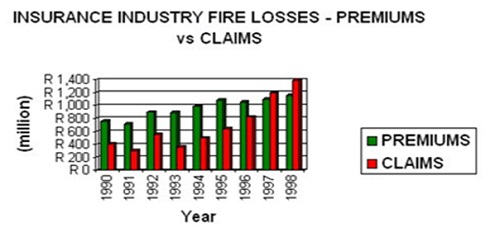
What caused this turnaround?
What were the reasons for the positive premiums to claims ratios of the past? Why has it changed since the late 1990’s? Here’s an overview of what worked then and what challenges are faced currently which are important for intermediaries to understand so they can properly advise their clients.
• Building Regulations are primarily focused on life safety so asset & property protection (which insurers have a vested interest in) are lacking. These regulations also form the base criteria of risk assessment within the insurance industry.
• Fire departments that are responsible for the proper design of buildings, responding and fighting fires and carrying out inspections on buildings, were professional at the time. In other words:
o They were more dedicated and insistent on making sure buildings complied completely with good designs.
o They were well trained.
o They aggressively fought fires and mitigated insurance losses in this way
o This is no longer the case with newspapers filled with horror stories of inadequate fire responses where buildings burn to the ground. Even where fire department personnel are dispatched, poor equipment, poor training, inadequate budgets, don’t deliver what is needed.
• Infrastructure was not aged in the early 1990s. This ageing infrastructure is now being combined with poor replacement programs, insufficient maintenance, and failures occur more regularly.
• There was not a huge middle class requiring sophisticated services which includes emergency services, electricity, water, and others. The huge growth on demand places a strain on these services as these have not been sufficiently upgraded to meet demand.
The growth in demand has the following results:
• Water pressures are affected which ultimately affects the insured sector and results in clients not being able to comply to the minimum requirements of fire protection, or, have to achieve this at a huge cost.
• Insufficient, and stolen, electricity to meet the demand which results in power cuts, power surges when the systems come back on, unreliable reticulation. This has a significant impact on insurance claims.
• The external environment, driven by climate change and weather related issues, was not problematic during the 1990s, but they are now. 2011 is regarded as the worst year worldwide with regard to natural peril losses for the insurance industry.
• Theft and crime was not as problematic in the 1990s, but it certainly is now and that impacts greatly on the insurance sector.
• Rational designs, alternate fire design for buildings, were not popular in the early 1990s. They are now and I believe it is no coincidence that fires started costing South Africa more in fire losses when those rational designs started becoming popular.
Shift the Paradigm
Current insurance risk mitigation has not kept pace with these changes. The insurance industry needs to move away from carrying out risk assessment based chiefly on the Building Regulations (as these do not sufficiently promote asset & property protection). We need to move towards an individualised risk based approach of risk assessment. This will go a long way in achieving satisfactory risk mitigation for the insurance industry.
(More on this topic from Marcel in our November issue.- Ed)

