

When fear grips the market
Many investors believe that the two emotions mostly responsible for market movements are fear and greed.
In partial agreement, I believe that fear itself is the greatest cause of the two in causing movements in the stock market. The behavioural biases of individuals show that it is the fear of losing out that drives investors to enter at the top of the bull market, and exit at the bottom of bear markets for the fear of further losses.
The English dictionary defines fear as an unpleasant, often strong, emotion caused by the awareness of danger. It involves anxiety and the loss of courage.
We live in a world crippled by fear. The issue regarding chemical weapons in Syria, the current tension in the Ukraine, as well as concerns of the growth outlook in China are all factors stirring unease and causing volatility in global financial markets.
The purpose of my article is not to inflict more fear, but to create awareness of the behaviour of investors during fearful times.
The influence of fear
Fear tends to push the sentiment of investors far below fair market value. This fear factor leads markets to often move much faster than required in a downturn. As mentioned previously, this fear arises from being afraid of holding on to a loser for too long.
Sandeep Bhanote, an investor and software engineer, says that fear is the most dangerous emotion. It can really do the market a lot of harm when it is not really necessary to be afraid.
To support the notion, I refer to a study conducted on how adverse events, on average, have affected the global markets:
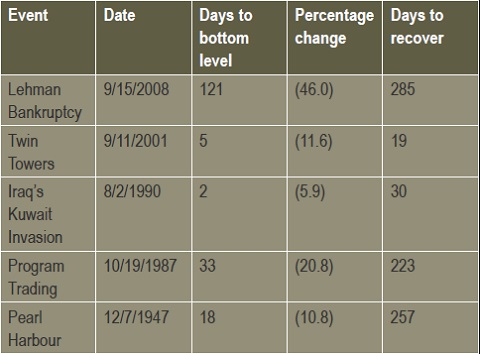
This study illustrates that, in most cases, the markets reached the bottom of the downturn significantly faster than the amount of time it took to recover back to the initial market level on the day before the respective events occurred.
“We are not dealing with a fundamental economic issue any longer” said James Paulsen, Chief Investment Strategist for Well Capital Management. “We are dealing with fear. And that does not respond to economic medicine.”
How to use fear for successful investing
According to Frank Collar1, all traders and investors experience a degree of fear at some time. What is important is how they address it. Comprehension of the definition and reason for the fear, can aid in overcoming it. Successful investors are not controlled by their fear. Instead, they manage it.
It is important to understand your investment. Knowing your investment’s fundamental ability to generate future earnings is useful to know when fear drives sentiment far below intrinsic value.
For someone pursuing long-term investment strategies, fear in investment sentiment is your friend - just don’t get caught up in the emotions over the short term.2
However, take caution to not mistake managing your fear for being stubborn. You need to constantly re-evaluate your investment strategy and remain rational in your decision making.
Managing fear by maintaining a long-term strategy is crucial for successful investing. Do not blindly follow market sentiment. However, not wavering from an investment strategy during times of fear in the market can also be catastrophic. Therein lies the challenge to the investor, to strive for the perfect balance.

