

Financial advisers are making ETFs popular
01 November 2013 | Magazine Archives FAnews & FAnuus | Investments | Lance Solms, Itransact
Exchange Traded Products (ETPs) is the term that collectively describes all index related products, such as Exchange Traded Funds (ETFs) and Exchange Traded Notes (ETNs). ETFs are simply unit trusts which are listed on a stock exchange, as opposed to ETNs, which are debit instruments (notes), also listed on a stock exchange.
The key difference between the two is that the assets in an ETF are held in a trust, protecting them from creditors, whereas the assets in an ETN are not protected, and an investor accepts the risk rating of the issuing bank.
South African awakening
Exchange Traded Products (ETPs) are increasing in popularity in South Africa simply because financial advisers and investors are becoming more familiar with the investment benefits that these products offer.
ETFs were launched in South Africa in 2000 and have accumulated approximately R50bn in 13 years. This may seem a bit slow, but consider that unit trusts were launched in 1960 and took almost 30 years to reach R30bn. It was only after 1990 that unit trusts increased
rapidly to the current R1tn mark, mainly due to the fact that infrastructure such as platforms, advisers and asset management companies were adequately set up to support unit trusts.
It makes sense that the ETP industry will follow suit since the necessary infrastructure is now in place. Itransact has played a significant role in the growth of ETPs. For example, it launched SA’s first ETF retirement annuity in May 2013 and has been encouraged by the take
up of the product by financial advisers and their clients. Even more encouraging is to see how financial advisers are introducing passive investments into their clients’ predominantly active portfolios resulting in significant cost savings, and potentially better returns, for investors.
Investor driven success
Itransact believes that the ordinary investor will drive ETPs to the same success levels as unit trusts, as they realise more and more that fees and costs are the most significant factors that reduce returns.
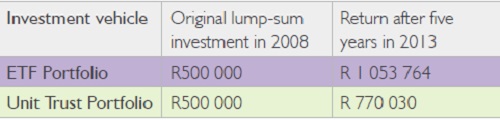
Research has demonstrated that investments, that use ETFs in a portfolio of diverse assets such as cash, bonds, property and equities, offer investors better investment returns. Consider the table below that measures what the difference would have been between a
R500 000 investment over five years made into a typical multi-asset class ETF portfolio as opposed to a typical multi-asset class unit trust portfolio, both of which have the exact same asset allocation.
The key reason for the ETF portfolio doing better is due to the fact that the average cost of the ETF portfolio was 0.52%, as opposed to the unit trust portfolio of almost 1.92%. That is a cost difference of 1.4% and a return difference of R283 734.
Source: Profile Media June 2013
Key benefits of the Itransact retirement annuity
• Affordable: you can invest by debit order for as little as R450 per month or with a once-off R5 000.
• Tax efficient: there is no income tax, capital gains tax or dividend-withholding tax to eat into your retirement savings.
• No penalties: you can stop or start your premiums when it suits you.
• Transparent costs: there is no layering of administration costs or hidden fees to undermine your retirement income.
• Forced saving: you cannot access your savings before you are 55.
• No complexity: you invest in simple, low-cost, risk-appropriate Exchange Traded Fund (ETF) portfolios.
• Strict governance: regulation 28 of the Pension Funds Act ensures that all retirement funds are properly diversified across and within appropriate asset classes to reduce investment risk.

