

No emoji beats face time
Conventional wisdom tells us that face to face communication is more effective than other types of communication such as telephone or email.
No smiley face can replace the warmth conveyed by the smiling eyes of a loved one; no cartoon red face can show the genuine embarrassment we show when we blush, no amount of LOLs can tell us when someone is having a belly laughter with tears in his eyes.
It’s about the reach
Vanessa K. Bohns, an Assistant Professor of Organisational Behaviour at the ILR School at Cornell University and author of ‘A Face-to-Face Request Is 34 Times More Successful than an Email’ says, “You could send an email to 200 of your friends, family members, and acquaintances. Or you could ask a few of the people you encounter in a typical day—face-to-face—to donate to a cause you care about. Which method would mobilise more people for your cause?”
“Despite the reach of email, asking in person is the significantly more effective approach; you need to ask six people in person to equal the power of a 200-recipient email blast. Still, most people tend to think the email ask will be more effective,” continues Bohns.
The argument in favour of face time is that telephone or email communication lacks important nonverbal cues to help us understand the message.
The power of persuasiveness
In research Mahdi Roghanizad of Western University and Bohns conducted, 45 participants asked 450 strangers (10 strangers each) to complete a brief survey. All participants made the exact same request following the exact same script; however, half of the participants made their requests over email, while the other half asked face-to-face.
People were much more likely to agree to complete a survey when they were asked in-person as opposed to over email. These findings are consistent with previous research showing that people are more likely to comply with requests in person than over email.
Participants who made requests over email felt essentially just as confident about the effectiveness of their requests as those who made their requests face-to-face, even though face-to-face requests were 34 times more effective than emailed ones.
“Why do people think of email as being equally effective when it is clearly not? In our studies, participants were highly attuned to their own trustworthiness and the legitimacy of the action they were asking others to take when they sent their emails. Anchored on this information, they failed to anticipate what the recipients of their emails were likely to see: an untrustworthy email asking them to click on a suspicious link,” said Bohns.
“Indeed, when we replicated our results in a second study we found the nonverbal cues requesters conveyed during a face-to-face interaction made all the difference in how people viewed the legitimacy of their requests, but requesters were oblivious to this fact,” continued Bohns.
A shift in communication
According to Paul Booth, PhD, an assistant professor of media and cinema studies in the College of Communication at DePaul University in Chicago, “There has been a shift in the way we communicate; rather than face-to-face interaction, we tend to prefer mediated communication. We would rather e-mail than meet; we would rather text than talk on the phone.”
Awash in technology, anyone can hide behind the text, the email, the Facebook post or the tweet, projecting any image they want and creating an illusion of their choosing. They can be whoever they want to be. And without the ability to receive nonverbal cues, their audiences are none the wiser, says Susan Tardanico, Forbes Contributor and author of ‘Is Social Media Sabotaging Real Communication?’
“This presents an unprecedented paradox. With all the powerful social technologies at our fingertips, we are more connected - and potentially more disconnected - than ever before. Every relevant metric shows that we are interacting at breakneck speed and frequency through social media. But are we really communicating? With 93% of our communication context stripped away, we are now attempting to forge relationships and make decisions based on phrases. Abbreviations. Snippets. Emoticons. Which may or may not be accurate representations of the truth,” continued Tardanico.
“In the workplace, the use of electronic communication has overtaken face-to-face and voice-to-voice communication by a wide margin. This major shift has been driven by two major forces: the speed/geographic dispersion of business, and the lack of comfort with traditional interpersonal communication among a growing segment of our employee population: Gen Y and Millennials. Studies show that these generations – which will comprise more than 50% of the workforce by 2020 – would prefer to use instant messaging or other social media than stop by an office and talk with someone,” said Tardanico.
When looking at the graph, published by Lori Lewis, Vice President of Social Media at Cumulus Media on LinkedIn, it is evident that social media is taking the world by storm and it is an effective tool in promoting businesses through networks such as Twitter, Facebook and LinkedIn to reach consumers.
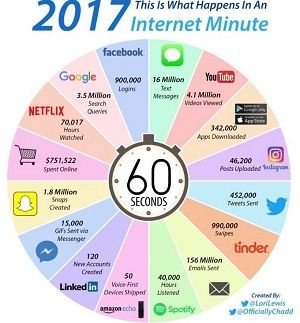
There is no doubt that social media’s effect on our ability to interact and communicate is visible throughout all areas of society, so what does this mean for interpersonal communication?
Media’s effect on our ability to interact
“Glance around a restaurant and you’ll be hard-pressed to find people have their heads down using their cell phones to text, Tweet, or update their Facebook statuses—all while sharing a meal with others at their table,” continued Booth.
According to Booth, studies have shown that people actually are becoming more social and more interactive with others, but the style of that communication has changed so that we’re not meeting face-to-face as often as we used to.
“That said, our interactions on social media tend to be weak ties—that is, we don’t feel as personally connected to the people at the other end of our communication as we do when we are face-to-face. So while we are communicating more, we may not necessarily be building relationships as strongly,” Booth says.
Three key issues are surfacing regarding the role social media now plays in people’s communication styles, Booth notes. First, when we communicate through social media, we tend to trust the people on the other end of the communication, so our messages tend to be more open. Second, our social connections are not strengthened as much through social media as they are face-to-face, so we don’t tend to deepen our relationships—they tend to exist in the status quo. Last, we tend to follow and interact with people who agree with our points of view, so we aren’t getting the same diversity of viewpoints as we’ve gotten in the past.
So what’s missing?
But when we communicate online, whether it's on Facebook or through email, or when we tweet or text, what's missing? What specific elements do we miss out on when we trade face-to-face communication for connecting through our computer or phone?
It may seem obvious to some, but we tend to forget about the importance of body language, voice inflection, and the simple act of looking someone in the eye during a conversation.
Our facial expression, physical gestures, and the emotional tone in our voice alter the meaning of our words, which is why it is very difficult to express ourselves fully and authentically in an email or text-or even in front of a Skype screen. So what's missing are the feelings that inform the words.
How to reconnect words to feelings? Fewer texts, less Facebook, and more face time. Face to face communication still remains the best and most complete way of getting our message across.

