

Dynamic asset allocation strategies reduce downside risk
01 June 2012 | Magazine Archives FAnews & FAnuus | Features / Profiles | FAnews
One of the consequences of the stock market collapse of 2008 is a proliferation of investment products to manage downside risk. Today’s financial advisors have more options to protect their clients’ investment than ever before. FAnews spoke to Verusha Ramlakhan, product manager at Glacier by Sanlam, to find out more about the Glacier P² strategies.
FA NEWS: How would you define Glacier P² strategies? And how does the solution work to the advantage of the investor?
Verusha: Glacier P² strategies are based on dynamic asset allocation methods. The strategy is overlaid on existing unit trust funds within certain investment products, such as Glacier’s Retirement Annuities, Provident funds and Living Annuities.
Selected unit trust funds with Glacier P² strategies are combined with a Trade Account, which holds investments in money market instruments. The proportion of assets held in unit trust funds and the Trade Account will fluctuate in line with market movements, as well as the value of the investment relative to the preservation target amount.
Clients can select to overlay these strategies on their entire investment, or only certain funds within their investment. They can further select which of the four preservation options best suits their risk profile. P² Strategies are built around each investor’s preservation target and strategy starting date. In a nutshell: Clients investing in the same fund but with different targets and/or starting dates will have individualised and dynamic investment strategies.
FA NEWS: The Glacier P² strategies manage downside risk by increasing risk-free exposure during periods of poor equity market performances. How effective is this strategy? Do you have any "back tested” data to show, for example, how an investment would have fared during the 2008 market collapse?
Verusha: We have a tool – which is available to intermediaries – that allows us to model the returns achieved by specific funds over custom periods, with or without the Glacier P² strategy overlay. The following shows the returns generated by the SIM General Equity fund, with a 10% target option, for the period 5 May 2008 to 3 June 2010.
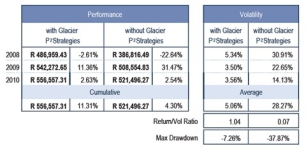
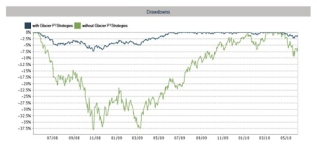
The overall return generated by the Glacier P² strategy overlay is a combination of the returns on the money market instruments in the Trade Account and the return on the unit trust fund. During a bear market, such as that experienced in 2008, the cumulative return with Glacier P² strategies is significantly higher. The investment with the strategy overlay returned 11.31%, versus just 4.30% without.
As with most investment strategies the results vary with investor choice, investment time frames, market performance and market volatility. If we consider the period 1 Jan 2011 to 31 March 2012 – a period during which the market went largely sideways – the difference in return between like-for-like investments with a Glacier P² strategy overlay, and without, is much smaller. The cumulative return on the investment with the strategy was 9.55%, versus 10.18% without.
FA NEWS: One of the positive features of the Glacier P² strategies is stated as: "You can better optimise your investment in growth assets.” It seems there is a contradiction between the investor’s "power to choose growth assets” and the strategy’s "responsibility to switch out of growth and into risk-free assets.” Could you briefly respond to this?
Verusha: We find that clients have an aversion to investing in riskier assets (equities for example) because of the volatility inherent in these markets. Instead of investing in the SIM General Equity fund, they invest in the SIM Value or SIM Balanced funds. A consequence of this conservative decision is lower returns.
The Glacier P² strategy allows investors to commit more capital to aggressive funds, safe in the knowledge it will determine when it is optimal to switch out into risk free assets. By using a model to make these decisions the strategy strips out the human emotion which leads to knee-jerk and ill-considered investor behaviour during periods of market volatility.
FA NEWS: Who should invest in Glacier P² strategies? And how should financial advisors go about marketing the solution?
Verusha: The strategy overlay is suitable for a number of your clients. It is ideal for clients who need more equity exposure but are unable to take the risk of a sudden market downturn. And the smoothing of returns over time makes it useful for clients who need to draw income. Others who might benefit from the strategy include those who are considering reducing their equity exposure by locking in capital gain, and those seeking long-term capital growth without the shocks.
The product is not only for older clients. Statistics show that 45% of retirement annuity investors in the 35 to 45-year age group have less than half of their capital invested in growth assets. These clients have many years until retirement and should have higher exposure to growth assets.
Financial advisors should re-visit clients with conservative to moderate portfolios to assess whether Glacier P² strategies can increase their exposure to growth assets without increasing risk.

