

Why investors yield to Australia’s bond market

Andrew Canobi, director, Australian Fixed Income, Templeton Investments Australia Limited.
At its meeting earlier this month, the Reserve Bank of Australia (RBA) decided to keep its benchmark lending rate at an all-time low of 2% for the 10th consecutive time. As the year progresses, we believe the RBA could likely reach or break its record of 17 monthly meetings in a row without a rate change. (The record was set in 1995-1996, when the benchmark cash rate stood at 7.50%.) We believe the RBA doesn’t feel the need to act on its easing bias because the Australian economy remains reasonably healthy, albeit at a pace of growth that is at the lower end of what policymakers would like to see.
That said, we acknowledge there are downside risks to the Australian economy that could eventually lead the central bank to lower interest rates—something the RBA has also opined. These threats include increasing spillover effects from a softer Chinese economy, and potentially weaker inflation and employment at home. At the moment, however, we consider these issues risks rather than expected outcomes.
The RBA may eventually decide to lower rates to tamp down the value of the Australian dollar. The RBA may feel an appreciating currency impedes the country’s international competitiveness, particularly since Australia is in the process of transitioning from a commodity-dependent economy to one more reliant on the services sector, including tourism, education and financials. However, the RBA is currently unlikely to regard the recent rise in the dollar as inconsistent with its objectives.
Relatively high yields
The health of Australia’s domestic economy, along with RBA policy, has determined the direction of the country’s government bond yields. By Australian standards, government bond yields are extremely low at the moment. Compare, for example, today’s 2.41% yield on a 10-year government bond to a yield of more than 4% offered at the end of 2014.
The current 2.41% yield, however, looks quite attractive when stacked against many other developed countries’ 10-year government bonds, as you can see in the chart below. Extremely accommodative monetary policy has driven 10-year yields down to 0.10% in the eurozone and -0.09% in Japan.1 And in the United States, where the US Federal Reserve is still abiding by what we feel to be excessively accommodative policy given the country’s generally positive economic circumstances, the 10-year Treasury yield stands at 1.72%. Relatively higher yields have lured bond buyers to the Australian market, but we believe it’s important to remember that the Australian dollar historically has been a fairly volatile currency, and global investors have understandably looked for a premium to compensate them for this risk. These forces have conspired to keep the Australian bond market at the higher end of valuations relative to what we think long-term value should be. If the global search for yield continues to lead investors to Australia, the country’s bonds could remain somewhat expensive.
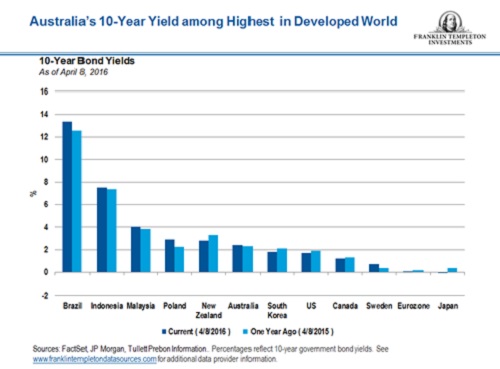
We believe global yields will likely move higher, and are not persuaded by arguments that yields will stay at these very low levels, or even lower, for any sustained period. We acknowledge that yields may not move as high as they may have in previous cycles, but we think global economic risks are more skewed towards a move higher than lower in the near term.
Seeking value
Opportunities can still be found even in the current low-yield environment. We believe high-quality corporate bonds still offer good value, particularly in utilities, high-quality commercial real estate and some segments of the banking sector, which we consider to be strong defensive sectors that offer compelling yields.
We also are looking at the attractiveness of some government bond yields in a relative sense to other government bond yields. Rather than just buying government bonds as a long-only strategy, we are looking at the relative difference between markets. We believe this is still a compelling opportunity, particularly in an environment where there is global divergence in monetary policies.
In our view, strategies that track an index may face considerable challenges in the period ahead. With interest rates at very low levels, and with the sensitivity of interest rates—what we call duration2—being at near-record high levels, there are risks to those strategies. If we move to a period where interest rates are moving higher, passive investors and those bond funds taking a more benchmark aware investment approach could incur significant capital losses; however, there are different ways of investing in bonds. Taking an absolute return approach to investing means we favor being very highly selective in the choice of securities. We also believe managing interest-rate risk is important and we focus carefully on yield securities that we believe can offer appropriate potential returns for the risk incurred.

