

Where to invest in uncertain times - why offshore diversification can be good

Chantal Marx, head of research support at Ashburton Investments.
Globalisation and the information age have made the world a much more fluid arena from an investment perspective. And with political uncertainty diminishing the certainty of good returns on the back of synchronised global growth, the case for geographic diversification has seldom been stronger. Country specific risks are reflected in all asset prices and the only way to reduce the risks rooted in any one market is to look elsewhere.
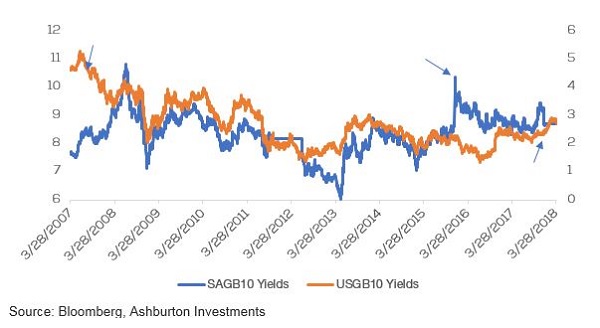
Investors will diversify to reduce the overall risk of their portfolio losing value. Because good diversifiers generally have weak, negative, or no relationship with other asset classes they may maintain or even increase in value when another asset class in the portfolio loses value or delivers low returns. Often when country risk spikes, asset prices elsewhere may not react or could even move in the opposite direction. For example, during the global financial crisis (GFC), South African bond yields spiked, while US bond yields trended lower. The same happened during Nene-gate, and more recently, the opposite happened as political changes locally resulted in a return in investor confidence while concerns over the United States trade policy and fiscal stability has seen bond yields creep persistently upward following President Donald Trump’s election to office.
Country specific risks are reflected in all asset prices and the only way to reduce the risks rooted in any one market is to look elsewhere.
SA generic 10-year bond yield versus US generic 10-year bond yield
For emerging market investors, the best home for offshore allocation will be developed markets and the opposite is true for developed market investors. For simplicity’s sake, we consider offshore diversification from the perspective of a South African (SA) and United Kingdom (UK) investor point of view.
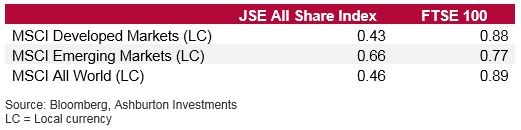
For the South African (SA) equity investor, the diversification benefit generally is very clear and from the correlation table below, the most benefit from a risk reduction perspective will be to invest in developed markets. For the UK investor, the diversification benefit will be much less but it will still be more worthwhile to diversify into emerging market equities than to stick to developed market exposure.
Correlations with selected MSCI Indices (total returns)
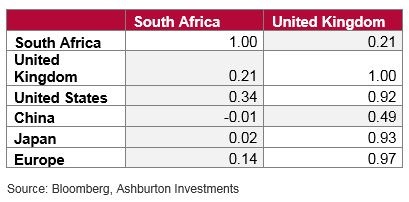
For fixed income investors, especially in the UK, there will be significant risk benefit to diversifying outside of developed markets. South African investors could also enjoy some diversification benefit from investing outside its borders, although the opportunity cost here is more significant. With the local cash yield markedly above developed market bond yields, this move will not necessarily make sense.
Selected country bond yield correlations
Risks of offshore diversification
Investing outside of one’s home market while providing protection from local asset price pressure invariably introduces a further risk – currency risk. The argument can be made, however, that currency risk is already embedded in most portfolios since it is often linked to bond prices and heavy weight equity names are mostly multinational operationally.
One must also consider the very real impact of contagion and synchronised global recession. If the GFC taught us anything, it is that the world is smaller and more interconnected than it has ever been and while it has made geographic diversification easier, it may have also left it less effective. But still, should an investor have only been exposed to the US during the crisis he or she would have been far worse off than having been exposed to more than one market.
Verdict : Is it worth the trouble?
Offshore diversification may not provide the best returns in any one year, but it has never provided the worst. And in the context of lowering risk, is vital in successfully executing a balanced mandate. With geopolitical risk rising, currency volatility in many emerging markets, and growth arguably peaking in developed markets there is still a case to be made for putting your eggs in as many baskets as possible.

