

When do I buy hard currency?
The decision to invest offshore is predominantly influenced by the search for superior returns in addition to stability against local and hard currency fluctuations and security of assets. The primary benefit of investing offshore is the diversification associated with investing in global asset classes.
The role of an investment portfolio is to reduce risk, which is particularly relevant when the assets out- or underperform at different points in the market cycle. But more than this, in offshore markets investors have access to markets and sectors which are either simply not available in South Africa or offer far more choice through which South African investors can access a world of growth opportunities.
It always makes sense for South Africans to invest a portion of their wealth offshore. This is tenfold so in the case of wealthy families. While ordinary South Africans tend to expatriate their money when pessimism about the country is at its peak, high net worth individuals (HNWIs) are in the fortunate position to do so as a conscious strategy rather than a knee-jerk reaction – thereby taking advantage of the benefits of diversification.
However, the preoccupation with the short-term volatility of the rand and the conversion rate in question when planning to invest abroad is prevalent among local investors, causing investors to sit on their hands while waiting for the “perfect” time to invest.
Traditionally, when the rand strengthened, global markets tended to correct at the same time, voiding the strong showing of the rand. So, while you waited for the rand to improve by 10% to send money offshore, the market may have gained 10%, resulting in zero gain. Investors would do better to phase in these investments over a set period to account for these currency fluctuations.
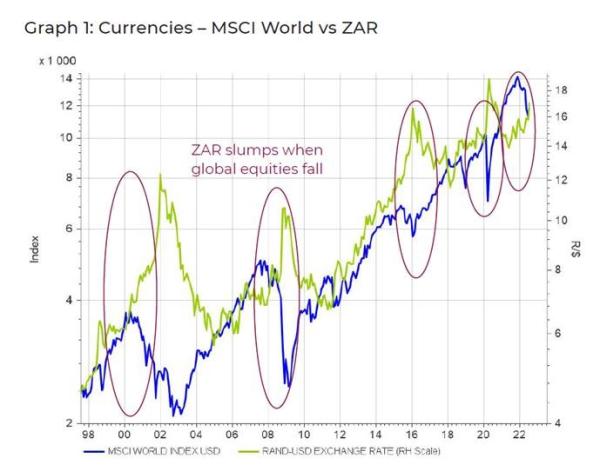
Sources: Refinitiv Datastream; Old Mutual Wealth
Over the 2020/2021 period of extreme global volatility, the rand retained relative strength to the US dollar as the South African economy is commodity driven, and there had been a flight to safety assets such as gold, which contributed to relative rand stability and strength. However, looking at the graph above, you will notice that the rand has currently reverted to type, as markets have begun to rise, and the rand has devalued.
It still holds that if you’re waiting for that “perfect” time for the rand to improve to send money offshore, keep in mind that markets are continually moving. Timing the rand remains a risky strategy. And more importantly, from the time that investors take the money offshore, investors need to value the investment in the currency in which they have invested. If they’ve chosen US dollars, growth needs to be measured in US dollars.
Having hard currency available in specific countries allows you to use it when travelling, financing children studying overseas, or in any situation when needing money abroad for immediate use. It also allows factoring out rand devaluation and hedging against local political instability in a country of residence or for emigration.


