

The Marriott Dividend Growth Fund – a local equity fund that should be a core holding in an investor’s portfolio
The objective of most general equity fund managers is to outperform the RSA All Share Index. Active investing in order to achieve this objective justifies higher fees than passive or index “tracking” funds. It is interesting to note that the majority of general equity funds have failed to deliver on this objective. As of the 31 August 2014 there were 112 general equity funds each with a 5 year track record; 81% failed to outperform the index. This is a poor statistic and suggests the promise of “outperformance” is a difficult endeavour with a very low probability of success.
The objective of the Marriott Dividend Growth Fund is not about outperforming the RSA All Share Index, but is rather to produce a reliable and growing dividend income stream for investors. The fund has successfully achieved this objective providing investors with growth in income of 8% in excess of inflation over the last decade. This is a unique characteristic of the fund and one of great practical value for living annuity investors.
Equities are typically included in a portfolio for capital growth but investors need to recognise that the real benefit of good equities is the growing dividend income. For example, R1m invested in the Marriott Dividend Growth Fund 10 years ago would have produced an income of R40 000 in the first year and R160 000 in the tenth year.
The chart below highlights the 10 year investment experience of an investor in the Marriott Dividend Growth Fund.
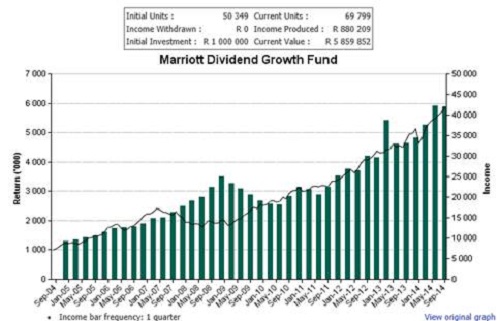
The fund’s ability to produce consistent and reliable income growth also ensures a predictable investment outcome. The value of a company grows over time at the rate at which its profits grow. In the same way, the value of an investment, over time, grows at the rate its dividends grow. Marriott only invests in companies that produce consistent and reliable dividends and is therefore able to provide investors with an accurate projection of their likely investment experience from both an income and capital perspective.
An accurate projection of a likely investment experience allows younger investors to set up a savings plan that will ensure the income from their investments will be enough to maintain their lifestyle in the latter years. This is another unique and practical benefit of the fund.
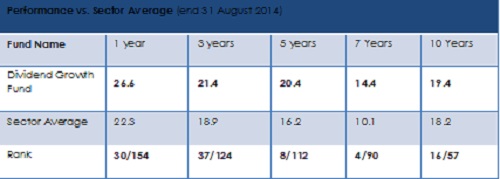
Although the fund is managed with an income focus, the fund’s track record from a purely capital growth perspective is exceptional. The table below compares the total return of the fund against the sector average for different time periods.
The fund’s outperformance is supported by research. A number of studies have shown that companies which pay and grow their dividends tend to outperform the market over the longer term. Possible explanations for why reliable dividend payers outperform include:
1. Reliable dividend growth typically indicates that a company has a dominant brand, a strong balance sheet and a high degree of confidence that its earnings and cash flows will continue to support future payments.
2. Over the long term dividend income contributes a large percentage to an investor’s total return.
3. Investors tend to overpay for exciting and high-risk companies, and underpay for more predictable investments.
In summary, the Marriott Dividend Growth Fund is unique and provides the following benefits; reliable growing income to reinvest or fund a lifestyle; meaningful investment planning, and above average returns. From an income perspective the fund has very few competitors and from a capital growth perspective the fund’s track record is hard to match. It is also worth noting that the fund’s 1% asset management fee is not considerably higher than the fees charged by certain index tracking portfolios.

