

The first cut is the deepest
It was a big week for South African investors, as the two most important central banks in their universe lowered policy interest rates. Of the two, the US Federal Reserve is the big gorilla, since its decisions can influence the South African Reserve Bank (SARB), but it is definitely not the case the other way round.
Moreover, almost all global investments price off the Fed’s policy interest rate directly or indirectly. Therefore, Fed decisions ricochet across the world, including to South African markets. Nonetheless, the SARB’s decisions also matter to local asset classes.
Front-loading
Let’s start with the US Fed, which announced a 50-basis points reduction in the fed funds rate on Wednesday evening. Going into the meeting, there was some uncertainty over the size of the move. The case for front-loading interest rate cuts makes sense in light of the recent weakening of the labour market. Given progress on the inflation side of the Fed’s dual mandate, it is prudent to shift focus to its other goal of maintaining full employment and taking a pre-emptive step to prevent the recent rise in unemployment from accelerating.
However, the risk with a bigger cut is that it is interpreted as a sign of panic. The Fed has traditionally only cut by more than 25 basis points at times of crisis, such as when Covid hit in 2020, and in the Global Financial Crisis in 2007 and 2008. Therefore, the messaging is important.
Fed chair Jerome Powell was at pains to argue that the Fed was not responding to a crisis or panicking, but rather that lower inflation afforded it room to make a bigger cut and forestall any further weaking of the labour market. Powell characterised the US economy as still being quite healthy and that he wants to keep it that way.
The plot thickens
Probably more important than the size of individual cuts is where rates ultimately settle. Every quarter, the forecasts of top Fed officials from across the country are collated anonymously in the so-called dot-plot. This is not cast in stone but gives an indication of how the collective wisdom in the central bank system sees economic and policy variables evolving.
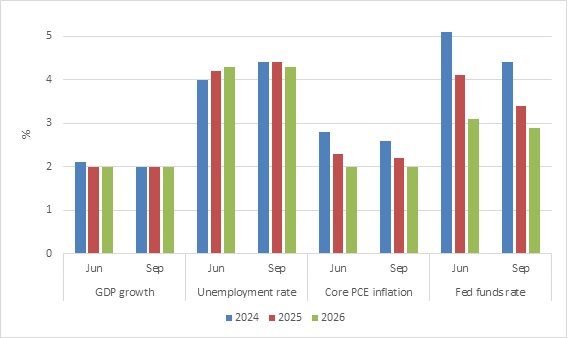
Whereas the June dot-plot only pointed to a single 25 basis point cut by year end, the latest version signals a further 50 basis points reduction on top of what was delivered last week (there are two meetings left this year). Rates are projected to fall towards 3.4% by end 2025 and 2.9% by end 2026. The dot-plot suggests that 2.9% is the “neutral” interest rate which theoretically allows the economy to operate on an even keel.
The projected end point for the cycle has not changed much since the previous version of the dot-plot, but the path to getting there has sped up.
Chart 1: Federal Reserve ‘dot-plot’ projections
Source: Federal Reserve Board of Governors
As chart 1 shows, the reason for this is concern over higher unemployment, now projected to hit 4.4%, but crucially, not increasing beyond that. Economic growth is expected to be around 2% over the medium term, which represents a downshift from a faster pace over the past year or so. Inflation is also declining somewhat faster than expected.
Any forecast is just a stake in the ground. Anything can still happen, and therefore central banks like to say they are “data dependent,” making policy based on what the numbers tell them. However, being too dependent on backward-looking data can obscure rather than illuminate the future, and lead to being behind rather than ahead of the curve. No one said this is easy.
In the end, investors need to ask themselves whether rates are falling for “good” or “bad” reasons. A good decline in interest rates would be a scenario where inflation is under control, growth is slower but not contracting, and unemployment still low – a soft landing, in other words. A bad decline would be if the Fed was to slash interest rates as the economy tips into recession. A soft landing is positive for equity markets, a recession is not. The Fed and its global counterparts continue to try engineering a soft landing by guiding rates lower. Time will tell if they are successful, or if they’ve left cutting rates too late.
Cautious cuts
The SA Reserve Bank’s Monetary Policy Committee took a more cautious approach to its first rate cut of the cycle. As with the Fed, its policy stance was probably too restrictive given the state of the economy. Before the recent cuts, the real short-term interest rate had risen to 3% in the US and 4% in South Africa due to falling inflation.
Unlike in the US, however, the economic growth outlook is improving as structural reforms are implemented, notably easing the electricity constraint. The Reserve Bank expects economic growth to rise from around 1% to 1.8% over the medium term, a forecast that still seems on the pessimistic side.
It should also be noted that the SARB is just an inherently conservative institution and was always unlikely to launch into the cutting cycle with a jumbo move, particularly since there is heightened uncertainty over how the two-pot retirement fund withdrawals will impact consumer spending and inflation in the short term (probably not by much).
However, more rate cuts are certainly on the way. The inflation outlook has improved from the July MPC meeting, and the SARB’s official forecast suggests inflation will be somewhat below the 4.5% target over the next two years.
Click here to read more...


