

Single stock futures – friend or foe
15 November 2013 | Investments | General | Richard Swain, Investec
Let’s take a moment to consider current macroeconomic conditions. Until the recent shutdown of U.S. federal government, economic data out of the US had signposted that a recovery was well underway in the world’s largest economy. Despite the market’s expectation for the tapering process of quantitative easing to begin, Federal Reserve members are said to have debated heatedly in September, before deciding not to slow the pace of bond purchases.
The decision was closely followed by Congress shutting down the U.S. government for 16 days, worrying market participants with the prospect of a debacle in which warring parties failing to raise the impending debt ceiling would potentially result in a default on U.S. debt. Although the shutdown was eventually lifted and a true debt ceiling crisis averted, uncertainty in the US is far from over.
Given the sluggish growth of the US economy, we can expect fiscal policy to remain highly restrictive. This means that the full burden of stimulating the economy will rest squarely on monetary policy. As a result, quantitative easing is going to unwind slowly and interest rates likely to remain lower for longer.
In such an environment, equities remain the preferred asset class for producing inflation-beating returns and global equities continue to be more attractive than domestic equities.
Despite a recent spike in real rates, the S&P 500 Index is still only pricing in a long term growth rate for earnings of approximately 2% (historical average is closer to 5%). Historically, a rise in US real rates has been accompanied by the S&P 500 outperforming the MSCI EM Index, and has also been correlated with commodity plays outperforming the interest rate plays. The valuation of global equities also remains attractive with some of the world’s best companies trading on compelling PE multiples, with fortress balance sheets and steadily growing earnings and dividends.
Closer to home, growth remains constrained and sentiment reasonably low given the growing union power in the mining sector. Even though South Africa’s inflation rate fell from the highest level in four years to 6 percent in September from 6.4 percent in August, continued Rand weakness (as a result of offshore funds returning home) still has the potential to press inflation higher, leaving less scope for more local easing of monetary policy.
Poor economic growth in South Africa, as reiterated by Pravin Gordhan’s downward revision of GDP for 2014, will reduce the attractiveness of SA Gilts to foreigners, who are believed to hold over a third of SA government bonds. Foreigners remain net purchasers of SA equities, but taking into account the local structural imbalance and the effects of a recovery in the US, the jury is out as to where emerging markets will trade to next.
What is clear is that South Africa remains overweight on local equities in relation to bonds, and alongside many peer asset managers, Investec feels it prudent to recommend that South African brokers seek some exposure to foreign equities on behalf of their clients.
So what are the practical considerations to gain exposure to foreign shares?
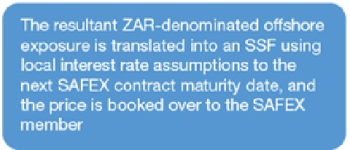
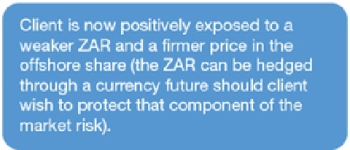
There are the relatively complicated routes of using Foreign Asset allowances – to take Rands offshore and set up offshore broking accounts with overseas vendors, or applying for access to Asset Swap mechanisms – as only the domain of the larger local brokers with foreign relationships. Avoiding both of these, Investec Equity Derivatives offer similar exposure to foreign shares on SAFEX, through its IDX International Derivatives Futures, these are Rand denominated Single Stock Futures, listed on SAFEX.
How does this work?


Given the seemingly relentless rise of the South African equity market, with the question of whether or not the impressive consistent pace of earnings growth can be sustained, we continue to favour the developed markets; both on valuation as well as growth prospects.


