

Should investors go offshore when the local environment improves?

Adriaan Pask, Chief Investment Officer at PSG Wealth.
There are always benefits to allocating assets offshore and it would be imprudent of investors to invest all their cash in the local economy. For one, South Africa accounts for only one percent of all investment opportunities globally.
Instead, it’s important to focus on finding investment opportunities based on their valuation and diversification benefits. This is exactly the benefit of taking your money offshore, even when the local environment appears to be improving.
Ideally your investment should grow while, at the same time, minimising the risk of losing your initial capital. One of the best ways to do this is to diversify your investments as much as possible.
Allocating money offshore offers diversification benefits. For example, when offshore markets crash, the rand usually tends to weaken against the US dollar. When your money is allocated to a diversified offshore fund, you will get a higher return in rands when our currency weakens against the dollar. However, your return in rands can also decrease when the rand strengthens against the dollar, but now you have a diversified portfolio that balances out that loss.
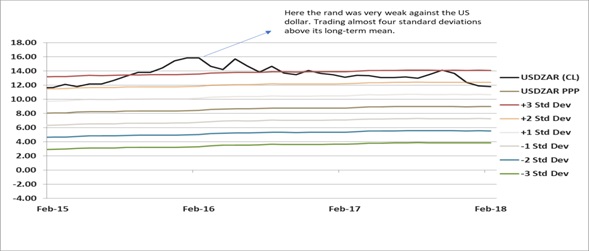
When money is allocated offshore, it shouldn’t be based on your view of the rand or the dollar, but rather on where the best opportunities can be found. However, you cannot be completely currency agnostic. There are times, like for example in February 2016, when you could clearly see that the rand was too weak. If you did not take this into account when allocating assets, the gains that you could have made on offshore equities would just have been destroyed by the strengthening of the rand.
ZAR/USD exchange rate: Spot price versus PPP in February 2016
Source: PSG Wealth research team
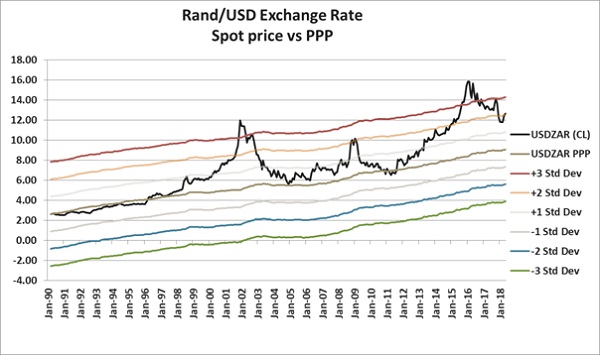
The purchasing power parity (PPP) graph above shows that the rand was trading more than three, to almost four standard deviations above its long-term average against the dollar at that time. Only two things can happen in this instance. Either the long-term average will start to catch up to the current level of the rand over a five-year period, or the rand will start to strengthen over the five-year period and return to its long-term average. The second scenario is exactly what has happened to the rand since February 2016, strengthening by almost 21% against the dollar from its highest peak of R16.87/$ on 18 January 2016 to R11.55/$ on 26 February 2018. While the rand rallied at the start of this year, the local currency started to weaken against the dollar from about May. Analysts believe the main reason for this is a stronger dollar due to the trade tiffs between the US and China. A contraction in the GDP and increasing negative sentiment towards emerging markets are also to blame.
It is very difficult to make the correct call on currencies. However, sometimes quality research leads to good opportunities, like in 2016 when one needed to be more cautious than one traditionally would have been.
ZAR/USD exchange rate: Spot price versus PPP as at 31 May 2018
Source: PSG Wealth research team
It’s notoriously difficult to call currencies
Typically, success can be found when the rand trades at the extremes, like in 2016 when it traded more than three to four standard deviations above its long-term average. At that stage it was likely that the rand would revert to the mean, or strengthen against the dollar.
Apart from diversifying your risks when you allocate money offshore, you need to consider all available opportunities based on valuations.
This means that you need to be quite agnostic about which region, local or offshore, you allocate assets to. You need to consider in what region assets make the most of their revenue. For example Richemont is a locally-listed company, but most of its revenue is made in offshore Asian markets.
As stated earlier, our local market accounts for only one percent of all investment opportunities across the globe. If one considers South Africa’s positive growth trend objectively, then you can say yes, South Africa looks cheap, but there are places in Europe that also look cheap. While the US might seem expensive now, there are still quite a few opportunities abroad that appear to be cheaply valued.
While we are aware of the extreme risks in our currency that we must consider in constructing portfolios we will never take a binary view when allocating any asset locally or offshore.

