

Shadows cast
People across North America were treated last week to the spectacle of a total solar eclipse. It is a rare event where the moon briefly blocks out the sun, leaving only a slim halo (or corona) visible while day turns to night for a few eerie moments.
The sun is about 400 times larger than the moon but also much further away. When the moon is perfectly positioned between the earth and the sun, and closer to earth than usual, it blocks out sunlight over an area around 150km wide. This shadow is called an umbra.
Since the earth moves in a predictable orbit around the sun, and the moon around the earth, scientists can pinpoint when and where eclipses will take place. According to NASA, there will be 224 solar eclipses in the 21st century, of which 77 will be total eclipses. For any given location on earth, it can be hundreds of years between total eclipses, though partial eclipses happen a bit more frequently. There will be a partial solar eclipse over parts of South Africa in February 2026 and a total eclipse in November 2030.
In the investment universe, the sun is the US Federal Reserve (the Fed). Just as the planets revolve around the sun, so do all financial assets worldwide price off the Fed’s policy interest rate since US financial markets dwarf all others, and the US dollar is the global reserve currency.
Eclipses happen from time to time, where the Fed’s influence is overshadowed by other events or narratives, but its gravitational pull is ultimately overwhelming. Hence the old market adage, “don’t fight the Fed”.
Twin goals
The Fed in turn makes decisions based on achieving two objectives, stable prices, and maximum employment. The first is interpreted as an inflation target of 2%. The employment goal is a bit fuzzier, but a range of 3.5% to 4.5% unemployment is probably ideal. Above that, there are people who want to work but can’t find jobs; below that, there is a shortage of workers, and an overheating economy. This in turn could undermine the inflation goal.
Not all central banks have this explicit dual mandate. The European Central Bank, for instance, has only an inflation objective. The South African Reserve Bank’s mandate is stable inflation “in the interest of balanced and sustainable growth”.
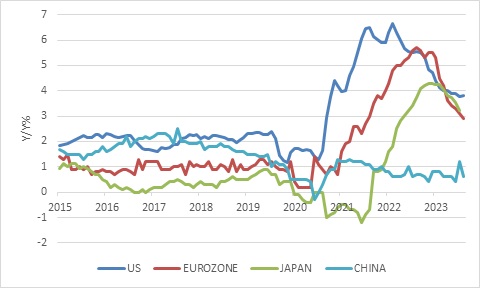
When inflation surged worldwide in the post-pandemic reopening, the Fed gave priority to the inflation objective. By hiking rates aggressively, it was prepared to cause rising unemployment (a recession) to return inflation to its target. Whether through luck or skill, consumer inflation has declined substantially from a peak of 9% in April 2022 to 3.8% in March without requiring sacrifices on the jobs side. In fact, unemployment remains low at 3.8% and the economy seems to be humming along.
Chart 1: Consumer price inflation excluding food and energy, %
Source: LSEG Datastream
Inflation declines in the last few months of 2023 were unexpectedly quick, leading to markets pricing in up to six rate cuts this year. Bonds and equities rallied, and the dollar pulled back. However, inflation in the first three months of this year have come in higher than expected and point to persistent price pressures in service categories.
This was always the fear. Solid economic growth means people have money to spend, which puts upward pressure on prices, while a tight labour market puts upward pressure on wages. When consumer demand is robust, companies can pass on wage costs. In many service industries – healthcare is a current pertinent example – salaries and wages are the biggest single input cost for businesses.
Goods price inflation remains low and is in fact still negative in many categories. Despite the Houthi attacks on Red Sea shipping and the recent dramatic bridge collapse in Baltimore, global supply chains are nowhere near as clogged up as in 2022. Goods inflation should remain under control, helped by falling Chinese factory prices.
Click here to read more...


