

People, pensions and policy choices
Last week’s 90th anniversary of US President Franklin Roosevelt signing the Social Security Act into law went by largely unnoticed.
However, it was a landmark reform, providing a minimum level of state support for people in old age for the first time, part of a package of interventions to combat extreme poverty in the Great Depression. This was not the first state-backed pension system in the world but would grow to be the biggest and most well-known. Some 52 million retirees receive a monthly cheque from Social Security, and for two thirds of them, it forms at least half their retirement income. For 16 million Americans, it is their only source of income in old age.
A lot has changed over the past 90 years, especially in the quality and extent of human lives. If we stay with the US for a minute, in 1930 about 85 babies out of every 1 000 born would not live to see their first birthday. Today it is only 5.6 out 1 000.This dramatic reduction in early child deaths contributed to a sharp increase in average life average expectancy, rising for women from around 62 years in 1930 to 77 today. The more recent gains in life expectancy are largely due to lower mortality rates among the middle and old-age cohorts thanks to better treatment and healthier lifestyles. Even in poor countries, lifespans have increased dramatically in recent decades though they still lag richer nations.
Chart 1: Female life expectancy at birth
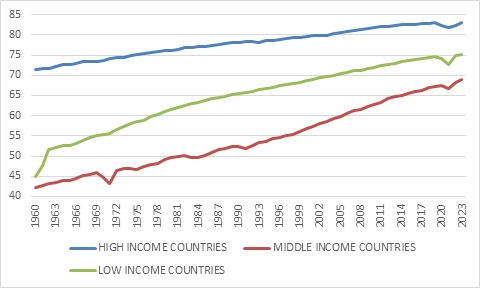
Source: World Bank
The other notable demographic trend is that the average woman is having fewer babies all over the world. In 1930, the US fertility rate (births per woman) was around 3. Today it is 1.6. The global fertility rate fell from 5 to 2.2 over the same period. The fact that women can choose to have fewer children today is widely celebrated, but it also means that in most rich countries the average woman is not having enough children to replace herself and her partner. The fertility rate in Japan is 1.02 and in Spain it is 1.2. The lowest fertility rate in the world is in South Korea. At only 0.7, it means that the average woman is not even replacing herself. Attempts to raise birth rates in low fertility countries have largely failed. Only large-scale immigration can turn this around, but as we’ve seen across the world, immigration is a political hot potato, even in countries with a long history of being open to migrants, such as the US.
The combination of rising life expectancy and falling birth rates results in rapidly ageing populations, mainly in rich countries but also in some emerging economies, where China stands out due to the implementation of the one-child policy between 1979 and 2015. It is remarkable that the great fear of the 1970s - and not just in China - was overpopulation and the Malthusian dread of running out of resources. Today, it veers to the other extreme, with more commentators warning of an economic calamity due to declining populations. As in the 1970s, this fear might also be somewhat overblown. The UN projects that the overall global population will keep rising until around 2080, largely thanks to India and Africa, though populations in many individual countries will fall over the next few years. Interestingly, the International Monetary Fund recently noted another silver lining: in a study of 41 developed and developing countries, it found that 70-year-olds today have the same average cognitive abilities as 53-year-olds in 2000. If this remarkable finding is true, it means people can remain productive workers late in life, thereby partially offsetting the impact of shrinking workforces. Technologies such as robotics and artificial intelligence will also stand in for some workers though probably not all.
Click here to read more...


