

Passive investment methods are not the same as active management techniques
14 April 2014 | Investments | General | Mike Brown, etfSA.co.za
In recent times, there has been a significant number of articles written by active investment managers defending their investment methods relative to passive index tracking investment techniques. These articles often tend to focus on the superior intellectual capacity of active managers and their methods that allow them to beat the average returns of the market, which is the performance return provided by the passive index trackers.
Of course, the active manager in South Africa is finding it increasingly difficult to defend their piece of turf because of the following:
• Underperformance by active investment managers is now endemic
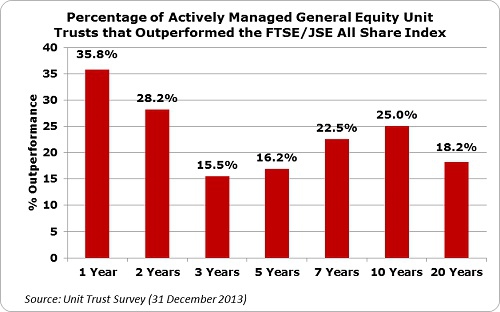
As the graph below shows, an average of 23% of active unit trust managers have outperformed the All Share index, which they are using as a benchmark, over the past 20 years. This, of course, means that you have a 77% chance of underperforming the market when choosing active investment methods.
• Undisclosed costs systematically erode the performance of active investment managers
A recent study by John Bogle "The Arithmetic of "all-in” Investment Expenses”, published in the Financial Analysts Journal (February 2014), found that US active investment managers understated their real costs by an average of 2,2% per annum. This finding would also seem applicable to South Africa, as the Total Expense Ratios (TERs) of active managers typically exclude: brokerage charges and other transaction costs incurred when creating new investment units or in churning existing portfolios; the impact of the "cash drag” in portfolio performance; and the distribution or sales costs of getting products to investors.
• Concentration is affecting investment performance
In most of the world, but also in South Africa, the active asset management industry is becoming more and more concentrated, with larger asset managers dominating the business. The problem is the bigger you get, the more difficult it is to perform. Because of their size, the mega-managers can really only buy the larger market cap companies, as other counters are too small to have any effect on the overall performance of the mega manager.
Of course, you can buy all the top counters through an index, so the large concentrated asset managers, really become closset index trackers, only with active investment management costs.
• Scalability
This is similar to the concentration issue. In a relatively narrow market, like South Africa, where the Top 40 shares make up 90% of the daily trade in the market, moving outside this narrow range of shares, brings liquidity, tradability and other risk issues.
Other scalability issues are the limits on market exposure that characterise the South Africa market. Prudential investment requirements limit foreign exposure as do asset swap constraints; Regulation 28 requirements stipulate maximum exposure to different asset classes; market size of asset classes can limit the mega active managers’ exposure to any particular asset class, listed property shares or inflation-linked bonds for instance. If a large asset manager decides to move 10% of their total assets to the listed property sector, the relatively small market size of this section would not allow this without creating significant price distortions.
Faced with these inherent difficulties in the South African market, it is not surprising that the active management industry in this country, often falls back on their supposed intellectual superiority to justify offering their high cost services. The passive investor is characterised by such active managers as a plodding adherent to the average returns of the market, who typically only owns one index tracker product (a broad market index like the S&P 600 in the US, or the Top 40 in South Africa).
How does passive investment technology work?
Of course, this is far from the truth. The passive manager in South Africa has some 70 different index tracker ETPs listed on the JSE to choose from. These cover all applicable asset classes, market sectors and alternative investment types. The passive investor can also exercise their intellectual capacity in finding the optimal mix of such index tracking products to deliver the risk profile plus the performance returns they require. This requires active choices to be made of asset classes, the indices chosen and the multi-product mix.
Passive investment methods and techniques can be equally as scientific as active management techniques, a view that is not often conceded by the active manager.
The passive methodology involves the following key features:
1. The passive investment manager looks only at the indices not at individual securities. This means that fundamental analysis of individual shares is not needed. Long term performance of indices, their variability in performance and their constituent weightings is rather the concern of the passive manager.
2. The passive investor uses a strategic asset allocation model, and sticks to it rather than a tactical asset allocation approach reacting continuously to changing market news or trends. The strategic asset allocation stays intact over the medium-to-long-term.
3. The passive manager pays particular attention to risk and variation of returns by carefully considering the standard deviation and correlation co-efficients of the various index trackers used in a portfolio. This idea is to lower the overall risk of the portfolio, well below the levels of risk experienced in actively managed portfolios.
4. Asset allocation is the core of the passive investment method. The passive investment manager is a strong adherent to the well-researched finding that the correct asset allocation accounts for over 90% of investment performance over the medium-to-long-term.
5. The passive manager then chooses ETFs or other index tracking products that will give direct access to the asset classes chosen in the strategic asset allocation market, with the most consistency of performance and with the lowest risk.
By focusing on an asset allocation model that is proven over time to deliver good performance, for an acceptable amount of risk, the passive manager delivers on this required return by using only index tracking products in a multi-asset managed solution.
Should we focus on the differences between active and passive management or rather on their combination?
The passive manager does not react to every market turn or changes in economic forecasts, they stick to their selected strategic asset allocation throughout the investment cycle. In this way, portfolio churn and unnecessary costs are avoided and consistency of returns is paramount.
The active investment manager often takes a largely bottom-up approach focusing on individual shares and opportunities. Portfolio churn and higher risk is often accepted as the corollary of investment rewards. Economic forecasts and market expectations are embraced enthusiastically, factories and mine shafts are visited, company presentations attended and fortunes spent on research and hiring the best professional staff. All of this activity is based on the premise that the market is inefficient and undervalued stocks can be identified by the active manager on a regular basis.
The passive manager has a less frenetic approach. They accept the collective wisdom of investors in setting market prices and the difficulties of beating the average return of the markets and rather focus attention on optimal asset allocation between asset classes.
The clear differences in the approach of the active and passive managers typically results in different types of solutions, investment performance and risk/reward payoffs. Clearly, there should be room for both approaches for an investor, whether individual or institutional, in building up a portfolio.
The real debate should be about "blending” the optimal mix between active and passive products in an investment portfolio.


