

Nedbank outperforms versus peers for ESG disclosure in 2019
…Risk Insights and Instinctif Partners release 2019’s SA Banking Sector ESG Disclosures Ranking...
ESG(environmental, social and governance) risk management company, Risk Insights, and ESG business communications firm, Instinctif Partners, today released the South African Banking Sector ESG disclosure rankings for 2019. Findings for this report are derived from Risk Insights’ proprietary ESG GPS rating tool, which has been recognised by the World Economic Forum. The ESG GPS uses AI and machine learning algorithms to transform publicly available disclosure reporting, integrated reports and news flow into ratings for environmental, social and governance metrics.
The rankings are based on TF-IDF1 (Term-Frequency Inverse-Document-Frequency) scores that can be used by investors, corporates and other stakeholders to identify key ESG risks and opportunities for listed JSE players. The Risk Insights ESG database includes data for all listed companies on the JSE from 2016 – 2020 and rates them by sector for a particular financial year. ESG ratings are done independently based on publicly available information.
Anashrin Pillay, acting CEO of Risk Insights and Executive for ESG says, “For the South African banking sector, ESG has been an important narrative and many banks have implemented voluntary ESG reporting standards over the past four years. Our research shows that governance disclosure still makes up more than 80% of total disclosure on average for the banking sector in 2019. Social factors where brand, reputation and diversity play an important role, and environmental disclosure are both around 8% respectively. ”
The JSE Finance Sector constitutes 10% of the total market capitalisation of all JSE listed companies, contributing 20% to GDP and 15.6% to employment. The research was conducted across the six largest banks listed on the JSE: Absa, Capitec, FirstRand, Nedbank, Rand Merchant Investment Holdings and Standard Bank. Sustainability frameworks (CDP, GRI etc), together with the laws of South Africa, were considered when curating the list of “B words1” which forms the basis of the ESG-GPS rating model. A TF-IDF score for E, S & G is calculated for each bank which is then compared to the total score for the sector and expressed as a percentage.
Environment
As one would expect from its decades long environmental narrative, Nedbank tops the leader board for environment with a percentage score of 46.8 %. Standard Bank comes in second with a score of 19.8%. At the bottom of the rankings is relative newcomer Capitec. The banking players achieved an 8.2% average for environmental outcomes. This indicates that as a sector, the industry has further opportunity to develop this aspect in terms of further actionable environmental commitments.
|
Name |
Rank |
% |
|
Nedbank Group Ltd. |
1 |
46.8% |
|
Standard Bank Group Ltd. |
2 |
19.8% |
|
ABSA Group Ltd. |
3 |
13.6% |
|
Firstrand Ltd. |
4 |
12.4% |
|
RMB Holdings Ltd. |
5 |
7.0% |
|
Capitec Bank Holdings Ltd. |
6 |
0.3% |
|
Total score |
|
100.0% |
While climate change is an ongoing conversation and some banks have recently made public statement about intentions not to finance conflicted or sensitive projects – such as fossil fuels – the reality is that to date, much of this is just talk and not yet a firm policy. This is because of a number of challenges that range from impact on projects underway to board and executive conflicts of interest regarding investment priorities.
“As a South African ESG rating company, Risk Insights has noted and acknowledged the structural changes in the country, which is adjusting its strategy in terms of renewable energy and fossil fuel usage, with financing thereof being a double edged sword,” adds Anashrin Pillay.
Social
Nedbank nabs first place for the social elements of the ESG ranking, making up more than 30% of the total sector score for this metric. Absa comes in second with Firstrand a close third.
Kim Polley, Managing Partner, Instinctif Partners comments, “While many banks have social responsibility programmes, they are not often structured to integrate into sustainability frameworks, nor do they incorporate specific and measurable socio-economic targets. Addressing social inequalities and driving inclusive growth are critical to South Africa’s economic recovery post-Covid 19. Banks sit at the intersect of commercial and individual financial opportunity, often serving as a gateway to economic success. They are uniquely positioned to enable socio-economic development and inclusivity in South Africa, which is why this aspect of ESG presents an opportunity for shared value creation.”
|
Name |
Rank |
% |
|
Nedbank Group Ltd. |
1 |
32.4% |
|
ABSA Group Ltd. |
2 |
19.7% |
|
Firstrand Ltd. |
3 |
19.6% |
|
Standard Bank Group Ltd. |
4 |
18.2% |
|
Capitec Bank Holdings Ltd. |
5 |
5.9% |
|
RMB Holdings Ltd. |
6 |
4.2% |
|
Total score |
|
100.0% |
Governance
According to the 2019 rankings, Nedbank again has come out ahead of its more established peers in terms of governance, scoring a 29.3%. The lowest governance score was accrued by RMB Holdings. However, the ranking clearly indicates that, as far as governance goes, banks are much more advanced in this aspect of ESG as a metric, as it makes up more than 80% of their total disclosure.
|
Name |
Rank |
% |
|
Nedbank Group Ltd. |
1 |
29.3% |
|
Firstrand Ltd. |
2 |
27.6% |
|
ABSA Group Ltd. |
3 |
18.3% |
|
Standard Bank Group Ltd. |
4 |
14.3% |
|
Capitec Bank Holdings Ltd. |
5 |
6.0% |
|
RMB Holdings Ltd. |
6 |
4.5% |
|
Total score |
|
100.0% |
Risk Insights’ acting CEO and Executive for ESG, Anashrin Pillay says, “Banks, by their very nature, would be expected to focus on governance disclosures, rather than environmental or social disclosures. It is no surprise therefore, that the governance scores out of 100% were so much better than the other two categories. However, the fact that no bank scored more than 10% in terms of disclosure for environmental and social metrics indicates significant opportunity for greater impact as banks move to balance their ESG focus. Increased disclosure regarding these metrics is required for ESG goal setting or meeting stakeholder expectations going forward.”
An overarching bank ranking that considers all three ESG elements was compiled and the result was that overall, Nedbank ranked best in ESG in South Africa’s banking sector. It was followed by Firstrand and Absa . Capitec and RMB Holdings were the laggards, both with significant room to grow their ESG contribution over time.
|
Total Banking Sector ESG Ranking for 2019 |
||
|
Name |
Ranking |
% |
|
Nedbank Group Ltd. |
1 |
31.0% |
|
Firstrand Ltd. |
2 |
25.7% |
|
ABSA Group Ltd. |
3 |
18.0% |
|
Standard Bank Group Ltd. |
4 |
15.1% |
|
Capitec Bank Holdings Ltd. |
5 |
5.5% |
|
RMB Holdings Ltd. |
6 |
4.7% |
Kim Polley, Instinctif Partners concludes, “ESG is a growing priority for listed companies in South Africa and it is encouraging to see the increase in disclosures and commitments. For the banking sector, we believe that the trend for disclosures in favour of social factors, including employee wellness, will be an important lever to unlock further ESG progress. In a world where underlying trust is weak, expectation of good and transparent governance is high and acceptance of failure is low, the ability to demonstrate strong, positive ESG outcomes is a critical resilience pillar in protecting a company’s reputation.
With an increasingly aware and active corporate and private citizenry, a critical blend of social, governance and economic issues has rapidly made its way into the business space. Companies need to anticipate, understand and respond to challenges quickly by applying effective reputation mitigation strategies that derive from a deep understanding of risk A clear and pragmatic view into your own ESG landscape is one of the most critical places to start!”
Four Risks Banks Should Focus on for ESG in 2021
According to the ESG GPS, there are four key risks the banking sector should focus on in 2021.
1) Governance: Non-alignment to ESG disclosure and integration
Disclosure and integration of ESG factors will assist with the mitigation of ESG risk and value creation for all stakeholders. Disclosure into reporting and strategy will allow for year on year measurement, as will the purposeful alignment with recognised, global sustainability frameworks.
2) Social: Diversity and Inclusivity
Transparency around gender, race and inclusivity is important to attract talent and for brand and reputation. Capitec, according to BrandsEye’s annual South African Banking Sentiment Index, is the incumbent bank with the highest net sentiment, driven largely by the bank’s affordability - the perception of accessibility for, and inclusivity of, the majority of South Africans continues to drive Capitec’s positive perception.
3) Governance: Cyber security
Governance processes around cyber security and cyber fraud become ever more critical. More than ever before, the customer is online and demanding a digital solution. In fact, the sentiment index highlighted that more customers than ever were engaging with their bank on digital platforms, and that the banks scoring badly on customer sentiment were those unable to satisfy customer queries or complaints coming through social media or online.
4) Environment: Climate change
Investment into sustainable energy sources other than coal is an ongoing theme. However, it still appears to be one that is difficult to implement. Many banks have a declared green agenda, but this is not often accompanied by specific, measurable targets.
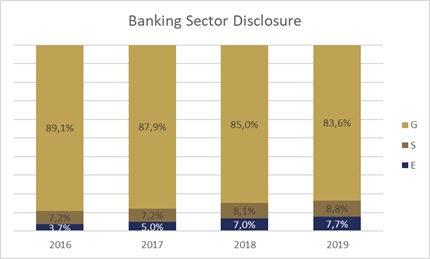
Current banking sector disclosures from 2016 - 2019, represented as a graph:
Source: Risk Insights ESG-GPS based on company specific disclosure.


