

Managing Mixed Messages
And so it begins. Donald Trump will only be inaugurated as US president in late January, but his social media announcements are already moving markets.
Last week he threatened that 25% tariffs would be imposed on Mexico and Canada on his first day in office, with an additional 10% tax on imports from China on top of any other future tariffs.
The reason given was that America’s neighbours are allowing drugs and illegal migrants to enter the US, while China is blamed for not stopping the export of chemicals used to make a particularly lethal drug, fentanyl. By invoking national security grounds, the president can impose tariffs without going through Congress.
All three countries run trade surpluses with the US, and in fact, the three combined account for half the total US trade deficit. It is notable, as chart 1 shows, that the US trade deficit with China is smaller, though it remains the largest bilateral deficit with any country. Part of the reason why may be that trade from China is rerouted through other countries, including Mexico. This is clearly something Trump will want to address. He has long argued that a trade deficit is tantamount to the US “losing” while other countries are “stealing jobs.” What is not said, is that these large deficits are also the result of voracious consumer appetites. Closing them would require less consumption and higher savings rates.
Make Manufacturing Great Again
The US, Canada and Mexico have had a free trade agreement since 1994. It was initially known as NAFTA, until Trump, who called it the “worst trade deal ever made” renegotiated it during his first term. Tariffs on Canada and Mexico could fatally undermine this arrangement, especially if they retaliate. Canada and Mexico are obviously much more reliant on their shared giant neighbour than it is on them, although many US businesses have come to depend on Canadian and Mexican workers and customers.
Chart 1: US bilateral trade balance
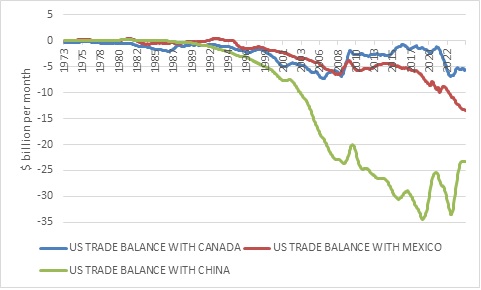
Source: LSEG Datastream
Offshoring production to Mexico, and particularly China, cost millions of US manufacturing jobs. Blaming those countries is not the whole story, since it was American CEO’s who made the decision in the interest of higher profits. Manufacturing wages are still around three times higher in the US than in China, and about six times higher than in Mexico. This remains a major obstacle to reshoring, specifically labour-intensive production. Automation, however, is a trend that is likely to continue. As chart 2 shows, US manufacturing employment has declined sharply, especially since 2000, while output increased.
The chart also shows that neither Trump’s earlier interventions, nor the Biden administration’s industrial policy push, has raised factory employment on a sustained basis. While Biden has overseen a surge in factory construction, they are mainly high-tech facilities that employ relatively few people. Nonetheless, Trump seems determined to make US manufacturing great again.
Click here to read more...


