

Low growth, high debt. How did we get here?

Fred White, co-manager of the Sanlam Investment Management (SIM) Balanced Fund.
‘Today we live in a world with very low interest rates, which are likely to cause very low returns from global bonds and which have changed the pricing levels on all alternative asset classes,’ says Frederick White, co-manager of the Sanlam Investment Management (SIM) Balanced Fund. It is also a highly indebted world, incentivising governments to keep interest rates low, which could allow some inflation into the system. And rising protectionism could reduce trade and contribute further to inflation. It is also a world in which China’s growth is slowing and emerging markets, including South Africa, are adapting to the hardship following the downturn in the commodities cycle.
How did we get here?
In the late 1990s, while most emerging economies experienced difficulties due to many commodity prices hitting all-time lows, China emerged as a savings giant and all that savings had only one place to go – the national banks. As a result, the ruling party of China was in a position to bankroll the biggest infrastructure development in a lifetime. This lured companies from across the world to relocate production to China, accessing the cheap labour force and a massive market amid a newly-built infrastructure. Commodities soared and things started looking much better for emerging economies. BRICS became more than a buzz word – these countries had to be represented in portfolios.
In the meantime, with all the factories relocated to China, the workers class delivering manual labour in developed economies was under pressure. Real income declined. But the rich who held more of their wealth in corporates – making great profits, especially at the lower labour costs – were getting richer, sowing the seeds for the rise of the anti-establishment, much later leading to Brexit and the election of president Trump. In 2007/08 the housing bubble burst, pushing rates down and causing a search for yield and the repricing of all asset classes. In China the super cycle was over and so were the good times for emerging markets. Just like in the 1990s, fundamentals deteriorated, deficits arrived and rating downgrades became a reality.
This is a world in which growth is under pressure. Investors across the globe are desperate for a yield pick-up, but also skittish around risk and once again looking for safe havens, protecting them against downside risk. In short, they are looking for a solution that would offer ‘the best of both worlds’ – growth and protection.
What is the aim of the SIM Balanced Fund?
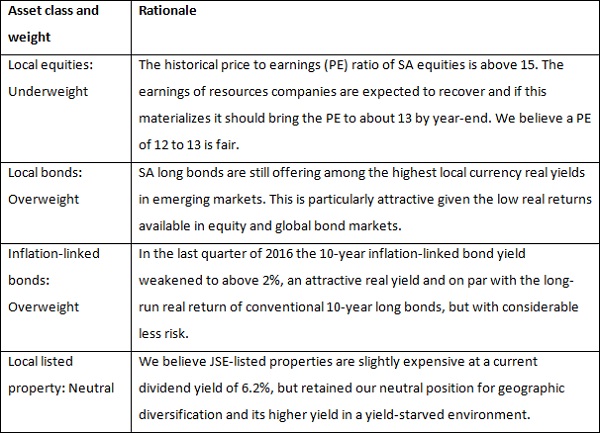
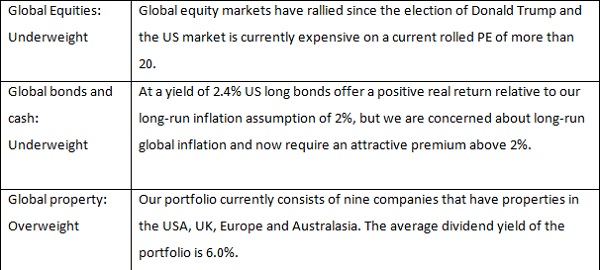
Fred says the purpose of the SIM asset allocation team is to use all the strengths of such a large asset manager to provide a global balanced solution that represents SIM’s best view (see current positioning below). The fund aims for the best possible capital growth without taking excessive risk. The team uses a process in which information is disseminated and discussed, followed by timeous, rigorous interaction between the right people, with the necessary checks and balances in place.
How does the SIM Balanced Fund offer the best of both worlds?
By using the above process, the SIM Balanced Fund is able to offer both long-term growth and shorter-term protection. It does this by using the following:
1. A valuations-based approach
A key to downside protection is buying assets when they are priced below SIM’s assessment of fair value and only selling assets when their value is fully priced in. Although it is possible for asset prices to fall significantly after SIM has acquired the assets, buying at a sufficient margin of safety does build in a buffer and it’s not that far a stretch for asset prices to recover back to this ‘buy level’ and beyond. In contrast, buying at fair value would have meant a much longer recovery time for these asset prices.
2. Diversification
Although equities and local listed property have proven to be the stellar outperformers over the past decades, uncertainty remains and the current valuation levels of both these asset classes show that significant drawdown risks remain. As a multi asset high equity fund, the SIM Balanced Fund invests across all main asset classes, locally and globally, thereby reducing the volatility of being in equities or property only, but still providing up to 75% exposure to equity and 25% to property, building in the potential for long-term growth.
3. Derivatives
With derivatives, if you have any doubt about why, how and when to use them, they are best avoided. We have a very specific strategy using a discretionary hedge with auto-valuation trigger. In fact, so serious are we about cementing SIM’s leadership in the derivatives space and establishing a centre of derivatives expertise in the balanced space, that we appointed Ralph Thomas, a derivatives specialist, as the newest addition to the team managing the SIM Balanced Fund.
Our positioning
How did the fund perform in the past?
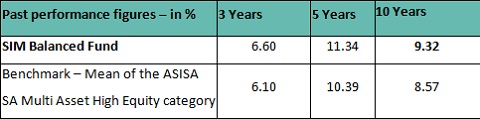
Source: Morningstar Direct | As at 31 Dec 2016 | Annualised performance for periods greater than 1 year | Annualised return is the weighted average compound growth rate over the period measured.
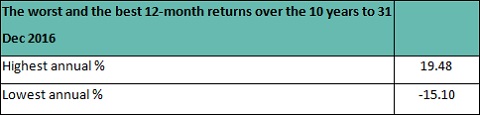
Source: Morningstar Direct |Lowest and highest 12-month returns in the 10 years to 31 Dec 2016 | Actual annual figures are available on request.
What are the minimum investment amounts?
Investors can invest from as little as R200 per month or a R5 000 lump sum.

