

Lessons for investors on risk and volatility
It is often posited that volatility is not a robust measure of risk. Our own investment process focuses a great deal more on the risk of permanent capital impairment, which results typically from paying more for an asset than its intrinsic value.
That said, it’s clear to us that volatility – the degree to which your investment results vary from one period to another – is not something to be ignored. Indeed, it can be demonstrated that for a long-term investor, volatility is an absolutely critical variable, right up there with investment longevity and performance.
As an illustration, let’s walk through a two-part thought exercise.
For the first part of the exercise, imagine there are 1 000 hypothetical investors. Each starts with US$10 000 and invests for 60 years – roughly a lifetime of investing if you are diligent enough to start with your first pay cheque. Each investor’s returns are random, sampled annually from the same distribution of returns from global stock markets, with the same volatility. All of our imaginary investors are therefore equally skilled (or unskilled) and equally good (or bad) at risk management. Let’s call this group the “normal” investors.
Interestingly, even with a completely random simulation the resulting distribution of wealth looks similar to real world outcomes. A few lucky investors accumulate hundreds of millions of dollars and help pull up the average (mean) result to about US$9 million. But this is hardly the typical outcome. About 80% of our investors are below this number – most of them come nowhere near it. Investor #500 – bang in the middle (i.e. the median investor) – ends up with about US$3 million.
Perhaps more interesting is that the resulting distribution of wealth is nonlinear. The mean result is much higher than the median result, meaning the results have a positive skew, as shown in the graph. As our investors become increasingly lucky, their luck compounds to provide ever-higher levels of wealth. Even among the top 1%, there are meaningful differences in outcomes. The good news is that the non-linearity of outcomes can work in your favour when investing.
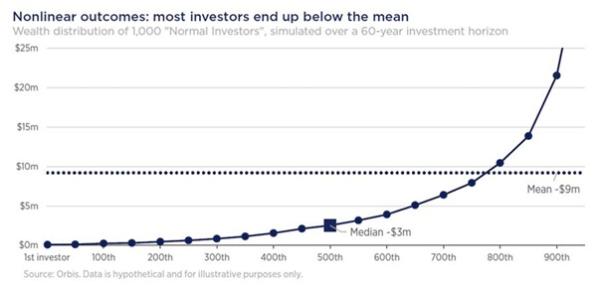
It means that small things add up, and every little improvement can make a big difference – even if you never end up with Warren Buffett and Elon Musk in the top 0.1%.
Let’s ask ourselves a question which may lead to a different outcome. What would happen if our fictional investors were equally skilled or unskilled, but were notably better risk managers? We can answer this question by keeping all of the original assumptions in place, but by reducing the chances of extreme losses and gains (i.e. narrowing the distribution used to randomise returns). Let’s call this group the “risk managers”.
The median investor in this group has a far better outcome than in the group of “normal” investors, simply by reducing volatility. In fact, only 10% of this new group ends up worse off than the original “median” investor. In other words, good risk management can significantly raise your wealth generation potential. The intuition behind this is that big losses are extremely tough to recover. As the saying goes, a 50% loss requires a 100% return to regain. Or as Buffett says, “Rule #1: Never lose money. Rule #2: Never forget Rule #1.”
Investing in the real world can be a lot more complex than in our simple thought exercise, but we see a lot of lessons that are applicable. The lesson is not to avoid risk altogether – it’s essential if you wish to compound your investments over time – but rather that no amount of skill or patience matters if you get wiped out from excess risk taking.
In other words, don’t let risk be your enemy, but rather, befriend it. For this, look for funds that are designed to offer a volatility profile that is substantially below the undulating returns of global stock markets.


