

Inflation Questions
Inflation concerns are rising again as an escalation of the US-Iran war puts renewed upward pressure on oil prices.
The cost of a barrel of Brent crude briefly rose above $100 for the first time since late May as not one but two crucial waterways for oil transport are under attack. Iran has effectively closed the Strait of Hormuz again, while its allies in Yemen, the Houthis, attacked shipping in the Bab-al Mandeb Strait. The latter impacts Saudi Arabia’s ability to export oil from Yanbu on its western coast. Saudi oil will now have to travel through the Suez Canal and around South Africa to reach Asian markets, a much longer and more costly exercise.
Where things go to from here is anyone’s guess, but broadly there appear to be three possibilities. One is that the US steps up its blockade of Iran but scales back military action. This will lead to higher oil prices until Iran’s fragile economy crumbles and its leaders capitulate. However, it will also require a degree of patience that US President Trump has never shown. It also means elevated petrol prices for American voters with mid-term elections a mere three months away. Option two is that the US dramatically steps up military action to force open the Strait of Hormuz. This would probably have to include the deployment of soldiers, an escalation of an already unpopular war that could be politically toxic. There is also no guarantee that it would work. This means that the third option, a renewal of negotiations, remains most likely. Indeed, hostilities were paused over the weekend to allow for talks. Oil prices were lower on Monday morning, but still substantially higher than the start of the month. This is compounded by recent Ukrainian attacks on Russian refineries, which have squeezed global supplies of refined products, especially diesel. Economic activity will therefore face renewed downward pressure, while inflation rates will rise.
Central banks typically don’t respond immediately to higher fuel prices, since it is a pure supply shock. They care more about how fuel influences other prices, which is called the second-round effect. Since these can become self-fulfilling, part of what central banks aim to do is use their words and actions to convince people that, even after an initial higher jump, inflation will eventually fall back to target. Interest rate increases are part of the process to “anchor” these expectations of future inflation. However, so far, the evidence of second-round effects has been limited.
Calm core
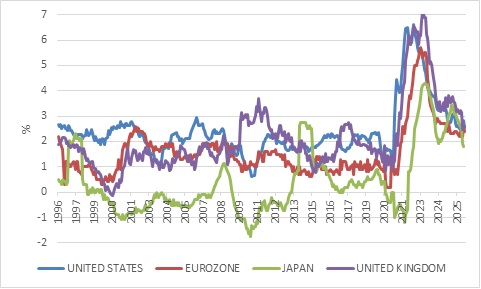
Chart 1 shows core inflation rates, excluding fuel and food prices, across major developed markets. They’ve been relatively well behaved, certainly compared to what happened in 2022. Then, the Russian invasion of Ukraine war also caused a jump in fuel prices, but it followed a sustained increase in the prices of other goods and services as the world exited Covid lockdowns. The war merely added fuel to the inflation fire of, if you excuse the pun.
Chart 1: Core inflation rates in developed economies
Source: LSEG Datastream
The current episode is therefore quite different, and even if oil prices increase further, it is very unlikely to mimic the extent of the 2021/22 cycle. It also follows that the interest rate response will be much milder.
For instance, of the four economies in Chart 1, the European Central Bank raised rates once by 25 basis points this year and kept policy unchanged at its meeting last week. The Bank of Japan also raised rates once to a three decade-high of 1% but would probably have done so anyway. The Bank of England and US Federal Reserve have not increased rates this year. The Fed’s actions matter greatly for the global economy and markets. Its new chair, Kevin Warsh, has repeatedly said the institution is committed to ‘price stability’ (low inflation) but said very little about how that will be achieved. The fact that core inflation declined slightly in June to 2.6% buys him and his colleagues some time. It is very clear that the Fed has not been dogmatic about returning to the 2% target on a short timeline. Being flexible and pragmatic has its advantages, but at some point, people will question whether the goal posts haven’t been permanently shifted. The other thing to bear in mind is that US mortgage rates are tied to long-term government bond yields, not the Fed’s policy rate. With the 30-year US Treasury yield hitting 5.1% last week, the highest level since 2007, there will be downward pressure on housing activity regardless of what the Fed does next.
Click here to read more...


