

How much longer will the bust in Chinese housing last?

David Rees

Oliver Willoughby
• David Rees, Senior Emerging Markets Economist at Schroders
• Oliver Willoughby, Economics Placement Student at Schroders
Schroders says China likely to miss its GDP targets this year – and much more decisive policy action required for it to start beating growth expectations again.
The August data round from China brought little cheer and suggested that sequential GDP growth in the third quarter may not show any improvement from the 0.7% quarter-on-quarter increase in Q2. That is some way off levels of growth required to achieve the country’s 5% target.
While exports continued to beat expectations last month, the domestic economy remained weak as consumer and investment spending fell short of consensus forecasts.
On Tuesday, China’s financial regulators announced a host of fiscal stimulus measures at an ad-hoc press briefing. Notwithstanding these initial fiscal stimulus measures, we still think China will miss its 5% GDP growth target this year, and that economic activity will cool even further in 2025 unless further action is taken by Government.
In the absence of additional fiscal measures equivalent to 4-5% of GDP geared to the demand side of the economy, including additional support for the housing market, the risks to our forecast are to the downside.
Housing crisis continues to weigh heavily
There are some bright spots in the domestic economy, such as investment in manufacturing and infrastructure. But the bigger picture is that the housing crisis continues to weigh heavily on the economy both directly through real estate activity and indirectly via shattered confidence and wealth effects.
Housing sales continued to tumble in August and have now fallen by more than 50% since mid-2021 to levels last seen in 2010. The collapse in housing starts has been even deeper, while official data show that house prices also continued to fall last month. This has left prices of new and second-hand homes down about 6% and 13% respectively since mid-2021.
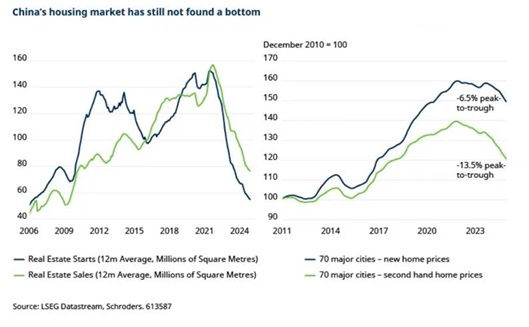
All of this begs the question of how much longer will the housing bust go on? According to our analysis of data from 20 major economies published by the Bank for International Settlements (BIS), on average house price corrections last almost six years with peak-to-trough falls in nominal prices of almost 30% (see table, below).
Moreover, house prices typically take another six years or so to recover to their prior peaks, and in some cases such as Japan and Spain its takes much longer to recoup the losses if they ever are recouped.
That would imply that the current housing correction in China has roughly three years to go, implying significant further falls in house prices. If anything, it could be argued that the slump in China will last longer than average given the degree of overvaluation in the housing market and demographic trends, which imply structurally weaker long-term demand for real estate. Meanwhile, the authorities have been resisting market forces through regulations such as price controls.
Click here to read more...


