

High-water marks
Almost two years’ worth of rain fell in Dubai last week, flooding a desert city completely unprepared for such a deluge. It is symbolic of a world under threat from climate change and extreme weather, but also a reminder that surprising things happen in surprising places (sadly, the recent flooding in KZN is not that unusual).
Although Dubai’s physical infrastructure could not cope with the water, its social infrastructure seemed to manage quite well.
Elsewhere in the Middle East, another unwelcome surprise was Iran and Israel firing missiles at one another in what might still be a dangerous escalation of not only the current conflict, but the long-standing feud between the two countries. However, in both instances, the attacks seemed designed to send a message, rather than cause damage. The price of Brent crude did not rise much above $90 dollars, a sign that oil traders still see the conflict as contained. Iran is a major oil producer and can interrupt oil supplies elsewhere as about a fifth of global oil is transported through the Strait of Hormuz, a narrow channel it could partially close.
A regional war in the Middle East could easily see oil jump above $100 per barrel, feeding into global inflation and slowing economic growth. However, unlike Russia, which started its war on Ukraine with a strong economy, ample foreign exchange reserves and supportive population, Iran has none of those. Despite its oil wealth, its economy is already very weak, hobbled by years of sanctions, with inflation of 40% and a currency trading at record lows on the black market (the official exchange rate is fixed by the government). Combined with repressive laws, this does not make for a happy population. This should hopefully limit Tehran’s appetite for open warfare. In turn, Israel’s allies in the West have urged restraint.
Markets generally struggle to price in the geopolitical risks that often have binary outcomes – there is or isn’t a war. But these risks also usually have a limited impact on long-term returns and asset allocation decisions. What really matters is the global economic growth outlook and interest rate cycle. And when we say global, in practice we mean the US. The biggest thing equity investors should fear is a global recession that is centred on the US. Such an outcome has historically been associated with major equity bear markets. Everything else is just volatility, corrections rather than crashes, a torrent that clears up when the clouds lift. As for the interest rate cycle, which is the main driver of bond market returns, we’ve seen substantial shifts in expectations over the past few weeks.
The good news and the bad news
There is good news and bad news on the global growth. The International Monetary Fund’s (IMF’s) latest bi-annual global projections point to the weakest medium-term outlook in 30 years, with average growth of 3% expected until 2028. This is largely the result of ageing populations in developed countries, while China’s era of rapid growth is over (better-than-expected first quarter growth notwithstanding). China’s contribution to global growth is therefore fading, while India is not quite big enough to offset it. Another major headwind to global growth, according to the IMF, is global fragmentation and increased trade frictions. Emerging artificial intelligence and robotics technologies might counteract this trend, but we simply don’t know yet.
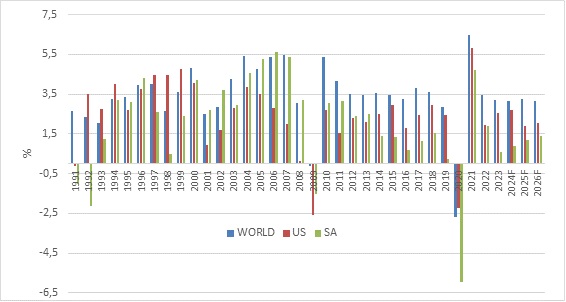
However, in the shorter term, the global economy has been remarkably resilient despite interest rates at multi-decade highs and the persistence of the various geopolitical risks. The IMF expects steady growth of 3.2% this year. The US is the main contributor to this improved outlook, with the IMF expecting it to grow 2.5% this year, faster than last year, and significantly faster than what was projected a few months ago.
Chart 1: Global economic growth with forecasts
Source: International Monetary Fund
The wrinkle in the tale, of course, is that strong US growth is seemingly leading to sustained upward pressure on inflation, particularly of services prices. Inflation fell rapidly from the mid-2022 peak without a concomitant rise in unemployment, but the decline seems to have stalled this year.
The flood of rate cuts expected by the market this year has therefore been pared back to a trickle. Bond yields have risen substantially since January. The equity market seemed unfazed at first, but reality sunk in over the last few days. All else equal, higher bond yields should put downward pressure on price: earnings multiples.
Some are now asking whether the Federal Reserve will be forced to hike rates, an outcome that would really cause stormy markets. This still seems very unlikely unless there was a meaningful and broad-based acceleration in inflation and wage growth. The inflation surprise of the past three months has mostly come from a handful of items (housing and car insurance) while wage growth has cooled.
Since there are lags between changes in interest rates and the direction of inflation, central banks do not need to wait for inflation to be at target to cut rates. However, they do need confidence that inflation is heading in the right direction and will remain on target once it gets there. The current environment means such confidence is in short supply. Fed Chair Jerome Powell admitted as much last week, saying that it will likely take “longer than expected” to achieve that confidence.
Powell’s lack of confidence robs many other central bankers of theirs. The SA Reserve Bank doesn’t have to wait for Fed cuts before it starts lowering the repo rate, but it needs to have a certain degree of clarity around the Fed’s intentions, and of course, it also needs to be sure that local inflation is moving in the right direction.
South African inflation declined to 5.3% year-on-year in March, helped by food prices rising at a slower pace. Rental inflation, a large component of the consumer price index, which is measured quarterly in South Africa, remains subdued. Whereas in the US, rental inflation (including the implied rent homeowners pay themselves – owners’ equivalent rent) has been a major reason why inflation has remained so elevated, in South Africa it is the opposite. The housing category has been a drag on overall inflation, running below the 4.5% mid-point of the Reserve Bank’s inflation target since mid-2018.
Click here to read more...


