

Global Investing: No Such Thing As Bad Timing

Reyneke Van Wyk, Head of Investment Management at Stonehage Fleming in South Africa.
Do investors place too much focus on timing of the exchange rate when funds are invested offshore?
Recent studies have revealed that when a disciplined approach to the regular investment of funds offshore is followed, the timing of these transactions is less important than many investors perceive it to be.
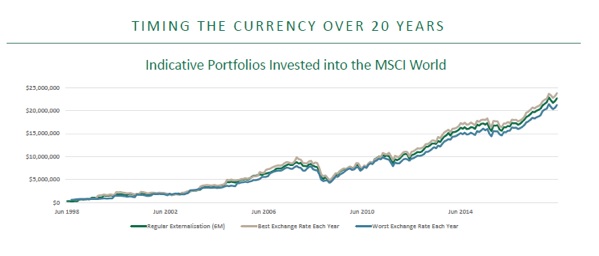
Reyneke Van Wyk, Head of Investment Management at Stonehage Fleming in South Africa, confirmed this in an exercise that looked at three international portfolios, each following a different phasing-in approach over a period of 20 years, with all proceeds invested into the MSCI World Equity Index.
In this simulation, the first investor was able to transfer R4 million per annum at the best possible exchange rate each year for 20 years, while the second investor transferred the same amount over the same time period at the worst possible exchange rate each year. The third investor paid no regard to currency fluctuations and transferred two tranches of R2 million each year, in the months of June and December.
When comparing the first two scenarios, the investor who transferred funds at the best possible exchange rate only outperformed the other by an accumulative 12.1% (0.6% per annum) over 20 years.
When comparing to the third investor who transferred R2 million twice a year in consistent months, the difference between this portfolio and the one invested at the best possible exchange rate each year was only an accumulative 4.9% higher (0.2% per annum) over 20 years.
“While the difference between annual performance percentages may be considered nominal,” said Van Wyk, “the effort and luck required to try and time such transactions year in and year out at the best exchange rate over an extended period should not be underestimated.”
Source: SFIM (calculations), Factset, Morningstar
Past performance is not a reliable indicator of future performance
Van Wyk adds that, there is also the potential opportunity cost by delaying investment, especially over long periods.
Equity market studies offer insights into the risks inherent in attempting to time equity markets. The best and worst days of performance are often clustered together and given the fact that markets go up over time, the risk of missing out on the best days is the greatest and can have a very negative effect on long-term investment success.
“We are not undermining the importance of being macro-aware,” says van Wyk. “However, at Stonehage Fleming we do not believe that market elements outside of our control should be the main drivers of any long-term investment decision. The focus should rather be on the appropriate long-term investment strategy for the investor.”
“Based on my practical experience advising clients on offshore investments over the past 18 years, the transfer of funds overseas should be carried out in a disciplined manner without yielding too great a concern over currency forecasts. We believe the most effective way to do this is to follow a structured process and it should be done in line with an agreed long-term investment strategy, which has defined any surplus assets available for offshore investment.”
He concluded:
“Investing on a global basis should be a crucial element of any investor’s overall strategy, as it reduces volatility and risk and improves risk adjusted performance in the long term. Stonehage Fleming has previously stated that South African tax residents should be investing 100% of surplus assets internationally, with surplus being defined as all capital not required to live comfortably and run your business within the next 10 years. Investing surplus capital offshore in a disciplined, structured way, is important to ensure positive long-term wealth preservation and growth, with reduced overall risk.”

