

Examining Companies Through the Lens of ESG
No matter where we invest, there’s always some sort of risk. This includes not only geopolitical or macroeconomic factors in a given country, but also issues that are unique to a specific sector or individual security. As bottom-up stock pickers, my team and I must assess the potential risks and returns related to each and every company we invest in. One area that warrants closer examination is environmental, social, and governance (ESG) risks and opportunities, which can play a big role in our stock selection and valuation process.
As part of our research process, the Templeton Emerging Markets Group evaluates a company’s market opportunity, competitive position, management strength, financial profitability and valuation. ESG issues can influence several of these factors. ESG does not typically incorporate strict screens that would automatically exclude any particular investment. Issues are considered if and when they impact the risk and return profile of an investment opportunity, similar to other company or industry investment considerations such as future growth prospects and market demand.
What might these ESG issues be? They might include natural resource scarcity, hazardous waste disposal, product safety, employee health and safety practices, or shareholder rights, to name a few.
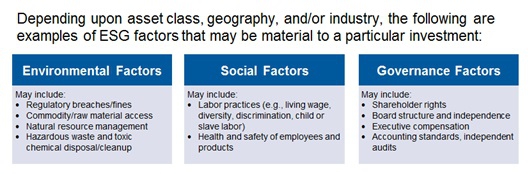
Some of the overall aspects we evaluate when analyzing individual companies include quality of company management, corporate governance, competitive position relative to peers, ownership structure and commitment to creating shareholder value. These dovetail with ESG factors. Our analysts typically conduct some 2,500 to 3,000 research meetings every year, meeting with company management, touring facilities, and meeting suppliers, clients and competitors.These meetings allow us to look at a company from many different perspectives and provide both broader and more detailed information across many factors (including ESG) which may otherwise not be captured.
In emerging markets, regulation and enforcement of issues pertaining to corruption, corporate governance, the environment and other social issues may be still evolving. However, as a country develops, generally these safeguards tend to become both more comprehensive and more stringently enforced.Thus, we believe companies with strong records of governance today (which can impact management of environmental and social issues) may be better prepared for the future, and thus, may provide a better investment case.For example, in our view, a company with inadequate environmental policies not only reflects badly on existing corporate governance, it may also bode poorly for the future competitiveness of that company.
Given the importance of corporate governance in evaluating investment opportunities, one of the key aspects we look for in company management is a strong culture and history of ethical business conduct. We conduct analyses of ownership structures, the management team’s track record, the company’s corporate governance history and its commitment to creating shareholder value. Additionally, we look for managers who know the business well, with experience in a given field, who are properly motivated through incentives such as stock options on company shares.We also pay attention to management’s ability to cope with a rapidly changing business environment. For example, in Thailand during the mid-to-late 1990s, when markets crashed and investor confidence was bleak, we could see the importance of strong company management and the steps these companies took to survive the crisis.
As part of our research process, we pay close attention to potential corporate governance concerns, and will not hesitate to actively oppose management at times if it is in the best interests of our investments. Not only do we take a proactive approach to monitoring corporate governance practices, we also scrutinize issues including the relationship between a company and its auditor, and related-party transactions, as these matters can uncover potential poor corporate governance practices.
Quality of management is a key consideration for us, as incompetence can potentially be extremely damaging. Accordingly, when researching a company, we seek not only to meet with management and tour facilities, but we also try to meet with competitors, suppliers, customers and regulators. The information gleaned from these meetings can be crucial in understanding the company and its management quality. For example, a business regularly in arrears with its suppliers may have poor cash flow management.
Risks are everywhere and in many forms, but with proper examination, knowledge and a broad team research effort, we can better determine which we think are worth taking—and which are not


