

Custodians of capital: why company management matters

Gustav Schulenburg, Equity Analyst at PSG Asset Management.
Every day a company’s management team makes decisions to allocate capital and resources to specific projects, divisions and expenses – and by default, not to others.
Management teams have a meaningful impact on shareholder returns
This critical decision-making process – which is at management’s sole discretion (with oversight by boards of directors) – carves out a company’s future business path and subsequent cash flows. Since this ultimately dictates shareholder returns, management is one of the key components to evaluate when investing.
Asset managers are stewards of their clients’ capital, and management teams act as secondary custodians. The odds of generating appropriate returns on client capital can be tilted in a fund manager’s favour if they partner with strong, proven leadership teams.
Evaluating management is often subjective, and not always scientific
There is no perfect way to evaluate management or to distinguish easily between good and bad teams. In addition, companies aren’t static: management teams and operating environments change. Fund managers should focus on factual, historical footprints and try to remain impartial by considering:
• Resource allocation (financial and human)
Arguably, this is any CEO’s most important task. However, very few of those new to the role of CEO will have any experience or training in resource allocation.
• Return on capital employed
This will drive long-term shareholder returns and should be the key consideration in any management team’s decision-making process (above other factors such as growth, diversification and margins).
• Management’s focus on cash profit
It is often said that ‘the top line is for vanity and the bottom line for sanity’, which speaks to the flawed focus that some management teams have on business growth, as opposed to profitability. Another common saying states that ‘net income is an opinion, while cash flow is a fact’. This alludes to the variability of accounting profits and management’s ability to influence these – flexibility that cash flow reporting does not allow for.
Alignment through ownership leads to better decision-making
Over and above these criteria, it’s important to invest with management teams who are directly aligned with the asset manager and its clients through meaningful ownership in their own businesses. Aligned management teams think like shareholders: they prioritise growing per-share value over growing the size of the business.
Responsible owners make superior capital allocators in cyclical industries
Ownership is not always a foolproof assessment metric – ‘empire building’-type CEOs may well view size (and not shareholder value) as success, even if they do have ownership stakes. It is therefore critical to assess capital allocation track records.
This is especially true in cyclical industries, as these businesses are cash flush with strong balance sheets at the top of a cycle. Good management teams will resist the urge – and often also pressure from institutional shareholders – to spend this money on seemingly attractive acquisitions or growth ventures that could cost shareholders once the cycle turns. Rather, they will recognise the importance of keeping cash on hand to weather the inevitable downturn and potentially deploy in an environment where prices are depressed.
The South African construction sector serves as a good case study
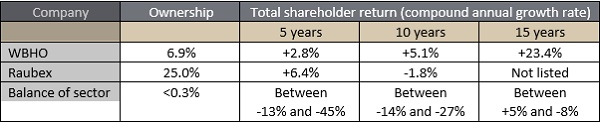
Consider the shareholder returns of two construction companies with management teams that have meaningful ownership stakes compared to the industry average: WBHO and Raubex. In an industry that is challenging at the best of times, these returns are not necessarily impressive in isolation. However, the benefit to shareholders is illustrated by the difference between the returns of these companies and those of their peers, where management teams are less aligned.
Total shareholder returns – WBHO and Raubex versus the sector (to 7 March 2018)
Sources: PSG Asset Management, Bloomberg, company annual reports
In tough cyclical industries, consistency often matters just as much as growth. However, this is hard to achieve: it is much more difficult to maintain profit in a downturn than it is to grow profit in an upcycle. It is therefore significant to observe the difference in volatility of reported profit margins between WBHO and Raubex and their peers. In aggregate, WBHO and Raubex have had uninterrupted positive net profit margins in both favourable and challenging cycles, while the sector has collectively had multiple periods of net losses in the last 15 years.
The importance of a long-term mindset
A long-term mindset helps to resist the urge to ‘swing for the fences’ on transitory ideas or to grow at any cost to impress short-term market commentators. Investments should be viewed on an absolute basis and risk defined as the potential for permanent capital loss, This offers an additional line of defence in protecting investors’ savings.

