

Concentration risk
The artificial intelligence (AI) capex boom provided an important boost to global economic activity, offsetting some of the drag from elevated oil prices. It has certainly driven stock markets higher, although the list of beneficiaries seems to be narrowing.
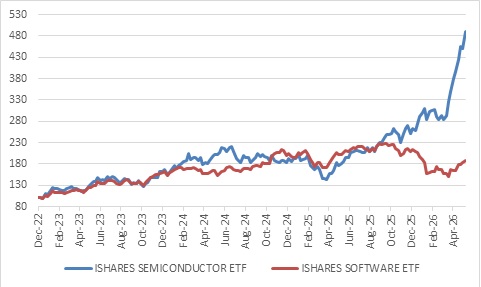
As chart 1 shows, it is not entirely correct to talk about a “tech” boom anymore, since semiconductor shares have increasingly diverged from software companies. The latter have come under pressure amid concerns that their business models could be disrupted by AI. For the producers of semiconductors (microchips), on the other hand, the gains have been nothing short of spectacular. Demand for microchips has been exceptionally strong as hundreds of billions of dollars are invested into datacentres and related AI-infrastructure.
While many fear that a bubble is blowing, this is not a bubble in the narrow sense. Semiconductor companies have experienced rapid profit growth, unlike the dotcom bubble of the 1990s, when expectations became completely detached from underlying profitability. However, it can still be a bubble in a broader sense. If the datacentre build-out were to stop tomorrow, for whatever reason, the demand for semiconductors will drop dramatically. Although it’s hard to imagine this now, it has historically been a highly cyclical industry.
Chart 1: Tech hardware versus software performance
Source: LSEG Datastream
It is very difficult to know if enough, too few or too many datacentres are being built today. It will ultimately depend on how businesses and consumers use AI and how much they are prepared to pay for it. It also depends on how disciplined the builders of this infrastructure are in matching supply with real demand. For instance, past real estate cycles show that more speculative construction takes place the longer the good times last. Similarly, later stages in commodity cycles are usually characterised by the development of low-quality, high-cost mines as current strong demand is projected into the future. While technology evolves, human nature does not.
What is beyond doubt is that concentration risk has increased. There are at least three dimensions to this. Firstly, it is well known that the S&P 500 has become more concentrated, with the top 10 stocks making up a larger share of market value than in the past at around 40%.
Click here to read more...


