

Between Hype and Fear
Many European football fans visiting the US for the FIFA World Cup have been astounded by the size and sophistication of American stadiums.
This includes the most expensive stadium ever built, the 70,000-seater SoFi Stadium in California. Named after its sponsor, a financial company, it could easily have been called the Sci-fi Stadium as it resembles a giant spaceship. The cost was also out of this world, coming in at $5.5 billion.
However, this pales in comparison to the cost of a typical artificial intelligence (AI) datacentre, which can be between $10 to $40 billion depending on the size. Although there are only a dozen or so stadiums in the US with a price tag of more than $1 billion, hundreds of datacentres are under construction with more than a thousand in the planning stage. McKinsey estimates that global spending on datacentres could reach a cumulative $7 trillion by 2030. Just as the FIFA World Cup draws fans from around the world, these datacentres rely on imported components, spreading the economic gains to many countries. Indeed, semiconductors account for 50% of a datacentre’s cost and are mainly sourced from Taiwan and Korea. Unlike the World Cup, this build-out is not ending any time soon.
The International Monetary Fund’s latest outlook is titled “Global Economy in Crosscurrents of War and Technology.” It doesn’t exactly roll off the tongue but still summarises the situation. On the one hand, there is the extraordinary, fixed investment boom as companies compete to get ahead in the AI race. On the other hand, the world economy faces not only the impact of the Gulf War, but in fact a series of geopolitical shocks, including the still-raging war in Ukraine and the 2025 US tariff shock.
A turn for the worse
In terms of the war, things took a turn for the worse last week. Iran fired on ships trying to cross through the Strait of Hormuz. The US retaliated by launching missile strikes on several sites in Iran. President Trump said that the ceasefire was “over” as far he was concerned, and the oil price predictably jumped about 5%.
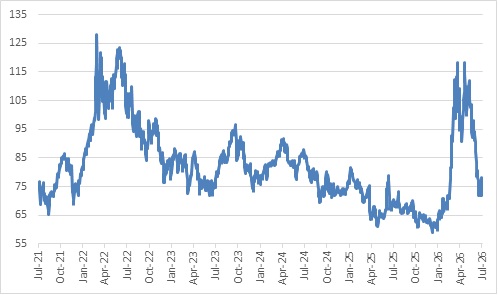
Chart 1: Brent crude oil price, $ per barrel
Source: LSEG Datastream
Since there is no trust between Iran and the US, the peace process was always going to be bumpy. However, both sides have a strong incentive to put the conflict behind them. America holds midterm elections in November, and this war and associated fuel price increases are unpopular with voters. As for Iran, it achieved a strategic victory against a much more powerful opponent simply by holding out. However, its fragile economy means it doesn’t have infinite capacity to absorb a US military and financial assault. At $76 per barrel, Friday’s closing price, it is clear that market believes that the peace process will continue.
At its worst, the oil price spiked to $120 per barrel, but never came close to the doomsday-scenario of $200 per barrel. While most people fixated on the loss of supply, there was enough demand flexibility to avoid things spiralling out of control, while there were also ample stockpiles to draw from, notably in China. If the conflict escalates further, investors will keep a nervous eye on those inventory levels.
Nonetheless, there was a negative economic impact. An oil price spike transfers income from buyers to producers, but the latter does not spend as much as the former. Therefore, total global spending on non-oil goods and services declined. Inflation rates also increased, though not nearly as much as was the case after the Russian invasion of Ukraine, since that episode was associated with a surge of pent-up demand as the world exited Covid lockdowns
In response to higher inflation, and particularly the concern that consumers and businesses will start believing that inflation will be permanently higher, several central banks raised interest rates. This includes the South African Reserve Bank. Long-term market-based rates (bond yields) also increased in countries such as the US and UK where central banks have so far remained on hold.
Click here to read more...


