

Beat the market flux with flexibility
12 March 2014 | Investments | General | Anet Ahern, PSG Asset Management
Investors were already tested this year by a sell-off in emerging market currencies, increased stock market volatility and a surprise rate hike here in SA. Questioning an investment strategy is therefore quite understandable.
There are times when various markets and asset classes spend extended periods of time moving – or not moving – in a constant direction. During these periods portfolio construction will be relatively stable. But, there are times, over the short- or medium-terms, when markets are in considerable flux and when portfolio construction has to change at short notice and a firm hand is required on the tiller.
According to PSG Asset Management CEO, Anet Ahern, investors have a few options with uncertainty in the markets:
• Run to safety and sit in cash. Some of the disadvantages of this choice include getting the timing wrong both on exiting and re-entering long-term growth asset classes and the resultant opportunity cost of being out of the equity market at the wrong time. There is the added complications of triggering CGT events and having to pay tax on the interest earned on the cash.
• Stick with your current strategy. This is not a bad option, as long as your strategy was a solid one for your needs to begin with. You can take advantage of rand cost averaging if you are a regular contributor to your portfolio and you reduce the risk of trying to time the market. However, you may need to "vasbyt” for a while and watch opportunities pass you by as the temporary market downturn plays itself out.
• The third option is to include a fund with a flexible mandate in your strategy. With these funds the manager has sufficient flexibility in the mandate to address your three main concerns- rising interest rates (by holding more cash and avoiding bonds and other interest rate sensitive shares if they don’t offer value), a weaker rand (by taking full advantage of the offshore allocation and picking global shares that offer good value) and a volatile stock market (by applying the cash to the equity market as lower prices provide opportunity and vice versa).
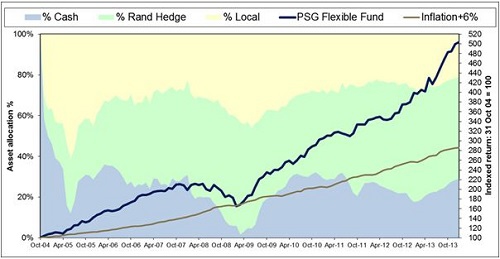
The chart below shows how the PSG Flexible Fund has taken advantage of its flexible mandate over time, best illustrated in the cash and rand hedge weightings in the fund. Notice, in particular, the low weighting in cash at the time of maximum pessimism and maximum value in 2009.
Source: PSG Asset Management Research
"In our minds, a flexible mandate is of little use if the fund manager is not fully aware of risks and valuations. An added comfort to an investor in such a fund should be that the valuations of the equity portion of the fund should be lower than that of the SA equity market, and at a level where long term investors are prepared to stay invested,” says Ahern.
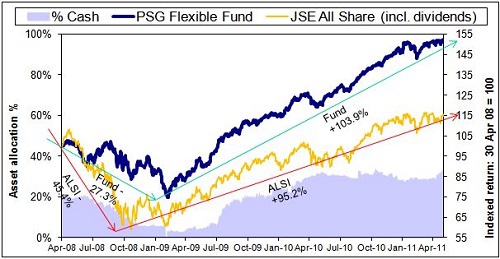
The chart below shows the draw-down of the PSG Flexible Fund relative to the FTSE/JSE All Share Index between April 2008 and April 2011. As can be seen, when the All Share Index (ALSI) had a 45% pull-back, the PSG Flexible Fund only declined by just 27%. By the time the ALSI had returned to its previous high some 3 years later, the PSG Flexible Fund had already significantly exceeded its previous high and did so in a considerably shorter period.
Source: PSG Asset Management Research
Ahern is of the opinion that flexibility in itself is a powerful ally during uncertain times, but it is the eye on valuations and risk that has made the PSG Flexible Fund a great companion for all markets.


