

All That Glitters
It started with stars and a bang. The elements that form the building blocks of life on earth were created in nuclear explosions inside stars billions of years ago and ultimately scattered throughout the universe.
This includes element number 79, gold. As our planet was forming, gold particles formed part of the earth’s core. It is theorised that a period of intense asteroid activity about four billion years ago forced some of this into the mantle. Other theories suggest hot fluids and magma dissolved the gold particles and moved it closer to the surface where it eventually cooled in fissures and cracks in the crust. Tectonic shifts, erosion, weathering and other geological processes over millions of years then exposed these gold deposits to a point where humans could eventually access them.
In the case of South Africa’s gold riches, a meteor strike two billion years ago concentrated these deposits in reefs that formed an arc from Witwatersrand to Klerksdorp and Welkom around the impact site near Vredefort.
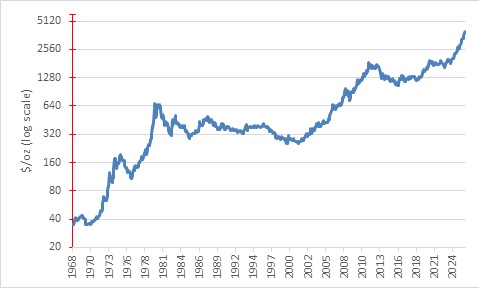
In other words, immense astrophysical forces created gold atoms, while ancient geological forces created the gold reefs and deposits that could eventually be mined. Arguably, humanity’s millennia-old fascination with gold as an object of value reflects some deep psychological force. Today, it is largely political forces that are responsible for gold’s glittering run, pushing the price towards $4000 per ounce for the first time.
Chart 1 Gold bullion price, $/oz
Source: LSEG Datastream
Fiscal follies
While the current upcycle in gold began in 2022, the most recent source of momentum is the two-week old US government shutdown. Democrats and Republicans cannot agree on passing a new budget, meaning that parts of the federal government have no funding for the fiscal year and workers must go on furlough until Congress can appropriate the money. This has happened before from time to time, with the longest shutdown in late 2018 lasting five weeks. Since government workers receive backpay, the economic impact was limited. Therefore, the big worry is not so much the shutdown as what it represents: deepening political divisions that will make tackling the US government’s long-term debt problem difficult.
The US is far from alone. France’s new prime minister resigned after scarcely a month in the role as he too has failed to get parliamentary support for tackling the country’s large budget deficit. It is not that any of these rich countries’ debt levels are unmanageable from a technocratic point of view. It is the political will that is missing and that is what markets are starting to worry about.
It points to an ongoing increase in government debt which means more bonds being issued but also increasingly a shortage of safe assets. US Treasury bonds have long been the world’s risk-free asset and will continue to be so in many contexts, but in other ways it is losing that role. This is firstly because of the political dysfunction described above that led to the US losing its triple-A credit rating, and secondly because many countries no longer see US bonds and the dollar as purely financial, politically neutral, instruments. Reserve managers like central banks and sovereign wealth funds had been gradually diversifying away from dollar assets, but this process sped up after a big chunk of Russia’s central bank reserves were frozen in the wake of the full-scale invasion of Ukraine in 2022. Most countries are (hopefully) not planning to invade their neighbours, but even peaceful nations wonder if there isn’t a small risk of falling foul of the US government.
But where to go? There is a shortage of triple A-rated government bonds to invest in. S&P Global only rates 11 countries as AAA. These include small countries like Switzerland, Singapore, Luxembourg and the Netherlands, whose markets are not liquid enough to absorb a large shift away from US assets. The largest AAA-rated sovereign is Germany, which until recently has been trying to reduce borrowing, i.e. shrinking its bond market. This is starting to turn around under the Merz government, but the reality remains that large investors have limited options if they want the ideal combination of safety, convertibility (which China doesn’t offer) and liquidity.
This is where gold comes in. Central bank purchases of gold have doubled since 2022 to an average of around 270 tonnes per quarter compared to 118 tonnes per quarter between 2010 and 2021 according to the World Gold Council. Central bank purchases are a small part of the overall gold market and still only half as big as the demand for gold for jewellery fabrication. However, since the overall gold market is not that big and supply is largely fixed, this increase in demand had a notable impact on the price. The daily turnover of between $100 billion and $200 billion in the global gold market is but a slice of the $900 billion daily turnover in the US Treasury market. This also means that gold can never be a perfect substitute for US bonds, since it too lacks liquidity.
Click here to read more...


