

Advice critical to ensure investors don’t miss out on returns

Carl Lategan, head of IFA distribution at Allan Gray.
Historical performance is the biggest driver of money flowing into unit trusts. After a unit trust does well, flows come in, and after performance dips, investors move money out. But it is precisely this behaviour that is most detrimental to wealth creation.
This is the view of Carl Lategan, head of IFA distribution at Allan Gray, who says that despite investment portfolios being more diversified today than ever before, there is a troubling correlation between investment flows and performance.
“Time and again we see investors disinvest when performance dips and then they come back when performance improves. The issue is that they don’t benefit from the uptick because they usually respond after the unit trust has done well. An important part of the value of an investment is destroyed by this behaviour,” says Lategan.
He adds that trying to time the market results in investors buying high and selling low, which means that investor returns are often lower than the returns of the unit trusts in which they invest.
To illustrate how this behaviour can eat into returns, in the graph below Lategan looks at money coming into and leaving the Allan Gray Balanced Fund (the Fund), represented by the grey area, and how this is correlated with the Fund’s performance, with a six-month lag (as illustrated by the green and red lines). Note how flows tend to peak after a period of strong performance and tail off after periods of underperformance.
Lategan explains that if you had been invested from points A to B you would have achieved 3.62% return. If you stayed invested for the two years form A-B and B-C you would have realised 3.62% and 15.77% respectively, leaving you with 20.12% returns over the two years. Annualised, this is a 9.6% return vs the 3.62%: a difference of 5.98%.
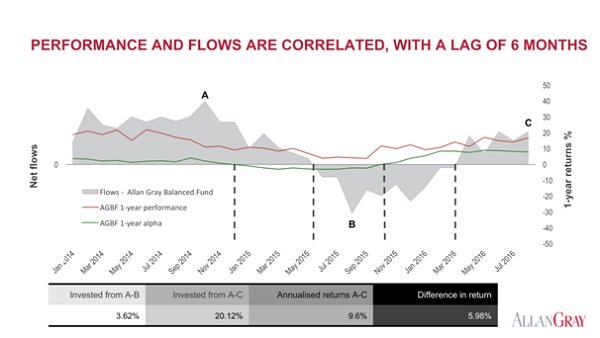
“This is an extreme example, but some investors are missing out on a 6% return in a year, over the longer term this becomes massive, especially when taking into account the impact of compound interest. Compared with staying in the fund and riding out the cycle, it may take years to make up the difference in returns,” says Lategan, adding that being prepared to sit out a period of negative performance means that investors would be in a better position to reap the returns when the fund bounces back.
“If you look at money going into the unit trust industry today, it is going to a wide range of investment managers and unit trusts, suggesting that the average portfolio is more diversified than a few years ago. A well-diversified portfolio spreads investment risk, meaning if one manager or asset class is underperforming, your returns should come from another. There should therefore be less temptation to switch,” he explains.
Lategan believes that independent financial advisers have a critical role to play in educating clients on how their behaviour can be detrimental to wealth creation. “Fluctuating performance is normal. It’s also normal for emotions to take hold when performance dips. Advisers can serve as a ‘voice of reason’, minimising doubt in volatile times, helping investors to be rational rather than emotional, and encouraging them to avoid switching between investments for the wrong reasons.”
The bottom line is that past performance is in the past. Our emotions cause us to make decisions - normally at exactly the wrong time: by the time you switch out of an underperforming unit trust it is too late, and you inevitably switch into a unit trust with good short-term past performance – too late once again! Essentially you are paying a double negative.
As US writer and independent financial adviser Carl Richard says: “Investing based on past performance is like driving while looking in the rear view mirror… It leads to a lot of accidents!”
“The best approach is to pick a good investment manager, stick with them for the long term and, if you are an adviser, convince your clients to do the same. This gives investors a better chance of getting the most value out of their investments,” Lategan concludes.

