

A new era of energy risk is reshaping the global economy – and driving the energy transition

Energy security fears used to be concentrated in heavy industry, manufacturing and transport. Today, energy risk is becoming embedded in the broader economy – and this is a structural tailwind for energy transition infrastructure.
In the past five years, two systemic shocks have tested the resilience of the modern energy system – a fundamental part of the modern economy: the war in Ukraine and the ongoing conflict in the Middle East. Both events triggered fuel supply shortages and a sharp spike in global energy prices.
These crises, in different ways, have revealed the same structural weakness. Economies that remain heavily dependent on internationally traded fossil fuels are acutely vulnerable to geopolitical disruption, price volatility and supply uncertainty. What begins as a regional conflict or supply shock rapidly becomes an issue affecting global markets, feeding into inflation, interest rates and broader economic growth.
The latest tensions in the Middle East are a further reminder that energy security can no longer be viewed narrowly as a question of maintaining supply. It is increasingly about reducing exposure to external fuel-price driven shocks altogether. This is a key structural tailwind for the global energy transition.
Supply-side shocks
Oil and gas markets remain highly sensitive to geopolitical developments, with even relatively small changes in supply expectations capable of moving prices sharply. Those price movements then cascade through economies via current and medium-term wholesale gas and electricity prices (see below example based on UK data), as well as through transport costs, industrial production and, ultimately, consumer inflation.
Wholesale electricity prices have surged
UK future wholesale electricity prices (£/MWh), March 2026-December 2028
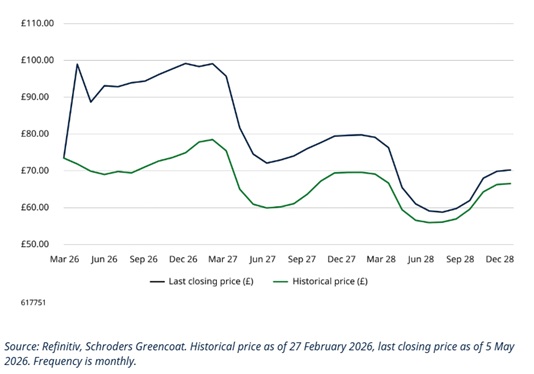
For policymakers, this creates a familiar but increasingly difficult dilemma: inflationary pressure driven by supply-side issues and input costs is notoriously hard to contain through the traditional mechanism of interest rate rises, which are designed to curb demand. Tightening policy too aggressively risks undermining growth, while failing to contain inflation raises the prospect of stagflation.
Demand-side shifts
If energy markets are currently a key focus in economics and monetary policy, then demand dynamics - specifically rising demand for power - are similarly altering the equation.
In the digital age, electricity is assuming an economic role comparable to the one oil played during the industrial age. The artificial intelligence revolution, data centre boom, and ongoing electrification and digitalisation of sectors across the economy is driving up demand for electricity – in some places for the first time in more than a decade.
Given the scale of the growth expected over the coming years (see chart), this in turn transforms electricity from a background utility into a core determinant of economic competitiveness.
Click here to read more...

