

State of the South African Exchange Traded Product (ETP) Industry – as at 31st March 2019
Market Capitalisation
At the end of March 2019, the total market capitalisation of all ETFs and ETNs, listed on the JSE, amounted to R89,4 billion. This is a significantly sharp increase on the total market capitalisation of R77,8 billion at the end 2018, a rise of 14,9%.
This increase was a function of: rising SA equity markets – large capitalisation local stocks staged a rally in early 2019 as investment sentiment improved; US and some other global equity markets, notably emerging markets, also staged a recovery in early-2019; and the rand did not appreciate to dampen this offshore equity market revival, which had been the case for much of 2018.
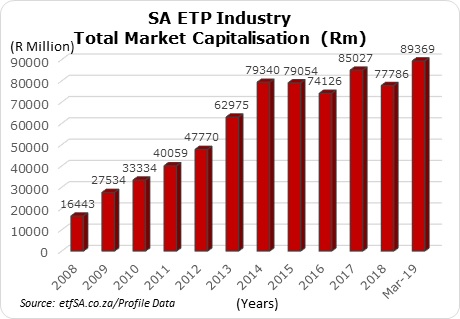
The total market capitalisation of close to R90 billion is the highest on record for the end of a quarter, since the inception of the ETP industry in South Africa in 2000.
New Capital Raised
The R11,5 billion rise in the market capitalisation of the ETP industry in the first quarter of 2019, was largely a function of the revival in the equity markets, which is fully captured by market capitalisation based indices.
However, there was also a sum of R5 215 million (R5,2 billion) rand raised in new capital issues of securities during this period. The main contributor to this capital raising was the NewGold Platinum ETF, issued by Absa Capital, which recorded a rise of R4,0 billion in new securities issued on the JSE, during the first quarter of this year.
This interest in platinum ETFs, follows the sharp price rise in the palladium and rhodium ETFs during the past 18 months. The market might be taking the view that the price gap between platinum and the other metals produced from PGM metals is likely to close.
Apart from this latent interest in platinum ETFs, there were steady flows of capital into some South African equity index tracking ETFs issued by Satrix and CoreShares. But profit-taking in certain foreign asset-based ETFs, listed on the JSE, saw a flow of capital out of such products, which particularly affected Sygnia Itrix, which recorded a negative capital flow of R202,6 million for the quarter.
The South African ETP Industry as at 13 March 2019
Table A summarises the South African ETP industry, which now has 12 separate issuers of Exchange Traded Products, with a total number of 104 such products listed on the JSE – 77 ETFs and 27 ETNs. The total market capitalisation of the industry at the end of the first quarter 2019, was R89,4 billion, of which R79,1 billion was ETFs and R10,3 billion ETNs.
Five new products - three smart beta ETFs, issued by Absa, and two new actively managed ETNs, issued by Union Bank of Switzerland, were listed on the JSE during the first quarter of 2019.
Table A
|
The South African Exchange Traded Product Industry (as at 31 March 2019) |
|||||||
|
|
Issuer |
Number of Products |
Value (Market Cap) of Shares in Issue (Rm) |
Total Market Capitalisation (Rm) |
|||
|
ETFs |
ETNs |
ETFs |
ETNs |
||||
|
1. |
Absa Capital |
21 |
5 |
26 796,0 |
488,1 |
27 284,1 |
|
|
2. |
Sygnia/Itrix |
10 |
- |
19 019,4 |
- |
19 019,4 |
|
|
3. |
Satrix Managers |
15 |
- |
17 148,3 |
- |
17 148,3 |
|
|
4. |
Standard Bank |
4 |
10 |
5 410,5 |
1 778,6 |
7 189,1 |
|
|
5. |
Deutsche Bank |
- |
3 |
- |
5 202,0 |
5 202,0 |
|
|
6. |
CoreShares |
9 |
- |
3 912,5 |
- |
3 912,5 |
|
|
7. |
Ashburton |
5 |
- |
3 095,1 |
- |
3 095,1 |
|
|
8. |
Stanlib |
8 |
- |
2 914,9 |
- |
2 914,9 |
|
|
9. |
Investec |
- |
2 |
- |
1 844,0 |
1 844,0 |
|
|
10. |
UBS |
- |
7 |
- |
951,0 |
951,0 |
|
|
11. |
FirstRand (RMB) |
3 |
- |
788,2 |
- |
788,2 |
|
|
12. |
Cloud Atlas |
2 |
- |
20,3 |
0 |
20,3 |
|
|
Totals |
77 |
27 |
79 105,2 |
10 263,7 |
89 368,9 |
||
|
Source: |
etfSA.co.za / JSE / Profile Data (31/3/2019). |
||||||
Absa Capital – continues as the largest issuer of ETPs in South Africa, with 21 ETFs and 5 ETNs listed on the JSE, with a total market capitalisation of R27,3 billion.
Renewed interest in the NewGold Platinum ETF in the early months of 2019, resulted in more than R4 billion new Platinum ETF security listings in the quarter.
Absa also issued 3 new innovative smart beta ETFs during the quarter. These products break new ground in shifting between SA equities and cash, depending on various momentum or volatility target being triggered. These mechanism automatically adjust the portfolios to market changes and the 3 ETFs have different managed objectives, namely defensive, moderate and high growth equity exposure. This is a relatively sophisticated technique and is probably better suited to the institutional, rather than retail market in South Africa.
Sygnia Itrix – has consolidated its place as the second largest issuer of ETFs in South Africa, with over R19 billion in total market capitalisation. The gap between Sygnia Itrix and Absa Capital has grown in the first quarter because of Absa’s success in listing new commodity ETFs, but the marketing prowess of Sygnia Itrix should keep the competition between it and Absa to be South Africa’s largest ETF provider finely balanced.
CoreShares – is focussing on rationalising its ETF product offerings and has closed the Low Volatility ETF because of lack of market interest. However, it is looking to list a multi-factor smart beta ETF in early May, which takes into account six different investment factors in the weighting of its portfolio constituents.
The dual listing of the CoreShares Global Property and S&P 500 ETFs on the Mauritius Stock Exchange, has been terminated and these products are now primarily listed on the JSE only. This should avoid duplication of costs.
CoreShares has also set up a ballot process for the delisting of the SA Equally Weighted Top 40 ETF, which has showed disappointing investing performance over the years of its listing.
Union Bank of Switzerland – UBS AG has now issued seven ETNs on the JSE that track actively managed portfolios of securities, both local and offshore, for various SA fund managers. Absa, Momentum Securities and the Efficient Group have used these portfolio notes for the purposes of listing on the JSE and this active/passive mechanism could develop further in time. The 7 ETNs now have a combined market capitalisation of R951 million.
Smart Beta in South Africa
The recent listing by Absa of three new managed volatility ETFs, brings to 17 the number of smart beta products now available to the SA investment products in ETF form.
Smart beta is the generally accepted term for basing index tracking products, not on indices calculated by market capitalisation (by size), but taking into account other factors and criteria for grouping of securities in an index.
Typically, the index calculators look at various investment “factors” such as value, momentum, volatility, etc. Research around the world indicates that such factors can be used to reduce risk or to extract investment performance in the market from time to time.
Another smart beta strategy is to look at “style” investing where index calculators isolate a specific criteria, such as high or consistent dividend payments as a criteria for stock selection to include in an index. Another concept would be to only include securities in an index that meet say, Islamic investment principles, or ESG criteria.
Table B, on page 5, shows the smart beta ETFs that are available in South Africa, listed by issuing houses and identifying the main factors tracked by such products. The 17 smart beta products have a combined market capitalisation just over R4 billion, which is only 4,4% of the total market capitalisation of the South African ETF products in issue. This market share of smart beta in South Africa is significantly lower than the penetration of smart beta products in developed markets.
What are the reasons for the relatively low acceptance of smart beta in South Africa?
• The ETF/ETN industry has been slow to develop investor acceptance in South Africa, probably because of the distribution domination and market clout of the active investment managers. The low margin ETF industry cannot compete with the distribution muscle of the established financial institutions.
So acceptance of passively managed products, like ETFs, will come, over time, from the investment public themselves and probably not from the sales teams of the major providers of investment products. Simple market capitalisation based ETFs/ETNs are easier for the investment public to understand than sophisticated smart beta ETFs and this explains the 96% share of market capitalisation ETFs in the local market.
• Given that institutions are likely to be the key market for smart beta based products, it is often easier to provide such factor based investment solutions, using segregated portfolios designed specifically for an institution’s requirements. So the smart beta ETFs listed on the JSE can be a “show-case” for the talents of the smart beta product providers.
• Single risk factor based smart beta ETFs require regular timing decisions by users of these products to choose the optimal investment factor at any point in time and to switch between factors on a regular basis. For this reason, multi-factor smart beta ETFs have become popular in the US and elsewhere and this solution might be more acceptable to the SA investment public.
Table B
|
Smart Beta ETFs Listed on the JSE (as at 31/3/2019) |
||||
|
Product |
Factor Tracked |
Current Market Cap. (Rm) |
Comments |
|
|
Absa Capital |
|
|
|
|
|
1. |
NewFunds Equity Momentum ETF |
Momentum |
86,0 |
Reweights and rebalances monthly to invest in shares showing the best upward momentum on the JSE. |
|
2. |
NewFunds Low Volatility ETF |
Low volatility |
29,5 |
Tracks 20 highly liquid shares exhibiting low volatility and low market beta. Also utilises equal risk contribution. |
|
3. |
NewFunds Value Equity ETF |
Value |
32,3 |
Low P/E and low risk-to-book ratios, with equal risk contribution. |
|
4. |
NewFunds S&P GIVI Resources 15 ETF |
Fundamental intrinsic value |
37,1 |
Filters resource stocks based on intrinsic value and low volatility. |
|
5. |
NewFunds S&P GIVI Industrial 25 ETF |
Fundamental intrinsic value |
37,0 |
Selects individual stocks on intrinsic value and low volatility. |
|
6. |
NewFunds S&P GIVI Financial 15 ETF |
Fundamental intrinsic value |
44,0 |
Chooses highly liquid financial shares based on value and volatility. |
|
7. |
NewFunds S&P GIVI Top 50 ETF |
Fundamental intrinsic value |
87,6 |
Index capped top 50 shares on JSE ranked on intrinsic value and volatility. |
|
8. |
NewFunds Shari’ah Top 40 ETF |
Islamic investment principles |
52,0 |
Constituents chosen on conforming to Islamic principles. |
|
9. |
NewFunds Volatility Managed High Growth Equity ETF |
70% momentum; 30% low volatility |
50,6 |
Changes asset allocation between equity and cash based on high drawdown triggers. |
|
10. |
NewFunds Volatility Managed Moderate Equity ETF |
50% momentum; 50% low volatility |
50,5 |
Changes asset allocation between equity and cash based on moderate drawdown triggers. |
|
11. |
NewFunds Volatility Managed Defensive Equity ETF |
100% low volatility |
50,4 |
Asset allocation switched between equity and cash based on low drawdown triggers. |
|
|
Sub-total |
557,0 |
|
|
|
Smart Beta ETFs Listed on the JSE (as at 31/3/2019) |
||||
|
Product |
Factor Tracked |
Current Market Cap. (Rm) |
Comments |
|
|
CoreShares |
|
|
|
|
|
12. |
CoreShares S&P Global Dividend ETF |
Dividends |
330,5 |
Tracks global portfolio of consistent dividend payers. |
|
13. |
CoreShares S&P SA Dividend Aristocrat ETF |
Dividends |
291,1 |
Tracks S&P index of SA stocks that have increased or maintained dividend payments for 7 consecutive years. |
|
|
Sub-total |
621,6 |
|
|
|
Satrix Managers |
|
|
|
|
|
14. |
Satrix Quality ETF |
Quality |
140,1 |
Tracks index based on return-on-equity, accruals and financial leverage ratios. |
|
15. |
Satrix Dividend Plus ETF |
Dividends |
1 635,9 |
Index tracking future high dividend yields. |
|
16. |
Satrix RAFI 40 ETF |
Value |
1 034,6 |
Shares selected on fundamental value. |
|
17. |
Satrix Momentum ETF |
Momentum |
13,2 |
Based on momentum criteria. |
|
Sub-total |
R2 823,8 |
|
||
|
GRAND TOTAL |
R4 002,4 |
|
||
|
Source: etfSA.co.za (end-March 2019). |
||||

