

State of the South African Exchange Traded Product (ETP) Industry – As at 29th March 2018

Mike Brown, Managing Director, etfSA.co.za
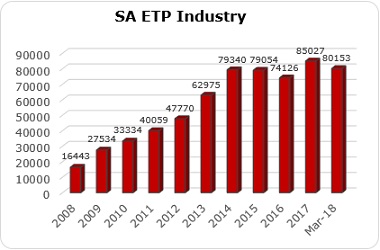
The Market Capitalisation of all Exchange Traded Products, listed on the JSE, was R80,2 billion at the end of the first quarter of 2018.
Market capitalisation
This is a fall of some R5 billion, or 5,7%, on the market capitalisation of the ETP industry at the end of 2017.
The drop in total market capitalisation was largely a function of the general decline in the SA equity markets over the first quarter of this year. However, some significant redemptions in commodity based ETPs took place over the past 3 months – the Absa Bank commodity ETFs redeemed over R2,2 billion and the Standard Bank commodity ETPs R882 million in capital over this period.
Interest in Exchange Traded Funds remains high, with 9 new ETFs listed on the JSE during the quarter. In IPOs and initial seed capital, these 9 new products raised a total capital sum of R278 million prior to listing on the JSE.
The ETP Industry as at end-March 2018
The number of ETFs and ETNs in issue on the JSE rose from 82 at the end of 2017 to 91 by the end of the first quarter 2018. Further listings of ETFs are expected in the second quarter of 2018.
The table below summarises the entire Exchange Traded Product industry in South Africa at the end of March, classified under: The issuers of these products; The market capitalisation of ETPs for each issuer; The number of ETPs in issue; and the new capital raised or redeemed during the first quarter of this year.
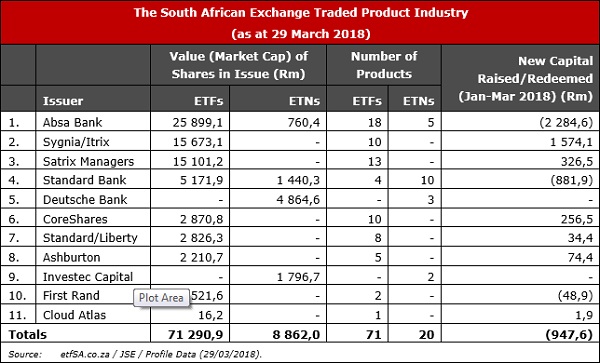
Absa Bank, with 18 ETFs and 5 ETNs listed on the JSE for a total market capitalisation of R26 659,5, remains the dominant ETP product issuer house in South Africa. During the first quarter, it redeemed some R2,2 billion through the delisting of commodity ETFs, mainly the NewGold Palladium and NewGold ETFs. Despite continued signs of improvement in global commodity prices, the relative strength of the rand and the strong price increases in such commodity ETPs during much of 2017, presumably led to profit taking by institutional investors in these products.
Absa listed two new innovative smart beta ETFs during the first quarter of this year. Developing new ETF products that look to manage and limit risk in portfolios appears to be a current focus at Absa Bank and further ETF listings covering this risk area of investment can be expected.
Sygnia/Itrix has now moved into second place, based on the market capitalisation of the ETFs it has in issue on the JSE, displacing Satrix Managers from its long-standing second place in the industry.
Sygnia/Itrix only became involved with ETFs in June 2017, when they purchased 5 offshore ETFs from Deutsche Bank, but it has since listed a further five new ETF products. During the first quarter of 2018, Sygnia/Itrix raised some R1 574,1 million in capital from new listings and existing ETF products on the JSE, making it the top capital raising issuer of ETFs by some margin.
Sygnia/Itrix shows every sign of becoming a major contender in the ETP business in South Africa and its future developments will be followed with great interest.
Satrix Managers - has now dropped to third place, but still remains well positioned through: its well-established brand; “ownership” of various key indices in South Africa with its ETF listings; steady roll-out of new ETFs, recently also covering global markets; and its links to Sanlam, one of South Africa’s largest asset managers.
Standard Bank – has formulated a niche issuing ETFs and ETNs covering commodities, ranging from precious metals to base metals, agricultural products and oil. ETFs and ETNs are the best way for SA investors to gain direct access to physical commodity markets through the JSE and this could become of more interest if commodities continue to make a case as an investment class in a steadily growing global economy.
CoreShares – has now moved ahead of Standard Liberty and Ashburton in terms of the number of ETFs it issues (10) and the total market capitalisation of these ETFs (R2 871 million) as at 29 March 2018.
CoreShares, as one of the smaller companies issuing ETFs, is a dynamic and innovative player in the industry and is always active in both developing the retail market and in the issue of new ETF securities.
Standard Liberty – issued 5 new ETFs in the first quarter of 2018, all covering global equity markets. Two products specifically fresh to the South Africa market are the Global Government Bond ETF and the S&P Information Technology ETF.
New ETFs Listed to Date in 2018
a) Absa NewFunds Low Volatility ETF
This ETF comprises an index of 20 highly liquid companies on the JSE that exhibit the lowest volatility as well as a low beta to the market. This focus provides an important risk control option for investors.
b) Absa NewFunds Value ETF
This ETF tracks an index of 30 highly liquid equities listed on the JSE that exhibit low price-to-book and low price-to-earnings characteristics. Again, this is a risk management product and can be a valuable investment tool for certain market cycles or as a long-term holding.
c) Stanlib S&P Info Tech Index Feeder ETF
This ETF uses the iShares S&P Information Technology UCITs ETF as a feeder fund. This index covers companies that are in the US S&P 500 index, but are specifically focused on the IT sector.
d) Stanlib MSCI World Index Feeder ETF
This ETF covers 1600 companies around the world, listed on developed nation stock exchanges to provide an overall exposure to the world equity market.
e) Stanlib S&P 600 Index Feeder ETF
Tracks the US S&P 500 index using the iShares Core S&P 500 UCITS ETF as a feeder fund.
f) Stanlib Global REIT Index Feeder ETF
Provides exposure to listed real estate companies (REITS) worldwide. The ETF uses the iShares Global REIT ETF, which tracks the FTSE/EPRA/NAREIT index, as a feeder fund.
g) Stanlib Global Government Bond Index Feeder ETF
Tracks the G7 country Global Government Bond index using the iShares Global Government Bond ETF as a feeder fund.
These 5 new Stanlib international ETFs all come with low targeted Total Exchange Ratios (TERs), which is a key benefit from using low cost iShares ETFs listed on global exchanges as the feeder funds. Although they appear to be aimed at in-house use by Stanlib Asset Management and Liberty Life, they do offer good alternatives to other investors looking for international passive index tracking exposure.
h) Ashburton World Government Bond ETF
Like the Stanlib Government Bond ETF, this new ETF also tracks a worldwide Government bond return, but uses the Citibank World Government Bond index (WGBI) index, which covers a wider spread of countries than the G7 index used by Stanlib.
i) CoreShares S&P Global Dividend Aristocrat ETF
Tracks a global portfolio of companies that have a consistent record of dividend payment growth. Provides an alternative to world index tracker ETFs by providing a quality filter using the dividend aristocrat method of choosing consistent dividend paying companies.

