

The merits of patient investing in a high-speed age
Investors who want to beat the market—and avoid competing with algorithms—can benefit from ignoring the noise and focusing on stock fundamentals.

For many equity investors today, proven traditional strategies, like focusing on the long term, may seem quaint. There is a heightened urgency today to pursue short-term gains, as reflected in high trading volumes and much shorter holding periods.
The emergence of algorithmic trading, hedge funds and passive strategies have intensified these trends but there is ample evidence that the tried-and-true methods still work. These include focusing on the long term and recognising that growth in corporate earnings has historically always been, by far, the primary driver of long-term equity returns. Traditional stock analysis, with its focus on company fundamentals remains an effective way to pursue market-beating returns. But it requires a rigorous and disciplined application to identify the companies poised to deliver growth that is not yet understood by the market. We outline below what that discipline entails, but first it is worth examining the current investment environment and why traditional investment strategies continue to demonstrate they offer the best way to pursue outsized returns.
Technology has enabled high-speed trading and short-term thinking, and neither leads to demonstrably better results
A profound transformation has reshaped equity markets in recent decades. While previous eras saw the predominance of patient investors with multi-year horizons, many investors now operate with a heightened sense of immediacy, holding stocks for months, weeks or less.
Figure 1: Investors’ horizons—and patience—has shortened
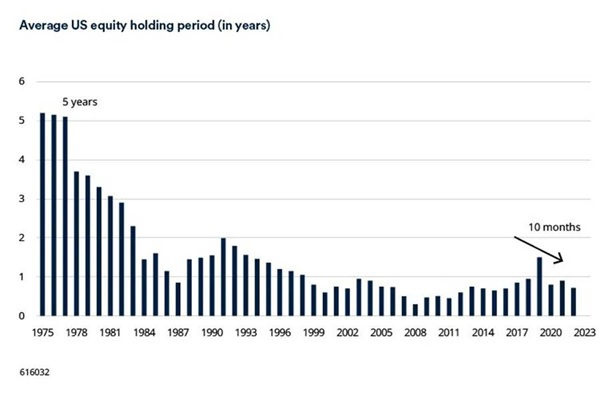
Source: World Federation of Exchanges, International Monetary Fund, New York Stock Exchange, and NASDAQ, market capitalization divided by total turnover value.
Multiple forces converged to drive this shift.
• The rise of algorithmic and high-frequency trading dramatically reduced the cost and friction associated with executing trades. These technologies have enabled transactions to be undertaken in milliseconds rather than days or weeks.
• Hedge funds and similar vehicles have grown their presence in the equity markets. These investors deploy strategies that prioritise short-term gains, fast arbitrage chasing small price differences in the market, and tactical portfolio repositioning. Long-term thinking, with strategic allocations, is not typically an emphasis.
• The meteoric expansion of passive investment strategies has reshaped market dynamics. Exchange-traded funds (ETFs) and other index-tracking vehicles are major players in today’s markets. As a result, a substantial amount of trading is now influenced by automated, rules-based buying and selling, as well as the periodic repositioning these vehicles must carry out when the indices they track re-balance.
Traditional approaches still provide the best potential for outperforming the broad market
For investors pursuing returns above what the broad markets deliver, competing with these new players on their terms is pointless. The algorithmic traders already have the fastest trading systems. Herd-driven investing influences much of the flow into and out of passive strategies. To state the obvious, you can’t outperform the consensus when you are following it. The good news is that there is no need to do so. A wealth of academic research demonstrates that traditional strategies still offer promising routes to superior gains in equity markets.
• Longer investment periods have delivered superior results. One study found that institutional investors with the longest holding periods outperform their short-term oriented counterparts by about 3% per year.1 In other words, the markets ultimately reward those who resist short-term pressures and exhibit patience.
• Fundamentals still matter because long-term stock prices follow corporate earnings. Empirical analyses demonstrate that around 80% to 90% of long-term equity returns are directly attributable to growth in corporate earnings and dividends. This underscores how critical a company’s true underlying profitability is to determining the stock value.2,3 Additional studies have shown consistent earnings growth significantly impacts long-term equity performance.4,5 All of this demonstrates the value of strategies that rely on traditional fundamental stock analysis: assessing the strength of companies’ balance sheets, the quality of their management teams, evaluating their competitive advantages, projecting their earnings potential and determining if their current stock prices are expensive or cheap relative to those earnings forecasts.
Investors who focus on the fundamentals—with a rigorous process—have an opportunity to excel
Once you recognise the historical primacy of corporate earnings in driving long-term stock prices, the next question is: What is potentially the best way to identify companies with the strongest fundamentals and the greatest potential for outsized returns? We believe that objective can be achieved with a number of disciplined strategies.
• Look for “growth gaps” that occur when a company’s growth potential is not yet fully reflected in its price. Even sophisticated investors who focus on fundamentals—like many research analysts at major investment firms—often fail to look far enough into the future. Those with longer horizons, analysing companies’ earning potential not over just the next 12 months but over the next three to five years, can identify significant “growth gaps” between the consensus earnings estimates and the companies’ much longer-term growth potential. As Figure 2 illustrates, a company’s structural and sustainable competitive advantages, as well as its innovativeness, can deliver long-term gains that significantly overshoot consensus expectations.
Click here to read more...

